
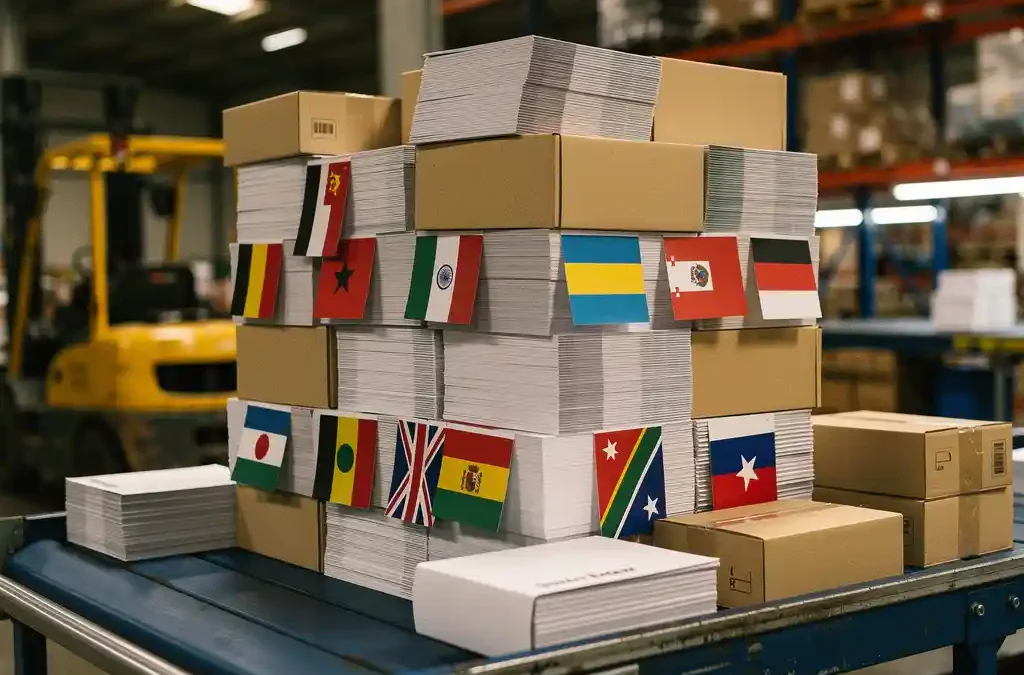
Managing print runs for a product launch across 10 countries means coordinating translation and localisation of your content, aligning with multiple regulatory environments, synchronising production timelines, and ensuring physical materials arrive at the right locations at the right time. The process is genuinely complex, but it becomes manageable when you break it into clear stages: localise first, then print, then distribute. This article walks through the key questions every project manager faces when taking a product launch global.
What makes multi-country print runs more complex than domestic ones?
Multi-country print runs involve far more variables than a single domestic production run. You are not just printing more copies of the same document. You are managing different languages, different paper sizes, different regulatory requirements, different shipping logistics, and different lead times, all simultaneously and often with a single launch date as the hard deadline.
Domestically, you control one language, one supplier relationship, one distribution network, and one set of compliance rules. Scale that to 10 countries and each of those variables multiplies. A product manual that works perfectly in English may need to expand by 30% in German or contract in Japanese, which changes your DTP layout entirely. Some markets require specific safety symbols, legal disclaimers, or certification marks that others do not. Packaging dimensions may need to change to meet local retail standards. Each of these decisions has a knock-on effect on your print schedule and budget.
The good news is that these complexities are predictable. If you plan for them early, they become manageable steps rather than last-minute crises.
How do you localise printed materials for 10 different markets?
Localising printed materials for 10 markets means adapting content beyond direct translation to reflect each country’s language, cultural conventions, legal requirements, and visual expectations. The process works best when translation, DTP, and print production are treated as a single integrated workflow rather than separate handoffs.
Start with a single master document in your source language. From there, professional translators who are native speakers of each target language handle the linguistic conversion, while localisation specialists review the output for cultural appropriateness. This is where details like date formats, measurement units, currency symbols, reading direction, and local brand tone get addressed.
Once translated text is approved, DTP specialists reflow the content into the original layout. This step is often underestimated. Translated text rarely fits the same space as the source, and illustrations, icons, or colour choices that work in one market may carry unintended meaning in another. A localisation partner with in-house DTP capability can handle this in parallel with translation, saving significant time.
Finally, a proofreading pass by a native speaker in each language confirms that the final laid-out document reads naturally and that no errors were introduced during the DTP process. Only then should files go to print.
Should you use one print supplier or multiple local vendors?
For most international product launches, using a single coordinating supplier is more reliable than managing multiple local vendors independently. A single point of contact reduces communication overhead, ensures consistent quality standards across all markets, and simplifies version control when last-minute changes occur.
Local vendors can offer advantages in specific situations, particularly where local printing regulations are strict, where import duties on printed goods make local production significantly cheaper, or where extremely fast turnaround in a specific market is the priority. However, coordinating 10 separate vendor relationships simultaneously, each with their own file specifications, proofing processes, and delivery timelines, creates real risk around launch day alignment.
A practical middle ground is to work with a single documentation partner who manages the full chain: translation, DTP, print production, and fulfilment. This model keeps accountability in one place and ensures that the people handling your print files are the same people who localised the content, which eliminates a common source of errors at the handoff stage.
What is kitting and why does it matter for international product launches?
Kitting is the process of assembling multiple printed or physical components into a single ready-to-ship package. For an international product launch, kitting means combining the right language versions of manuals, quick-start guides, warranty cards, and other inserts into the correct package for each destination market, before those packages are shipped to distributors or end customers.
Kitting matters because it removes a major source of fulfilment error. Without it, the responsibility for matching the right language materials to the right product falls on warehouse staff or distributors in each country, which creates risk of mismatches, missing inserts, or incorrect language packs reaching customers. When kitting is handled centrally by your documentation partner, each package leaves the facility already verified for the correct market.
For a 10-country launch, kitting also makes inventory management significantly cleaner. Rather than shipping bulk print stock to 10 locations and hoping local teams assemble it correctly, you ship finished, market-ready kits directly to each destination. This reduces waste, simplifies customs documentation, and speeds up the final leg of distribution.
How do you manage inventory and fulfilment across multiple countries?
Managing inventory and fulfilment across multiple countries requires a centralised system for tracking stock levels, a clear understanding of each market’s demand forecast, and a reliable logistics partner who can ship from a single fulfilment hub to multiple destinations. The goal is to avoid both stockouts and excess inventory in any single market.
Start by working with your sales and marketing teams to build a demand forecast for each country. Even rough estimates help you avoid printing wildly different quantities for each market, which drives up per-unit cost. Print-on-demand options exist for lower-volume markets, but for a coordinated launch, a single production run with allocated quantities per country is usually more cost-effective.
Centralised fulfilment, where all printed materials are held in one location and shipped outward to each country as needed, gives you flexibility to rebalance stock if one market outperforms expectations. It also simplifies reorder management. When one market runs low, you are restocking from a central inventory rather than placing a new local print order, which takes significantly longer.
Partnering with a provider who offers integrated inventory management alongside translation and print services means your documentation workflow and your physical distribution chain stay in sync throughout the product lifecycle, not just at launch.
What’s the best way to keep a multi-country print launch on schedule?
The best way to keep a multi-country print launch on schedule is to build your timeline backwards from the launch date, assign clear ownership to each stage, and treat translation and localisation as the critical path rather than an afterthought. Most delays in international print projects happen because content is finalised late, leaving insufficient time for localisation and print production.
Work backwards from your in-market date and allocate realistic time for each stage: content freeze, translation, DTP, proofreading, print production, kitting, and shipping. Translation alone for 10 languages typically requires more time than teams expect, especially when specialist subject matter is involved. Build in a buffer at the content freeze stage, because late changes after translation has started are expensive and time-consuming to cascade across all language versions.
Consolidating your workflow with a single partner who handles translation, DTP, print, and fulfilment removes the delays that accumulate at every handoff between separate vendors. When the same team manages the full process, they can flag potential scheduling conflicts early and adjust production sequencing to protect the launch date.
Regular milestone check-ins, a shared project tracker, and a named project manager on the supplier side are simple practices that make a significant difference on complex multi-country jobs. Do not underestimate the value of proactive communication at every stage.
If you are planning an international product launch and want a partner who can handle the full documentation chain from translation and localisation through to print, kitting, and fulfilment, we are here to help. Request a quote to get started, or contact us directly to discuss your project requirements with our team.
Frequently Asked Questions
How far in advance should we start the localisation process before our planned launch date?
For a 10-country launch, you should ideally begin the localisation process at least 12–16 weeks before your in-market date, depending on the complexity and volume of your printed materials. This allows time for content freeze, translation across all languages, DTP reflowing, native-speaker proofreading, print production, kitting, and international shipping — each of which has its own lead time. Starting late is the single most common cause of launch delays in international print projects, so locking your content freeze date early is the highest-impact scheduling decision you can make.
What happens if we need to make last-minute content changes after translation has already started?
Late content changes are costly and time-consuming in a multi-language project because every amendment needs to be translated, reviewed, reflowed in DTP, and re-proofed across all affected language versions — not just the source document. The more languages involved, the more the impact compounds. To manage this risk, establish a formal content freeze date with internal sign-off from all stakeholders before translation begins, and treat any post-freeze changes as a scope change with associated time and cost implications. If changes are unavoidable, working with a single integrated partner rather than separate vendors significantly reduces the time needed to cascade updates across all versions.
How do we handle regulatory and compliance differences across markets — for example, required safety symbols or legal disclaimers?
Regulatory compliance requirements should be researched and documented for every target market before translation begins, not discovered during the DTP or print stage. Each country may mandate specific safety symbols, certification marks, legal disclaimers, or labelling formats, and these requirements can affect your layout, page count, and even packaging dimensions. Your localisation partner should have experience identifying these requirements, but it is ultimately the brand owner’s responsibility to confirm compliance with local regulations. Building a market-by-market compliance checklist as part of your pre-production planning is the most reliable way to avoid costly reprints or market entry delays.
Is print-on-demand a viable option for lower-volume markets in a multi-country launch?
Print-on-demand (POD) can be a practical solution for markets where demand is uncertain or volumes are too low to justify a dedicated production run, but it comes with trade-offs. Per-unit costs are typically higher than offset print runs, turnaround times can vary, and maintaining consistent print quality across POD and conventional print markets requires careful management. For a coordinated launch where all markets go live simultaneously, mixing POD and conventional print in the same project adds scheduling complexity. A common approach is to use a single conventional run for your primary markets and reserve POD for secondary markets where timing flexibility is greater.
What file formats and pre-press specifications should we prepare to avoid delays at the print production stage?
Supplying print-ready files in the correct format from the outset prevents one of the most common sources of last-minute delays. Most professional print suppliers work with press-ready PDF files built to PDF/X-1a or PDF/X-4 standards, with bleed areas, crop marks, embedded fonts, and colour profiles (typically CMYK) correctly set. However, specifications can vary by supplier and print method, so always confirm requirements with your print partner before DTP work begins rather than after. If your documentation partner handles both DTP and print production in-house, this handoff is managed internally, which eliminates the risk of file specification mismatches entirely.
How should we approach translation memory and terminology management to keep costs down across a large multi-language project?
Translation memory (TM) tools store previously translated segments and automatically apply them when the same or similar content appears again, which directly reduces the word count billed on current and future projects. For a product launch with multiple document types — manuals, quick-start guides, packaging, warranty cards — consistent source content across documents means higher TM leverage and lower translation costs overall. Pairing TM with a managed glossary or termbase ensures that product names, technical terms, and brand language are translated consistently across all languages and all documents. Ask your localisation partner how they manage TM assets and whether those assets remain accessible to you for future projects.
What should we look for when evaluating a documentation partner to manage this kind of end-to-end international print project?
The most important capability to look for is genuine end-to-end integration: a partner who handles translation, localisation, DTP, print production, kitting, and fulfilment under one roof, with a single project manager as your point of contact. This eliminates the handoff errors and accountability gaps that arise when separate vendors manage different stages of the same project. Beyond that, look for demonstrated experience with multi-language DTP, knowledge of regulatory requirements in your target markets, transparent project tracking, and the ability to provide references from comparable international launch projects. A partner who asks detailed questions about your timeline, content complexity, and market requirements before quoting is generally a stronger indicator of project management maturity than one who quotes quickly without scoping the work thoroughly.
Related Articles
- What is the Triman logo and what does it mean for exporting my products and manuals to France?
- Am I required to provide my manuals in print, or is digital sufficient?
- How can I ensure that the brand identity comes through in all my documentation?
- What is the most efficient way to ship printed materials to multiple countries?
- Should I write my own technical manual or hire someone?