
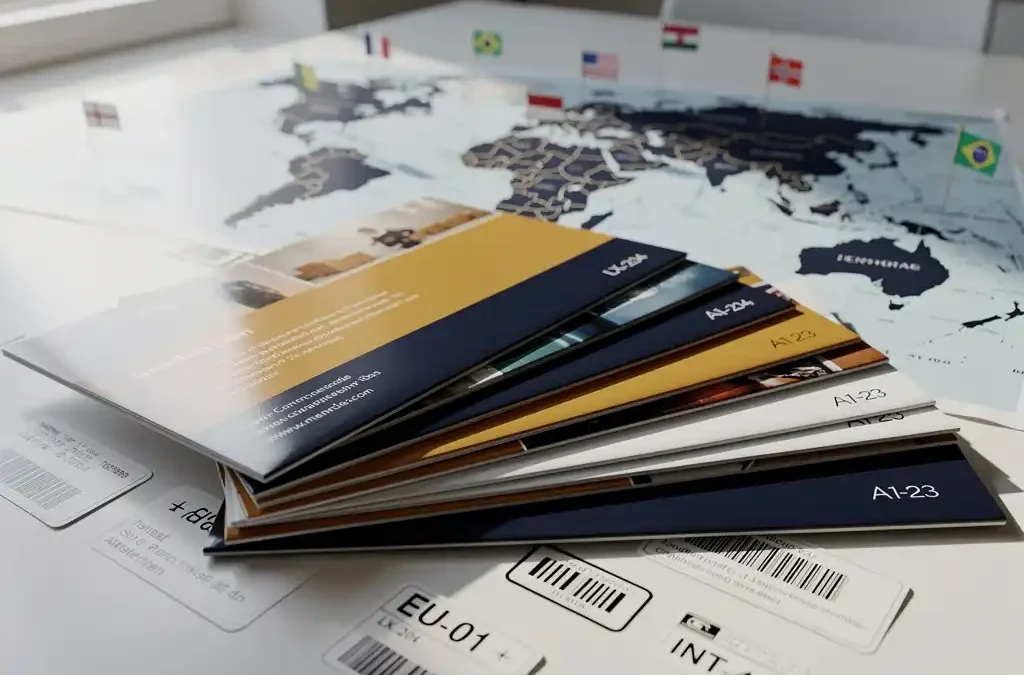
The most efficient way to ship printed materials to multiple countries is to combine centralized printing with a professional fulfillment service that handles storage, localization, and distribution from a single hub. This approach reduces per-unit costs, eliminates the complexity of managing multiple local print vendors, and ensures consistent quality across every market. The questions below unpack the key decisions involved, from choosing where to print to selecting the right partner for global distribution.
What are the biggest challenges of shipping printed materials internationally?
The biggest challenges of shipping printed materials internationally include customs regulations, variable shipping costs, language and compliance requirements, and the logistical complexity of coordinating deliveries across multiple countries simultaneously. Each of these factors can delay distribution, increase costs, or result in materials that are unsuitable for a specific market if not addressed proactively.
Customs clearance is one of the most common friction points. Printed materials may be subject to import duties, content restrictions, or documentation requirements that differ significantly from one country to the next. A shipment that moves smoothly into Germany may face unexpected delays entering Brazil or South Korea.
Beyond customs, there is the challenge of scale. Ordering small quantities for each country individually drives up unit costs, while ordering large quantities centrally requires reliable storage and distribution infrastructure. Companies that try to manage this without a structured process often find themselves dealing with excess stock in one market and shortages in another.
Is it better to print centrally or locally in each country?
Centralized printing is generally more efficient and cost-effective for companies distributing across many countries, provided the materials have been properly localized before production. Local printing makes more sense when quantities per country are very small, turnaround times are extremely tight, or local regulations require specific paper grades or certifications.
Centralized production offers clear advantages in quality control. When all materials come from a single print facility, color consistency, paper stock, and finishing standards are uniform across every market. This matters particularly for brand-sensitive materials like product brochures, packaging inserts, and technical documentation.
The trade-off is lead time. Centralized printing requires all language versions to be finalized before production begins, which means translation and localization must be completed upstream. When this workflow is well-managed, the result is a single production run that covers all markets efficiently. When it is not, delays in one language version can hold up the entire print run.
How does a fulfillment service simplify multi-country print distribution?
A fulfillment service simplifies multi-country print distribution by consolidating storage, order processing, and shipping into a single managed operation. Instead of coordinating separate shipments from a print facility to dozens of destinations, companies send one bulk delivery to a fulfillment center, which then handles all outbound distribution according to demand.
This model reduces the administrative burden considerably. Rather than managing relationships with local couriers, tracking individual shipments, and reconciling inventory across locations, a company works with one partner who handles all of it. Fulfillment services typically offer real-time inventory visibility, so it is straightforward to see stock levels per market and reorder before shortages occur.
Kitting is another valuable capability that fulfillment services provide. When printed materials need to be assembled into packs alongside other items, such as product documentation combined with USB drives or welcome kits, a fulfillment partner can handle this assembly before dispatch. This removes a step that would otherwise require coordination between multiple parties.
What role does translation and localization play in print shipping efficiency?
Translation and localization directly affect print shipping efficiency because materials that have not been properly adapted for each market cannot be distributed, regardless of how well the logistics are organized. Localization ensures that content, formatting, and compliance requirements are addressed before print production begins, preventing costly reprints or distribution holds.
The connection between translation and localisation and logistics is often underestimated. A document that looks identical across languages may require different page counts due to text expansion in German or Finnish, different reading direction for Arabic or Hebrew, or different regulatory disclosures for markets with specific legal requirements. These differences affect file preparation, print specifications, and ultimately the timeline for production and shipping.
When translation and print production are handled by the same provider, these dependencies are managed internally. File handoffs happen faster, formatting issues are caught before they reach the press, and the overall time from content approval to delivered materials is significantly shorter. Separating these functions across different vendors introduces coordination overhead that slows everything down.
Which types of printed materials benefit most from centralized distribution?
The printed materials that benefit most from centralized distribution are those used across multiple markets with consistent branding, technical content, or regulatory requirements. This includes product documentation, user manuals, safety data sheets, marketing brochures, packaging inserts, and training materials.
Technical documentation is a strong candidate for centralized production because accuracy and consistency are critical. A user manual for an industrial product must contain the same safety instructions regardless of which country it is shipped to, with only the language adapted for the local audience. Producing these centrally ensures that the source content is controlled and that every language version goes through the same quality process.
Marketing materials such as product catalogs and point-of-sale displays also benefit from centralized production, particularly when a campaign runs simultaneously across multiple regions. Centralized production guarantees that the visual identity is consistent and that all versions are available at the same time, which is difficult to achieve when relying on local print vendors with different capabilities and schedules.
What should you look for in a print and fulfillment partner for global distribution?
A strong print and fulfillment partner for global distribution should offer integrated translation, print production, warehousing, and shipping under one roof, along with proven quality management systems and experience across the specific markets you serve. The ability to handle the full workflow internally, rather than subcontracting key steps, is the most reliable indicator of efficiency and accountability.
Quality certifications matter. ISO 9001 certification signals that a partner follows structured quality management processes, while ISO 27001 indicates that your content and data are handled securely. For companies distributing sensitive technical or commercial materials, information security is not a secondary concern.
Language capability is equally important. A partner that covers a broad range of languages with native translators, rather than relying on machine translation for less common markets, ensures that your localized materials are accurate and culturally appropriate. This is particularly relevant for markets in Eastern Europe, the Middle East, and Asia, where linguistic nuance has a direct impact on how materials are received.
Finally, look for a partner with genuine experience in your industry. The requirements for distributing medical device documentation differ from those for consumer electronics or heavy machinery, and a partner familiar with your sector will anticipate compliance needs before they become problems. We work with clients across technology, manufacturing, and other industries to deliver exactly this kind of end-to-end support. If you are ready to streamline your global print distribution, request a quote or get in touch with us to discuss your specific requirements.
Frequently Asked Questions
How do we handle reprints when content changes in just one or two markets?
When content changes affect only specific markets, a well-structured centralized workflow allows you to reprint individual language versions without restarting the entire production run. The key is maintaining print-ready files for each language version separately, so a regulatory update in one country or a product revision for a single region can be actioned quickly and independently. A fulfillment partner with live inventory tracking can also flag which markets are running low, helping you time reprints efficiently rather than reactively.
What is the most common mistake companies make when starting with international print distribution?
The most common mistake is treating print production and logistics as separate workstreams managed by different teams or vendors, without a shared timeline or handoff process. This typically results in translated files arriving after the print window has opened, or finished materials sitting at a warehouse while customs documentation is still being prepared. Bringing translation, print, and fulfillment under a single coordinated workflow — ideally with one accountable partner — eliminates the gaps where these delays occur.
How far in advance should we plan a multi-country print distribution campaign?
For a multi-country campaign covering five or more markets, a realistic lead time is eight to twelve weeks from content sign-off to delivered materials, though this varies depending on language complexity, print volumes, and destination countries. Languages with significant text expansion (such as German or Finnish) or right-to-left scripts (such as Arabic or Hebrew) require additional time for layout adaptation and quality review. Building a backwards timeline from your required delivery date — and sharing it with your print and fulfillment partner early — is the most reliable way to avoid last-minute compression.
Can a fulfillment partner manage on-demand distribution, or does it only work for large bulk orders?
Modern fulfillment services are well-suited to on-demand distribution models, where materials are dispatched in smaller quantities as orders come in rather than in a single large shipment. This is particularly useful for companies with field sales teams, event-based distribution needs, or markets where demand is unpredictable. The trade-off is that per-unit shipping costs are higher for smaller dispatches, so many companies use a hybrid approach — bulk shipping to high-volume markets and on-demand fulfillment for lower-volume or emerging regions.
How do we ensure our printed materials meet local compliance requirements in each country?
Meeting local compliance requirements starts during the localization stage, not at the point of distribution. A localization partner with market-specific expertise will flag mandatory regulatory disclosures, required certifications, restricted content, and formatting obligations (such as mandatory font sizes for safety warnings) before files go to print. For heavily regulated sectors such as medical devices, pharmaceuticals, or industrial equipment, it is worth engaging a partner with documented experience in those compliance frameworks, as the cost of distributing non-compliant materials — including recalls or legal exposure — far outweighs the cost of getting it right upfront.
What happens to leftover stock when a product is updated or discontinued?
Obsolete stock is a real cost in print distribution, and the best way to manage it is through accurate demand forecasting and phased print runs rather than producing large quantities upfront. A fulfillment partner with real-time inventory visibility can provide consumption data per market, which helps you calibrate reorder quantities more precisely over time. When a product is discontinued, a good partner will also have a clear process for quarantining or destroying outdated materials to ensure they are not inadvertently shipped — an important safeguard for regulated industries.
Is centralized print distribution cost-effective for smaller companies or those entering new markets?
Centralized distribution can be cost-effective even for smaller companies, particularly when entering multiple new markets simultaneously, because it avoids the setup costs of establishing local print and logistics relationships in each country. The key is choosing a fulfillment partner that does not require large minimum order quantities and offers transparent per-unit pricing that scales with your volumes. For companies testing a new market, a small initial print run distributed through an established fulfillment network is a lower-risk approach than building local infrastructure before demand is confirmed.
Related Articles
- How does warehousing and kitting work together with my printed materials?
- How do I quickly process product changes across all my printed documentation?
- Can I have print work combined with translation and localization in a single order?
- Can I print small runs of my product manuals per target market?
- What is software localisation?