
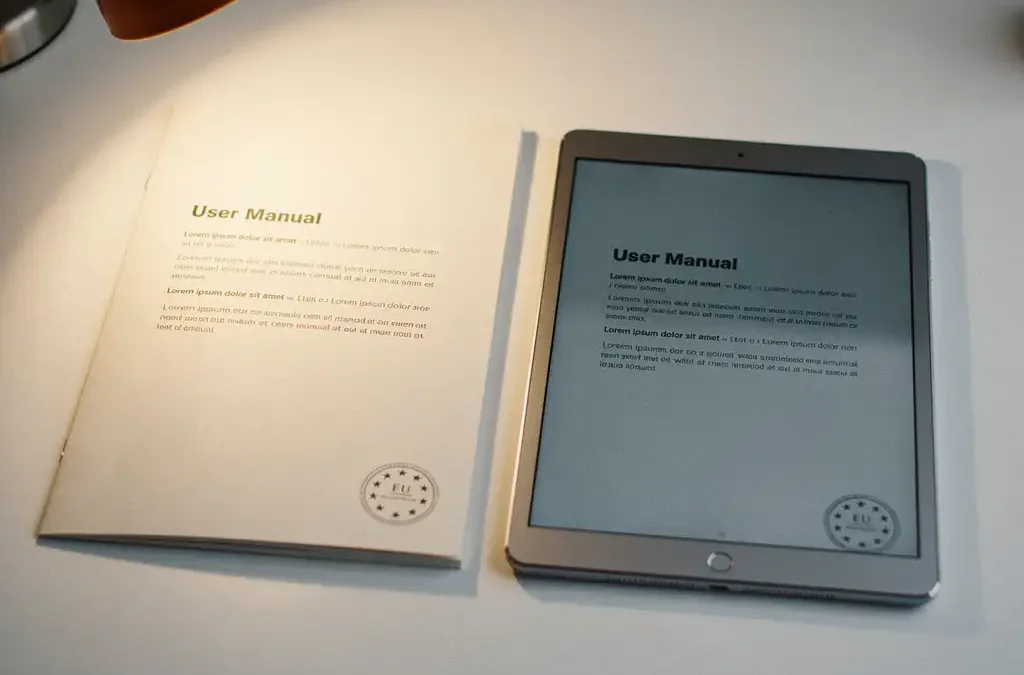
In most cases, you are not required to provide manuals exclusively in print. European legislation increasingly allows manufacturers to opt for a digital format, provided certain conditions are met. That said, there are situations where a printed version remains legally mandatory, depending on the product type, the target audience, and the specific regulations that apply. If you are unsure what applies to your situation, we are happy to help via our contact page. In this article, we answer the most frequently asked questions about format requirements for manuals.
What does European legislation say about the format of manuals?
In most cases, European legislation does not prescribe a specific format for manuals. Directives such as the Machinery Directive, the Low Voltage Directive, and the General Product Safety Regulation (GPSR) require that user information be available, comprehensible, and accessible, but largely leave the choice between print and digital open. The specific requirements depend heavily on the product category and the applicable sector legislation.
The General Product Safety Regulation, which entered into force in 2024 and will be fully applicable in 2026, modernizes the approach to product information. It recognizes digital channels as a valid means of informing consumers, as long as the information is easy to find and understand. However, the same regulation includes exceptions for vulnerable groups and situations where digital access cannot be guaranteed.
In short: European legislators are moving toward digital, but have not yet fully phased out the printed manual. Anyone seeking compliance must consult the specific directive for each product category.
When is a printed manual legally required?
A printed manual is legally required when specific sector legislation explicitly demands it, or when the target audience does not have reliable access to digital information. Examples include medical devices covered by the MDR regulation, certain categories of machinery, and products intended for consumers who lack digital literacy or a stable internet connection.
Specific situations where print is required or strongly recommended:
- Medical devices: The EU MDR (Regulation 2017/745) generally requires a physical leaflet or manual, unless digital delivery has been explicitly permitted.
- Machinery with safety risks: The Machinery Directive (and its successor, the Machinery Regulation 2023/1230) requires that safety instructions be immediately available with the product, which in practice often means a printed document.
- Products for vulnerable users: Older adults, people with disabilities, or users without internet access are entitled to accessible information, which may require a printed version.
- Situations without power supply: If a product is used in locations without electricity or internet, digital is simply not practical and print may be required.
Under what conditions is a digital manual sufficient?
A digital manual is sufficient when the applicable legislation does not require a printed version, the target audience has digital access, and the information is permanently and freely available. In addition, the digital manual must contain at least the same content as a printed version would, including safety warnings and installation instructions.
Conditions that a digital manual must generally meet:
- The manual is freely available via a stable URL or QR code included with the product.
- The information remains available for as long as the product is reasonably in use.
- The user is clearly informed at the point of purchase about how to access the manual.
- There is an option to request the manual in printed form, with or without a reasonable fee.
- The digital version is accessible on common devices and readable without specialist software.
For consumer electronics, software, and many B2B products, a fully digital manual is now the norm. Nevertheless, it is wise to always have a printed version available for specific markets or customer segments.
What are the risks of going digital-only without a legal review?
Going digital-only without a legal review carries serious risks. If it turns out that a printed manual is still required for your product category, this can lead to non-compliance with CE marking requirements, product recalls, fines, or liability in incidents where users claim they were unable to access the instructions.
The most common risks are:
- Market access issues: Products without proper documentation may be held up by customs authorities or market surveillance bodies.
- Liability in accidents: If a user suffers harm and argues that the instructions were not accessible, the manufacturer may be held liable.
- Loss of CE marking: Incorrect or missing documentation can jeopardize CE conformity.
- Reputational damage: Customers who cannot find or access a manual perceive this as a quality issue.
A legal review per product category and target market is therefore not a luxury but a necessity before deciding to switch entirely to digital documentation.
Do requirements differ by country or market?
Yes, requirements differ by country and market, even within the European Union. While EU directives provide a common foundation, member states sometimes have additional national requirements. Outside the EU — for example in the United Kingdom, the United States, or Asian markets — entirely different regulatory frameworks apply, which may require printed documentation.
Within the EU, there are subtle differences in how directives are transposed into national law. Germany is known for strict enforcement of product documentation requirements, while other member states allow more flexibility for digital alternatives. For markets outside the EU, the following applies:
- United Kingdom (post-Brexit): The UKCA framework has its own documentation requirements, which do not always align with EU rules.
- United States: The FCC and product liability legislation impose their own requirements on user documentation, with print remaining the norm in many sectors.
- Japan and Asian markets: Local regulations often require manuals in the local language and sometimes in printed form.
Anyone distributing internationally must map out the specific requirements for each market. We assist with the translation and localization of documentation into more than 90 languages, ensuring you always have the right version for the right market.
How do you combine print and digital for optimal compliance?
The most robust approach is a hybrid strategy: a concise printed manual covering essential safety and usage information, supplemented by a comprehensive digital version for detailed instructions. This way, you meet the strictest legal requirements while also taking advantage of the benefits of digital documentation.
In practice, a hybrid approach looks like this:
- Print a concise manual containing safety instructions, warranty information, and basic installation guidance.
- Include a QR code linking to the full digital manual, available in all relevant languages.
- Ensure the digital version is always up to date and that older versions are archived for traceability.
- Give users the option to request a full printed version.
- Keep internal records of which version corresponds to which product batch, so you can demonstrate compliance during audits at any time.
Through our print services, we ensure seamless integration of translation, layout, and printing, so your printed manuals always meet the highest standards of quality and accuracy. Whether you need thousands of copies or small print runs for specific markets, we tailor production to your schedule and budget. Want to find out how to best structure your documentation strategy for your products and markets? Get in touch with us and we will be glad to help.
Frequently Asked Questions
Do I need to offer my digital manual in all EU languages?
No, you are not required to offer your manual in all EU languages, but you must use the language or languages required in the country or countries where you place the product on the market. This means you need to determine which languages are legally required for each target market. In practice, it is advisable to work with a specialized translation partner with experience in technical and legal documentation, so you can be confident that translations are accurate and compliant.
If my product is updated, do I also need to reissue the manual?
Yes, for significant product updates or changes that affect safety, installation, or use, you are required to update the manual and make it available. For digital manuals, this is relatively straightforward to manage through version control on your website, but do not forget to update the printed version for new product batches as well. Always keep internal records of which manual version corresponds to which product batch, so that in the event of an audit or incident you can demonstrate that users had access to the correct information.
How do I ensure my QR code linking to the manual keeps working long-term?
Use a dynamic QR code rather than a static one, so you can update the underlying URL without having to replace the QR code on the product or packaging. Host the manual on a stable, dedicated domain and avoid temporary or free hosting services that may disappear over time. Legally, you are required to keep the digital manual available for as long as the product is reasonably in use, so a reliable and durable hosting solution is essential for compliance.
Is there an exemption if my product is sold exclusively to professional users (B2B)?
In a B2B context, the requirements around accessibility for vulnerable users are less strict, meaning a fully digital manual will suffice in many cases. However, even in B2B situations you must take into account the applicable product directive — for example, machinery covered by the Machinery Regulation is subject to specific safety documentation requirements, regardless of whether the buyer is a business or a consumer. Check the specific requirements per product category and target market, including for professional buyers.
What is the most common mistake when switching to digital manuals?
The most common mistake is eliminating the printed manual entirely without first conducting a legal review per product category and target market. Many companies assume that digital is always permitted, while specific sector legislation — such as the EU MDR for medical devices — may still require a physical document. A second common mistake is failing to offer an option to request the manual in printed form, which is mandatory under some regulatory frameworks.
How do I get started setting up a hybrid documentation strategy for my product line?
Start with a compliance audit per product category and target market to determine the legal requirements for the format, language, and content of your manuals. Then create a documentation matrix that specifies which information must appear in the printed version and what is available digitally only. Work with a specialized partner for translation, layout, and printing to ensure both the printed and digital versions meet the highest standards of quality and accuracy, and schedule periodic reviews to keep your documentation current when products are updated or legislation changes.
Are there specific accessibility requirements my digital manual must meet?
Yes, digital manuals must be readable and usable on common devices such as smartphones, tablets, and computers, without requiring any specialized or paid software. Under the European Accessibility Act (EAA), which applies from 2025, additional requirements also apply to digital content aimed at consumers, such as sufficient contrast, readable font sizes, and compatibility with screen readers. When designing your digital manual, take into account users with visual or cognitive impairments, and consider offering a PDF version that complies with the PDF/UA accessibility standard.
Related Articles
- How do I protect confidential product information when outsourcing print work?
- What is the best way to update printed marketing materials after a product change?
- How do I adjust my print materials for different paper sizes by country?
- How does my printed material help create a premium brand?
- How do you choose localisation management tools?