
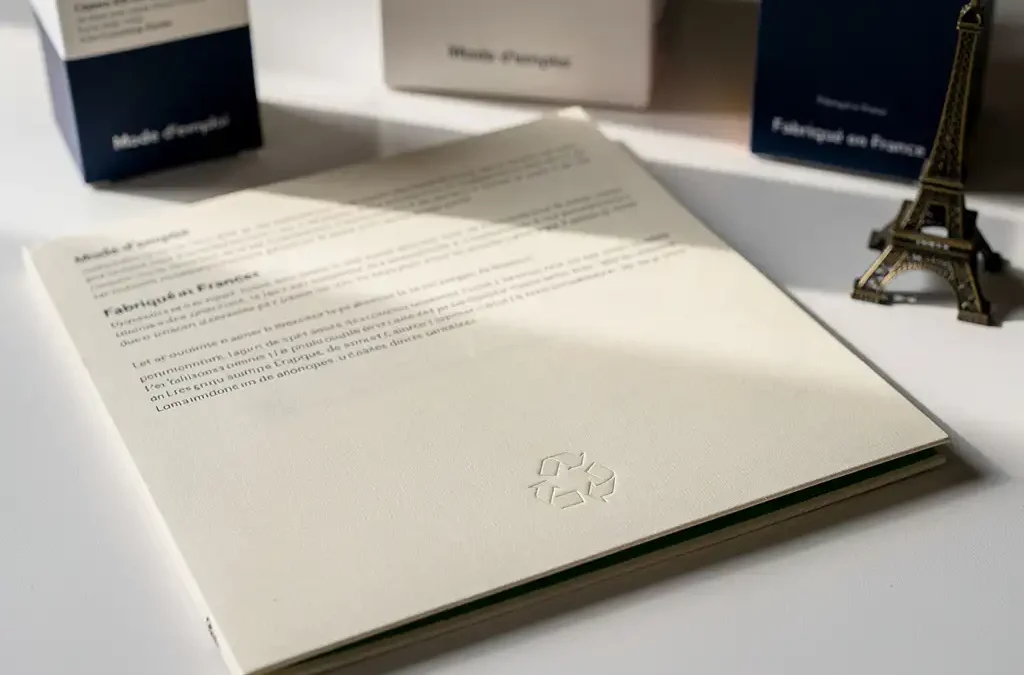
The triman logo is a French recycling label that indicates a product or packaging falls under a recognized collection system in France. If you place products or packaging on the French market, you are in many cases legally required to display this logo. The same applies to accompanying documentation, such as manuals and packaging texts. In this article, we answer the most frequently asked questions about the triman logo, from which products must carry it to how to correctly incorporate it into your print materials and documentation. Do you have questions about the practical implementation? Feel free to get in touch and we will be happy to help.
Which products must carry the triman logo in France?
In France, producers and importers are required to place the triman logo on all products and packaging that fall under French extended producer responsibility legislation, also known as REP. This applies to a wide range of product categories, including consumer electronics, household appliances, furniture, toys, textiles, batteries, packaging materials, and more.
The obligation is not limited to products manufactured in France. Foreign companies selling their products in France are also subject to these rules. This means that a Dutch or German company exporting products to the French market must verify whether its product categories fall under a REP scheme and whether the triman logo is mandatory.
The list of mandatory categories has expanded considerably in recent years. By 2026, virtually all physical consumer products and their packaging will fall under one or more REP schemes. It is therefore advisable to check the specific requirements for each product type, as some categories require additional information or variations of the logo.
How does the French REP system linked to the triman logo work?
The REP system, short for Responsabilité Élargie du Producteur, requires producers and importers to contribute financially to the collection and processing of their products at the end of their useful life. The triman logo is the visible symbol that informs consumers that a product is registered with a recognized collection organization, known as an éco-organisme.
Companies placing products on the French market must register with an approved eco-organization appropriate to their product category. Well-known examples include Citeo for packaging and paper, Ecologic for electrical appliances, and Valdelia for professional furniture. After registration, the producer pays a contribution per unit sold, which finances collection and recycling.
The triman logo serves as the visual confirmation of this participation for the consumer. The logo features a stylized arrow figure and is often accompanied by an additional instruction telling the consumer how the product or packaging should be sorted for disposal. This additional instruction, known as the consigne de tri, is in many cases just as mandatory as the logo itself.
What are the consequences of missing the triman logo on products intended for the French market?
The absence of the triman logo on products or packaging that are legally required to carry it can result in fines, sales bans, and reputational damage. The French authorities actively enforce REP legislation, and violations can be flagged by market regulators or by competitors filing a complaint.
In addition to financial penalties, a company risks having its products recalled or temporarily withdrawn from the market until the packaging and documentation have been updated. For exporters, this can mean serious delays and additional costs, particularly if products have already been printed and shipped without the required logo.
Another practical risk is that major French retailers and distributors are increasingly checking whether suppliers comply with REP obligations before accepting a product into their range. The absence of the triman logo may therefore also mean that your product is simply not accepted by your distribution channel, regardless of any formal enforcement by the authorities.
Does the triman logo also need to be included in manuals and documentation?
Yes, in many cases the triman logo is also required in the printed documentation supplied with a product, such as manuals, installation guides, and warranty cards. French regulations stipulate that the sorting instruction must be clearly visible on the product, the packaging, or the accompanying documentation, depending on the product category and available space.
For technical documentation and user manuals, the logo and the accompanying sorting instruction must be included in the French-language version of the document. This is an important consideration when localizing documentation: it is not just about translating the text, but also about correctly integrating mandatory graphic elements such as the triman logo.
Companies having their documentation translated and laid out for the French market would do well to discuss this aspect explicitly with their documentation partner. A specialized provider that combines translation, layout, and print can ensure the logo is placed in the correct location and at the correct size, so that your documentation meets French requirements.
How do you correctly add the triman logo to your documentation and packaging?
The triman logo must be applied in accordance with the official graphic guidelines established by the French authorities. The logo is available as a vector file and must not be distorted, recolored, or placed in any way that reduces its legibility. The minimum dimensions and required clear space around the logo are defined in the official specifications.
In addition to the logo itself, the consigne de tri must also be included in most cases. This is a short text instructing the consumer on how the product or packaging should be presented for recycling. The exact wording depends on the product category and the associated eco-organization with which you are registered.
For practical integration into print materials and documentation, it is important that the source files are updated in good time before the printing process begins. We offer an integrated solution in which translation, DTP layout, and printing are seamlessly aligned. This ensures the triman logo is correctly incorporated into all French-language versions of your documentation, without the need to coordinate multiple parties.
What is the difference between the triman logo and other European recycling labels?
The triman logo is a specifically French label and has no direct equivalent in other European countries. It differs fundamentally from the Green Dot, the universal recycling arrow, and other labels used across Europe, because the triman logo applies exclusively to the French market and is tied to the specific French REP system.
The Green Dot versus the triman logo
The Green Dot, also known as Der Grüne Punkt, indicates that the producer has contributed to a financing system for packaging recycling. It is widely used in many European countries, but it does not automatically mean that a product or packaging complies with French REP obligations. In France, the Green Dot does not replace the triman logo and may not be used as an alternative.
The universal recycling arrow versus the triman logo
The universal recycling arrow — the familiar three arrows forming a triangle — is not a legally protected label and carries no specific legal meaning in the context of French REP legislation. Using this symbol alone is insufficient to meet French requirements. The triman logo was specifically designed for the French market and carries a clear legal status that the other symbols do not.
For companies selling products in multiple European countries, it is important to check which labels and obligations apply in each country. European legislation is gradually harmonizing this area, but as of 2026, significant national differences remain. The triman logo remains, for the foreseeable future, a specifically French requirement that cannot be replaced by a generic European alternative.
Want to make sure your documentation, packaging texts, and manuals fully comply with French requirements, including the correct incorporation of the triman logo? Get in touch and we will be happy to discuss how we can support you.
Frequently Asked Questions
Do I need to reapply for the triman logo if I switch eco-organization or expand my product range?
Yes, if you switch eco-organization or add new product categories to your range, you must re-register with the relevant eco-organization for that category. The triman logo itself remains the same, but the associated consigne de tri can vary by category and by eco-organization. Make sure that with every expansion of your product line you check which specific sorting instruction applies, and update your packaging and documentation accordingly.
What should I do if my packaging or manual does not have enough space for the triman logo and the sorting instruction?
French regulations take space limitations on small packaging into account. In that case, the consigne de tri may be omitted from the packaging itself, provided it is visible elsewhere — for example, in the enclosed manual or on the product page. The triman logo itself has a legally defined minimum size and may not be displayed smaller than the official specifications require. Always discuss this with your documentation or print partner so that the correct prioritization is applied.
Does the triman requirement also apply to products sold exclusively online to French consumers?
Yes, the obligation applies to all products placed on the French market, regardless of whether the sale takes place through a physical store or an online channel. Foreign online retailers delivering to French consumers are also subject to REP legislation and are required to register with a recognized eco-organization. In that case, the triman logo must be incorporated on the physical packaging and accompanying documentation received by the consumer.
How often are the graphic guidelines and mandatory texts for the triman logo updated, and how do I stay informed?
The official graphic guidelines are managed by the French authorities and may be updated as a result of new legislation or the expansion of REP categories. It is advisable to periodically consult the website of the relevant eco-organization with which you are registered, such as Citeo or Ecologic, as they actively inform their members about changes. A reliable documentation and print partner with experience in the French market can also proactively alert you to relevant changes before you start a new print run.
Can I create one combined document version for multiple European countries, including France, or do I need separate French-language documents?
Technically, you can create a multilingual document serving multiple countries, but for the French market the French-language section must include the triman logo and the associated consigne de tri. Other language versions within the same document do not need to carry this logo, unless the country in question has a comparable obligation. In practice, many companies opt for separate country-specific document versions to minimize compliance risks and keep the layout manageable.
What are the most common mistakes companies make when incorporating the triman logo into their documentation?
The most common mistakes are using a version of the logo that is too small or low resolution, omitting the mandatory consigne de tri, and placing the logo without the required clear space around the symbol. Another frequent error is incorporating the triman logo into all language versions of a document rather than exclusively in the French-language version, which can cause confusion among consumers in other countries. Always have the source files reviewed by a party with specific knowledge of French graphic and legal requirements before going to print.
Are there transition periods or exemptions for small businesses or startups just beginning to export to France?
French REP legislation does not, in principle, make distinctions based on company size; small businesses and startups placing products on the French market are also required to register and use the triman logo. That said, phased implementation timelines are sometimes introduced when new product categories are added to the REP system, giving companies some time to adapt. It is strongly recommended to seek legal and practical advice at an early stage of your export plans, so that you are fully compliant from your very first delivery.
Related Articles
- What is the difference between transcreation and translation when adapting marketing materials?
- Can I have my printed manuals distributed directly to my dealers in Europe?
- How do I reduce the costs of multilingual print materials without compromising on quality?
- What does EU law require on a product label or package?
- How do I write technical documentation that non-experts can understand?