
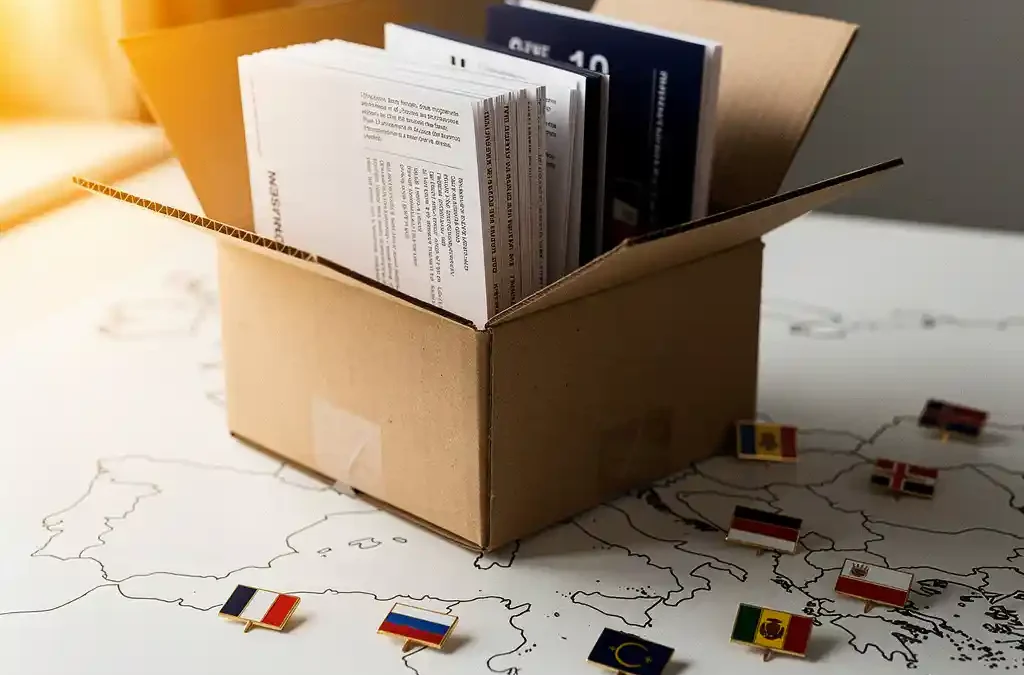
If you sell products across multiple European countries, you need a print-on-demand partner who can produce and deliver multilingual documentation quickly and reliably. The right partner combines local market knowledge with an efficient production process, so you can focus on your core business. In this article, we answer the most frequently asked questions about print on demand for European markets. Have a question right away? Feel free to get in touch — we’re happy to help.
What are the benefits of print on demand for European markets?
Print on demand allows businesses to have documentation printed when needed, in the required language and quantity, without having to maintain large inventories. This is particularly valuable for European markets, where you deal with multiple languages, fluctuating demand by country, and frequent product updates.
The benefits are concrete and measurable:
- No overproduction: You only print what you need, per market and per moment.
- Always up-to-date content: Product changes or regulatory updates can be implemented immediately without discarding a large stock of outdated materials.
- Storage cost savings: Smaller inventories mean lower warehousing costs.
- Faster time to market: New markets can be served more quickly without waiting for large print runs.
- Regional flexibility: Each country receives exactly the right documentation in the right language and format.
For companies active in the technology or manufacturing industry — where documentation is updated regularly and may vary by country — print on demand is a strategic advantage.
How does print on demand work for multilingual documentation?
Print on demand for multilingual documentation works by integrating translation, layout, and printing into one continuous process. Once a document has been translated and formatted for a specific market, it is printed on demand and shipped directly to the appropriate destination in Europe.
The process typically follows these steps:
- Submit source material: You provide the original documents in the source language.
- Translation and localization: The text is translated into the required target languages, taking into account local terminology and regulations.
- DTP and layout: The translated text is integrated into the existing layout, including adjustments for text length and reading direction.
- Print preparation: The file is technically checked and prepared for digital or offset printing.
- Printing and shipping: On request, the document is printed and shipped directly to dealers, distributors, or end customers in Europe.
The strength of this model lies in the seamless collaboration between translators, DTP specialists, and print partners. When all these steps are carried out under one roof, you reduce coordination risks and significantly accelerate the entire process.
Which document types are suitable for print on demand?
Virtually all printed documentation that is regularly updated or needs to be available in multiple language versions is suitable for print on demand. This includes both technical documents and marketing materials.
Commonly used document types include:
- User manuals and installation guides
- Product data sheets and specification sheets
- Safety and compliance documentation
- Sales brochures and product catalogs
- Point-of-sale materials for the retail sector
- Packaging inserts and quick start guides
- Training and onboarding materials
Documentation with a short shelf life benefits most from an on-demand approach — particularly for products that are updated frequently or materials that must comply with local regulations in each country. Large-format materials for trade shows and events can also be produced on demand.
What should you look for in a print-on-demand partner for Europe?
A strong print-on-demand partner for Europe has a broad network of print partners across the continent, covers multiple European languages, and can offer translation, layout, and printing as a single streamlined process. Certifications such as ISO 9001 and ISO 27001 are reliable indicators of process quality and information security.
When making your choice, consider the following criteria:
- Language coverage: Can the partner handle all the languages relevant to your European markets?
- Integrated services: Does the partner offer translation, DTP, and printing as one cohesive process?
- Logistics capacity: Can the partner also handle warehousing, kitting, and fulfillment for direct delivery to dealers or end customers?
- Quality certification: ISO 9001 confirms structured quality management; ISO 27001 ensures the secure handling of your documentation and business data.
- Print run flexibility: Can the partner handle both small print runs per market and larger bulk orders?
- Proven experience in your sector: A partner with experience in technology or manufacturing understands the specific requirements around technical documentation.
A partner who offers translation, print production, storage, and shipping under one roof eliminates coordination issues and shortens the time between a product update and the delivery of updated materials in the field.
How do you combine print on demand with translation and localization?
The most effective way to combine print on demand with translation is to integrate both processes with a single partner that has in-house translators, DTP specialists, and print facilities. This way, once a document is translated, it is immediately laid out and printed — without files being sent back and forth between different suppliers.
In practice, the combination works as follows: when a product document is updated, the change is immediately applied across all required language versions. The translated versions are then laid out in your organization’s house style, technically checked, and printed on demand for the specific market they are destined for. This is what a true one-stop solution means.
Localization goes beyond translation. It also means adapting images, units of measurement, colors, and legal notices to the local market. A well-integrated process accounts for this automatically, so you don’t have to reinvent the wheel for every market.
We manage the entire workflow — from translation and localization through to printing and fulfillment — in more than 90 languages. That makes us a reliable partner for companies looking to streamline their European documentation processes. Ready to take the next step? Request a quote and we’ll work out the best approach for your markets together.
Frequently Asked Questions
How quickly can multilingual documentation be printed and delivered after a product update?
The turnaround time depends on the complexity of the document and the number of language versions, but with an integrated partner that offers translation, DTP, and printing under one roof, updated documentation can typically be ready for dispatch within a few business days. For time-sensitive updates, it is advisable to establish a framework agreement with your partner in advance, so that processes and templates are already in place and no time is lost on setup procedures.
What are the minimum print runs for print on demand in European markets?
One of the greatest advantages of print on demand is precisely that no high minimum print runs are required. Depending on the partner, you can print from as little as one copy, which is ideal for smaller markets or niche countries within Europe. Do discuss the cost per unit at different quantities with your partner, so you can make an informed choice between printing on demand and a small bulk run.
How do I ensure my documentation complies with local laws and regulations in different European countries?
A reliable print-on-demand partner with in-house translators and localization expertise will automatically account for country-specific legal requirements during translation and layout — such as mandatory safety warnings, CE markings, or specific language legislation in countries like Belgium and Switzerland. However, it is also advisable to periodically verify internally or through a legal advisor that your documentation is up to date with the latest local regulations, especially following significant product changes.
Can I use my existing house style and layout templates with print on demand?
Yes, a skilled DTP specialist works with your existing templates and brand guidelines, ensuring all printed documentation looks consistent across all languages and markets. It is advisable to provide a clear style guide and a set of approved templates at the start of the collaboration, including instructions for text expansion or contraction during translation, so that the layout is always correct.
What is the difference between translation and localization, and why does that distinction matter for print on demand?
Translation converts text from one language to another, while localization adapts the entire document to the cultural and legal context of the target market — including adjustments to units of measurement, date formats, images, colors, and country-specific legal notices. In print on demand, this distinction is crucial, because a document that has only been translated and not localized can in practice be confusing or even non-compliant for the end user in a specific country.
How do I manage document version control when operating across multiple countries and languages?
Effective version control starts with a central document management system (DMS) or content management workflow in which every update is recorded and linked to the correct language versions and markets. An integrated partner can support this process by immediately translating changes in source documents into all active language versions, so you always have an up-to-date overview of which version is in circulation where. Also make sure that printed documents include a version number and date, so that dealers and end customers can easily verify whether they have the most recent version.
Is print on demand suitable for small or medium-sized businesses, or is it mainly interesting for large enterprises?
Print on demand is actually particularly well suited to small and medium-sized businesses that want to serve their European markets without major investments in inventory or storage capacity. Because you only print what you need, initial costs remain low and you avoid the risk of holding outdated materials. For SMEs looking to enter new European markets step by step, the model offers the flexibility to start small and scale up as demand grows.
Related Articles
- What are the environmental certifications I should look for when choosing a printing partner?
- Can I have my logo and corporate identity printed on promotional gifts and office supplies?
- How do I make sure my product message isn't misunderstood abroad?
- How do you localise desktop software?
- What tools are essential for software localisation?