
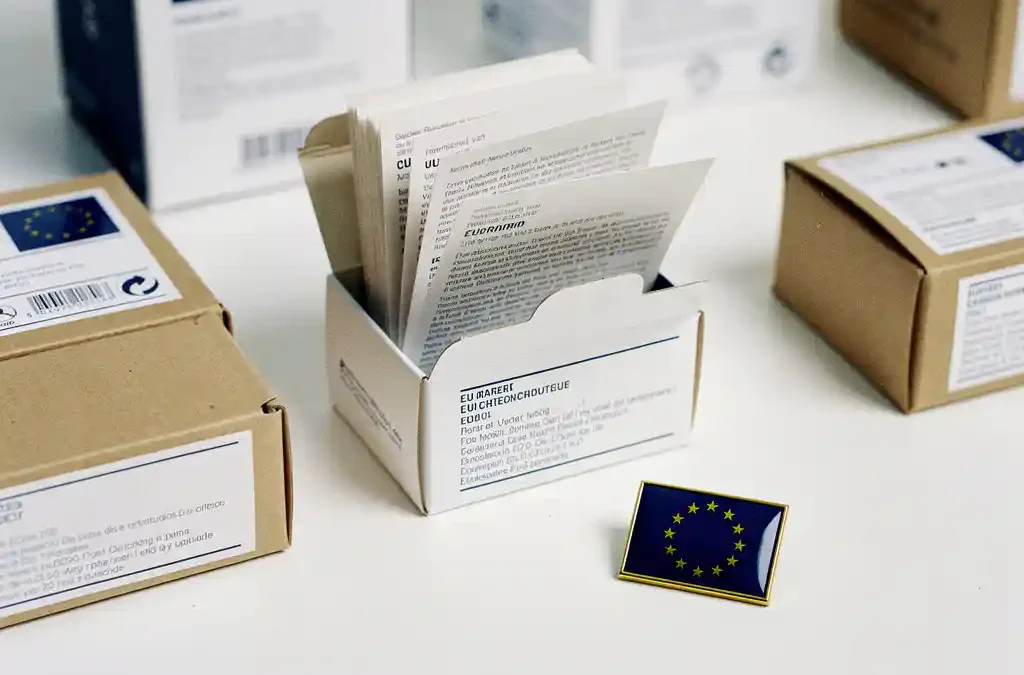
EU law requires product labels to display the manufacturer’s name and address, a product description, safety warnings, the country of origin where applicable, and any legally mandated information specific to the product category. These requirements come from a combination of EU-wide regulations and sector-specific directives. The sections below walk through each key aspect of EU labelling compliance, from core rules to language obligations and multi-market preparation.
Which EU regulations govern product labelling?
EU product labelling is governed by a combination of horizontal regulations that apply across all product types and sector-specific legislation targeting individual categories. The General Product Safety Regulation (GPSR), which came fully into force in 2024, establishes baseline safety and labelling obligations for most consumer products placed on the EU market. Additional regulations apply depending on the product type.
The most relevant overarching frameworks include the CE marking regulations, the EU Market Surveillance Regulation, and the General Food Law for food products. For specific categories, the following legislation applies:
- Food and beverages: Regulation (EU) No 1169/2011 on food information to consumers
- Chemicals and mixtures: The CLP Regulation (EC) No 1272/2008
- Cosmetics: Regulation (EC) No 1223/2009
- Electrical equipment: The Low Voltage Directive and relevant CE marking rules
- Textiles: Regulation (EU) No 1007/2011 on textile fibre names and labelling
Understanding which regulations apply to your specific product is the essential first step before designing any label for the EU market. In many cases, multiple regulations apply simultaneously, meaning a single label must satisfy several legal frameworks at once.
What mandatory information must appear on an EU product label?
Across most product categories, EU law requires labels to include the manufacturer’s or responsible person’s name and address, a clear product description or identification, any applicable safety warnings, instructions for use where necessary, and the country of origin in specific regulated sectors. CE marking must appear on products within its scope.
Beyond these common requirements, the specific mandatory elements vary, but a baseline EU-compliant label typically includes:
- Name and registered address of the manufacturer or EU-based responsible person
- Product identification (model number, batch number, or serial number)
- Intended use or product description
- Safety and hazard warnings relevant to the product
- Instructions or restrictions on use
- CE marking where legally required
- Country of origin where mandated by sector-specific rules
For food products, the list is considerably longer and includes ingredients, allergens, net quantity, best-before or use-by dates, nutritional information, and storage conditions. The key principle across all categories is that label information must be accurate, legible, and not misleading to the consumer.
Do EU labelling rules differ by product category?
Yes, EU labelling rules differ significantly by product category. While the General Product Safety Regulation sets a universal floor, each sector has its own detailed requirements that go well beyond the baseline. A cosmetics label has entirely different mandatory fields than a food label or an electrical appliance label.
Some of the most distinct category-specific requirements include:
- Food and drink: Mandatory nutrition declarations, allergen highlighting in the ingredients list, and specific font size requirements for legibility
- Cosmetics: Full ingredient listing using INCI nomenclature, the function of the product, and shelf-life indicators
- Hazardous chemicals: Standardised hazard pictograms, signal words (Danger or Warning), and precautionary statements under the CLP Regulation
- Medical devices: Strict labelling under EU MDR (Regulation 2017/745), including UDI codes and specific symbols
- Toys: Age suitability warnings, safety markings, and CE marking requirements
Businesses operating across multiple product lines must manage these differences carefully. A labelling process that works well for one category may be entirely insufficient for another, making category-specific legal review essential before market entry.
What language requirements apply to EU product labels?
EU product labels must be written in the official language or languages of the member state where the product is sold. There is no single EU-wide language requirement. Each country sets its own rules, and some, such as Belgium, Luxembourg, and Finland, require labels in two or more official languages simultaneously.
This means a product sold across multiple EU markets typically requires a different language version of the label for each country, or a multi-language label that satisfies all relevant national requirements at once. Key points to understand include:
- France requires French on all consumer product labels sold in France
- Germany requires German
- Spain requires Spanish, though regional languages may also be required in certain autonomous communities
- Belgium requires French, Dutch, and German depending on the region of sale
- Some countries accept English for technical or professional products but not for consumer-facing goods
This is where professional translation and localisation becomes critical. Translating a label is not simply a matter of converting words. It requires cultural accuracy, correct terminology for the product category, and full compliance with the linguistic conventions expected in each target market. We work with native translators across all European languages to ensure that every label version meets both legal and cultural standards.
What are the consequences of non-compliant product labelling in the EU?
Non-compliant product labelling in the EU can result in products being withdrawn from sale, fines imposed by national market surveillance authorities, mandatory product recalls, and reputational damage. In serious cases involving safety-critical information, criminal liability for responsible persons is also possible under national law.
The consequences operate at several levels. At the administrative level, national authorities can order a product to be removed from shelves immediately if labelling does not meet legal requirements. Under the General Product Safety Regulation, market surveillance authorities across all EU member states have strengthened powers to act quickly against non-compliant products, including those sold online.
Financial penalties vary by member state, as enforcement is handled nationally, but fines can be substantial. Beyond direct penalties, the commercial cost of a product recall, relabelling exercise, and relaunch can far exceed the original cost of getting compliance right from the start. For businesses entering the EU market in 2026, investing in accurate labelling upfront is considerably less costly than managing a compliance failure after launch.
How should businesses prepare labels for multiple EU markets?
Businesses preparing labels for multiple EU markets should start with a single master label template that satisfies the most demanding national requirements, then adapt it for each market’s language and any country-specific legal additions. A structured localisation workflow, ideally supported by a language service provider with EU regulatory experience, is the most efficient approach.
A practical multi-market labelling process typically involves the following steps:
- Regulatory mapping: Identify which regulations apply in each target market and which mandatory fields they require
- Master content creation: Develop the core label content in the source language, ensuring all legally required information is present
- Professional translation: Translate label content into each required language using native translators familiar with product-specific terminology
- Localisation review: Check that translated content reflects local conventions, correct units of measurement, and culturally appropriate phrasing
- DTP and formatting: Reformat the label for each language version, accounting for text expansion and legibility requirements
- Legal review: Confirm each final version meets the applicable national requirements before print
- Print and fulfilment: Produce and distribute the correct label version for each market
We support businesses through every stage of this process, from translation and DTP through to printing and fulfilment, operating as a single point of contact for multi-market label preparation. If you are preparing product labels for EU distribution and want to ensure full compliance across multiple languages, request a quote or get in touch with us to discuss your specific requirements.
Frequently Asked Questions
How do I find out exactly which EU regulations apply to my specific product?
Start by identifying your product’s category and intended use, then cross-reference it against the EU’s sector-specific legislation. The European Commission’s product safety pages and official EUR-Lex database list applicable directives and regulations by product type. For products that span multiple categories — such as a cosmetic device or a food supplement — it is strongly advisable to seek a formal regulatory review, as multiple frameworks may apply simultaneously and the consequences of missing one can be significant.
Does the EU's General Product Safety Regulation (GPSR) replace all other product labelling laws?
No — the GPSR sets a baseline floor for consumer product safety and labelling, but it does not replace sector-specific regulations. For example, food labels must still comply with Regulation (EU) No 1169/2011, cosmetics with Regulation (EC) No 1223/2009, and hazardous chemicals with the CLP Regulation. Think of the GPSR as the minimum standard every consumer product must meet, with additional obligations layered on top depending on the product category.
What is the most common labelling mistake businesses make when entering the EU market?
One of the most frequent mistakes is treating translation as a simple word-for-word conversion rather than a full localisation exercise. This leads to labels that are technically translated but legally non-compliant — for example, using incorrect product-specific terminology, failing to meet minimum font size requirements, or omitting country-specific mandatory fields that were not present in the source market. Another common error is assuming that a label compliant in one EU member state automatically satisfies requirements in all others, which is rarely the case.
Are digital or electronic labels acceptable under EU law, or must labels always be physical?
EU law generally requires mandatory label information to be physically present on the product or its packaging at the point of sale, and digital-only labels are not yet a widely accepted substitute for most consumer product categories. However, the EU is actively exploring digital product passports and extended digital labelling under sustainability legislation, particularly for textiles and electronics. For now, businesses should ensure all legally required information appears on the physical label, and treat any digital supplement as an addition rather than a replacement.
How much physical space do I need on a label to meet EU multi-language requirements?
This depends heavily on the number of target markets and the volume of mandatory text required for your product category. Food labels, for instance, carry a significant amount of mandatory content, and reproducing this in five or six languages can require considerably more label real estate than a single-language version. Professional desktop publishing (DTP) and label design services can help optimise space through careful typography, layout, and text condensation — without compromising legibility standards, which are themselves legally regulated in some categories such as food.
If I sell products through an online marketplace into the EU, do the same labelling rules apply?
Yes — the General Product Safety Regulation explicitly extends labelling and safety obligations to products sold through online channels, including marketplaces. If you are a non-EU seller placing products on the EU market via e-commerce, you are typically required to appoint an EU-based responsible person whose name and address must appear on the product label. Market surveillance authorities now have enhanced powers to act against non-compliant products sold online, making digital sales channels subject to the same scrutiny as physical retail.
How far in advance should I begin the labelling compliance process before launching in a new EU market?
Ideally, labelling compliance should begin at the product development stage, not as an afterthought before launch. For businesses entering multiple EU markets simultaneously, allow sufficient lead time for regulatory mapping, professional translation, localisation review, DTP reformatting, legal sign-off, and print production — a process that can realistically take several weeks to a few months depending on product complexity and the number of target languages. Starting early also gives you time to address any compliance gaps without delaying your go-to-market timeline.