
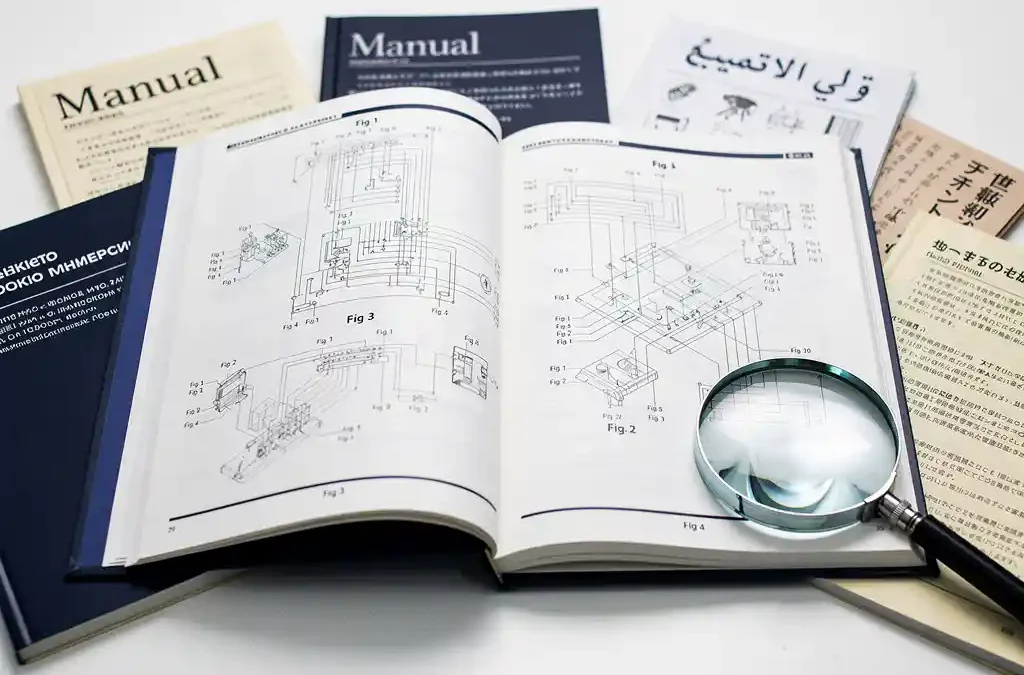
In most cases, it is a legal requirement to translate manuals into the official languages of the countries where your product is sold. Within the European Union, this is a basic requirement: consumers and users must be able to understand product information in their own language. Whether you need to cover all spoken languages in a given market depends on the regulations applicable to each sector and country. In this article, we answer the most frequently asked questions about translating manuals, so you can make well-informed decisions. Have a question right away? Feel free to contact us — we’re happy to help.
What legal obligations apply to the translation of manuals?
In the EU, manufacturers and importers are legally required to provide user documentation in the official language or languages of the country where the product is sold. This follows from various European directives, including the Machinery Directive, the Low Voltage Directive, and the General Product Safety Regulation. Without a correct translation, a product risks losing its CE marking and may not be placed on the market.
Which directive applies depends on the product category. Medical devices, toys, electrical equipment, and machinery each fall under specific regulations with their own language requirements. Common to all these directives is that safety and usage information must always be understandable to the end user. This is not an administrative formality, but a fundamental consumer protection measure.
Outside the EU, different rules apply. Countries such as Brazil, China, Japan, and Russia have their own language requirements for product documentation. Anyone operating internationally would do well to check local regulations for each market before launching a product.
What are the risks of not translating manuals?
Failing to translate manuals — or translating them incompletely — carries significant legal, financial, and reputational risks. Products without correct documentation in the local language can be recalled, blocked at the border, or removed from the market. In addition, the manufacturer can be held liable if a user suffers harm because instructions were not understandable.
Beyond legal consequences, there is a practical risk: users who cannot understand the manual are more likely to make mistakes when using a product. This leads to higher customer service costs, more returns, and a negative brand image. In sectors such as mechanical engineering or medical technology, the consequences of incorrect use can also be serious.
There is a commercial disadvantage as well. A manual that is poorly translated or unavailable in the customer’s language creates an unprofessional impression. In a market where customer experience carries ever greater weight, this can make the difference between a returning customer and a lost opportunity.
Does every language in a market need to be covered, or do the official languages suffice?
In most cases, the official languages of a country or region are sufficient. European regulations stipulate that documentation must be available in the official language of the country of sale — not in every language spoken by its residents. In countries with multiple official languages, such as Belgium or Switzerland, the obligation applies to each of those official languages.
There are exceptions, however. In regions with a strong regional language — such as Catalonia in Spain or Quebec in Canada — additional language requirements may apply under local legislation. It is advisable to assess this on a market-by-market basis, especially if you operate in regions with their own language policies.
From a commercial perspective, it can also be worthwhile to go beyond the legal minimum requirements. If a significant portion of your target audience speaks a language other than the official one, covering that language as well increases accessibility and customer satisfaction. This is a strategic consideration, not a legal obligation.
How do you determine which languages to prioritize when translating manuals?
Language priorities are determined based on three factors: legal obligations, market size, and user risk. Always start with the languages that are legally required for the markets where your product is sold. Then look at volume: in which markets is the expected sales volume greatest? Finally, weigh the risk: the greater the potential for harm from incorrect use, the higher the priority for a complete translation.
A practical approach is to create a language matrix. For each country, you list the official languages, sales volume, and risk classification of the product side by side. This provides a clear overview of which languages are immediately necessary and which can be added later.
We work with clients in more than 90 languages and regularly assist with this kind of prioritization. Our experience in the technology and manufacturing industries means we can quickly assess which languages are strategically most relevant to your specific situation.
What is the difference between translating and localizing a manual?
Translation means converting text from one language to another. Localization goes further: it adapts the content to the cultural, technical, and legal context of the target market. For a manual, localization may mean converting units of measurement, adapting safety icons to local standards, or adding references to local regulations.
A translated manual is understandable. A localized manual feels to the user as though it was made specifically for their market. That difference is noticeable in the user experience and can influence customer satisfaction and brand trust.
For technical documentation, localization is particularly relevant when products are adapted per market, or when safety regulations differ by country. In those cases, a straight translation is insufficient and full localization is the right choice.
What is the most cost-effective approach for multilingual manuals?
The most cost-effective approach for multilingual manuals combines structured source files, translation reuse through translation memories, and an integrated production process. By building manuals in a modular way and maintaining consistent language use in the source text, you significantly reduce translation costs with each new version.
Translation memories store previously translated sentences and automatically reuse them when similar or identical text appears. This is especially valuable for manuals that are updated regularly, as only the changed passages need to be retranslated. Across multiple languages and versions, this delivers substantial cost savings.
An integrated approach — where translation, layout, and printing are handled by a single partner — reduces coordination costs and shortens turnaround times. We offer exactly that combination: from translation and DTP to professional printing, all under one roof. This means you don’t have to coordinate between multiple suppliers, and quality remains consistent across all languages.
Finally, it pays to invest in a well-written source text. A manual that is clear, consistent, and well-structured is faster and cheaper to translate than one filled with jargon, long sentences, and inconsistencies. Technical writing as part of the documentation process is therefore also a long-term cost-saving measure.
Want to find out how we can optimize your multilingual documentation process? Contact us for a no-obligation conversation.
Frequently Asked Questions
How long does it typically take to have a manual translated?
The turnaround time depends on the length of the manual, the number of target languages, and the complexity of the content. A standard technical manual of 20–40 pages in one language is typically ready within 3 to 5 business days. For multiple languages simultaneously, this can be accelerated by processing languages in parallel. If you have an urgent deadline, always discuss the schedule with your translation partner in advance so that quality and speed remain balanced.
Can I have an existing manual reused as the basis for new product versions?
Yes, and this is strongly recommended from a cost perspective. Using translation memories, previously translated segments are automatically recognized and reused when an updated version is processed. Only the changed or new passages need to be retranslated, which significantly reduces both costs and turnaround time. Make sure your source files are well-structured and version-controlled so that changes are easy to track.
Which file formats are suitable for submitting a manual for translation?
The most common and editable formats are InDesign (.indd), Word (.docx), XML, and HTML. These formats allow text to be efficiently extracted, translated, and reinserted without losing the layout. PDF files are less suitable as source files, because text is harder to edit and the layout has to be rebuilt manually. If in doubt, ask your translation partner which format best fits your production process.
What should I do if my manual also contains images with text?
Images with embedded text — such as technical drawings, diagrams, or screenshots with labels — require extra attention during translation. Ideally, you provide the source files for these images (for example, Illustrator or Visio files) so that the text can be edited directly in the original file. If only a rasterized image is available, the text must be recreated through DTP editing, which takes more time and increases costs. Keep this in mind when setting up your documentation process.
Is it advisable to use machine translation for technical manuals?
Machine translation can be a useful first step for reducing costs, but it is rarely sufficient as a final result for technical manuals. Technical terminology, safety instructions, and product-specific nuances require human review by a specialized translator to prevent errors. A hybrid approach — machine translation followed by post-editing by a subject-matter expert — can be cost-effective for large volumes, provided the quality of the source text is high. For documents where safety is a factor, full human translation is always the safest choice.
How do I ensure consistent terminology across multiple manuals and languages?
Consistent terminology starts with creating a terminology list or glossary in the source language, with approved translations for each target language. This glossary is then integrated into the translation process so that all translators and tools use the same terms. Combine this with a translation memory and you build a valuable, company-specific language database over time. This prevents inconsistencies across products, versions, and markets, and reinforces the professional image of your documentation.
Do I need to have my translated manual certified or validated?
For most consumer products, formal certification of the translation is not required, but the translation must be demonstrably accurate and complete within the framework of the applicable directives. In regulated sectors such as medical devices or industrial machinery, additional validation may be required, in which a second translator or subject-matter expert reviews the translation. It is advisable to document this process formally, so that in the event of an audit or liability issue you can demonstrate that the translation was produced with due care. Ask your translation partner about the quality assurance and certification options available.
Related Articles
- How do I keep my printed catalog up to date with a frequently changing product range?
- What is the difference between print-on-demand and offset printing, and which solution is right for my business?
- How do you scale software localisation operations?
- What is software localisation?
- How do you localise mobile applications effectively?