
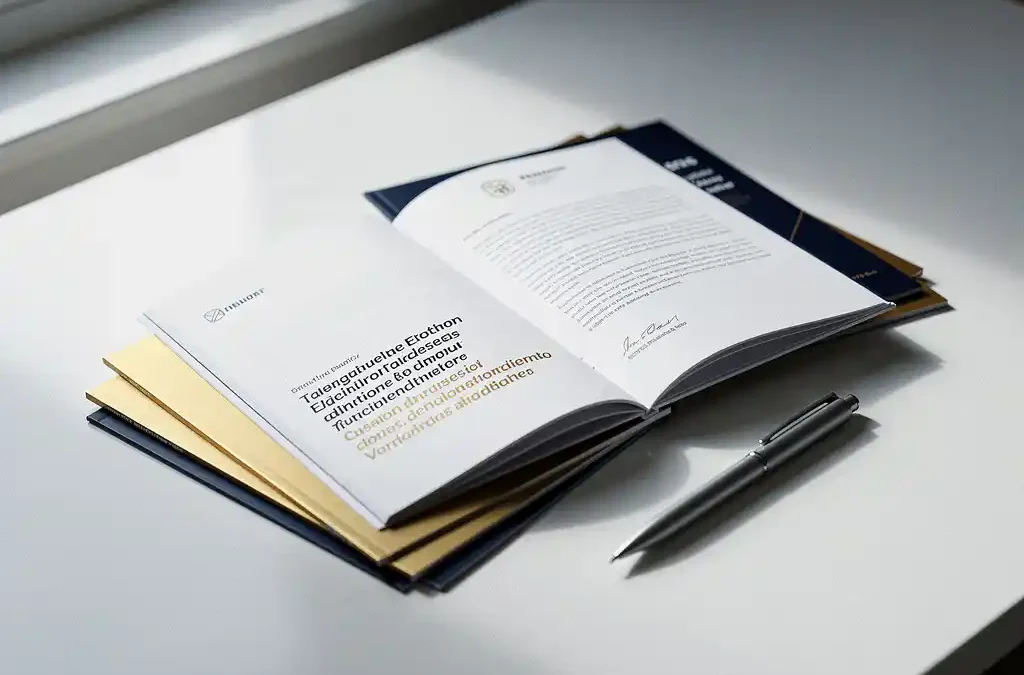
Options for personalized print include variable data printing, personalized direct mail, custom packaging, and personalized promotional materials where the name, image, or message varies per recipient. These techniques make it possible to produce large print runs where every copy is uniquely tailored to the individual recipient. In the sections below, we answer the most frequently asked questions about how personalized print works, when to use it, and how to combine it with other channels. Want to find out right away what we can do for your organization? Feel free to get in touch and we’ll be happy to help.
What techniques make print truly personal?
Print becomes truly personal through variable data printing (VDP), a technique in which text, images, colors, and layout elements are automatically adjusted per copy based on customer data. This means every reader receives a version specifically tailored to them, without production time increasing exponentially.
With variable data printing, you link a data file to a print-ready design. Fields in the design — such as a name, a product recommendation, or a personalized URL — are automatically populated from that file. Every print is therefore unique, while the workflow remains scalable.
In addition to VDP, there are other techniques that contribute to a personal feel:
- Personalized URLs (PURLs): each recipient receives a unique web link on the printed piece, directing them to a custom-built landing page.
- Custom QR codes: dynamic QR codes that open a different destination for each recipient.
- Inkjet and laser overprinting: adding personalized elements to a pre-printed base after the fact.
- Digital-offset combinations: printing a base sheet in offset for color quality, followed by digital personalization for the variable elements.
The choice of technique depends on the print run, the budget, and the degree of personalization you want to achieve. For smaller runs, fully digital printing is often the most efficient option. For larger volumes, a hybrid approach combining offset and digital printing can be more cost-effective.
What are the most common forms of personalized print?
The most common forms of personalized print are personalized direct mail, individually addressed brochures and catalogs, personalized packaging, and promotional materials such as flyers or invitations containing individual details. Each of these forms has a specific area of application and communication objective.
Personalized direct mail
Direct mail is the classic application of personalized print. Letters, cards, or leaflets include the recipient’s name and address, as well as tailored offers based on purchase history or behavior. Research in the direct marketing sector consistently shows that personalized direct mail achieves higher response and conversion rates than generic alternatives.
Personalized brochures and catalogs
Companies in the technology and manufacturing industries use personalized brochures to show customers only the product information relevant to their sector or stage in the buying journey. A customer who already owns a base product receives a catalog featuring upgrades and accessories. A new prospect sees an introductory version. This increases relevance and reduces information overload.
Personalized packaging and promotional materials
In the retail sector, packaging is increasingly being personalized — from seasonal editions featuring a name on the pack to personalized point-of-sale materials tailored to each store location. Our print team also delivers these types of materials, from small runs for special promotions to large-scale campaigns across multiple points of sale.
How does personalized print differ from standard offset printing?
Personalized print differs from standard offset printing in that each copy contains unique, variable elements, whereas offset printing produces identical copies in large runs. Offset printing is more cost-efficient at high volumes of the same design. Personalized print requires digital printing technology and a data source, but delivers greater relevance per recipient.
In standard offset printing, printing plates are made for a fixed design. All copies are identical, and the cost per unit drops significantly at higher volumes. This makes offset printing ideal for mass-produced materials such as leaflets, magazines, or packaging without variable elements.
Personalized print almost always relies on digital printing, where a printer outputs directly from a data file without fixed plates. The cost per copy is higher than with offset, but the added value lies in the relevance to the recipient and the greater likelihood of a response or conversion. For campaigns where the message needs to vary per recipient, digital personalized print is the only practical option.
What data do you need for personalized print campaigns?
For personalized print campaigns, you need at minimum basic contact data — such as name and address — supplemented by segmentation data such as purchase history, location, industry, or behavioral characteristics. The richer and more reliable the data, the more relevant the personalization and the greater the impact of the campaign.
The quality of your data is a key factor in the success of personalized print. Incomplete or outdated data leads to errors in personalization, which can have the opposite effect of what you intended. It is therefore essential to maintain a well-managed CRM system or marketing database as your foundation.
Typical data fields used in personalized print campaigns:
- Name and salutation
- Address details for mailing
- Purchase history or product category
- Customer segment or industry
- Geographic location or language preference
- Stage in the customer journey (prospect, existing customer, at-risk customer)
In addition to the content data, you also need to account for privacy legislation. In Europe, the GDPR applies, which means you need consent to use personal data in marketing communications. Make sure your data processing and campaign setup comply with applicable regulations before rolling out a personalized print campaign.
When is personalized print the right choice?
Personalized print is the right choice when you want to reach a specific target audience with a relevant, tailored message, and when the higher cost per copy is justified by a higher response rate, conversion rate, or customer value. It is less suitable for mass communications where all recipients receive the same message.
Situations where personalized print is particularly effective:
- Customer retention campaigns: reaching existing customers with offers based on their purchase history.
- Welcome packages: new customers or employees receive a package featuring their name and information relevant to their specific situation.
- Event communications: invitations and badges with personalized information for each attendee.
- Technical documentation by market: product documentation that varies by region or language — an application where translation and personalization come together.
- Loyalty programs: points balance summaries, personal offers, and birthday communications.
Personalized print is less suitable when the budget is limited, the target audience is homogeneous, or the message is identical for everyone. In those cases, standard offset printing offers better value for money.
How is personalized print combined with other communication channels?
Personalized print is most effective when used as part of an integrated multichannel approach, combining print with email, social media, and digital landing pages. The combination reinforces the message across multiple touchpoints and increases the likelihood that a recipient will respond.
A widely used approach is the so-called print-to-digital bridge. A personalized mailing includes a QR code or PURL that directs the recipient to a digital environment tailored to their profile. The data collected digitally can then be used to make the next print communication even more relevant. This creates a learning loop between physical and digital.
Other effective combinations include:
- Print and email: a physical mailing is preceded or followed by a personalized email carrying the same message, which increases recognition and response.
- Print and social media: online retargeting campaigns are supported by physical print materials targeting the same audience.
- Print and events: personalized invitations, badges, and follow-up materials around events ensure a consistent experience.
At Crestec Europe, we combine translation, DTP, and printing under one roof, making it particularly straightforward to produce personalized materials in multiple languages for international campaigns. You no longer need to coordinate between multiple suppliers, and your campaign maintains the same quality and consistency in every country. Want to explore how personalized print fits within your communication strategy? Get in touch and we’ll be glad to think it through with you.
Frequently Asked Questions
How large does my database need to be to get started with personalized print?
There is no minimum size required to get started with personalized print. Even with a list of a few hundred contacts, you can set up an effective personalized campaign. What matters is not the size of the database, but the quality and completeness of the data: a small, well-segmented list often delivers better results than a large list with incomplete or outdated records.
What are the most common mistakes in personalized print campaigns?
The most common mistake is using incomplete or inaccurate data, which leads to embarrassing errors such as a wrong name or an irrelevant offer — both of which damage the recipient’s trust. Another frequent mistake is superficial personalization: filling in only the name while the rest of the message remains generic. Effective personalization goes beyond a name and also adapts the content, the offer, and the call to action to the recipient’s profile. Always run a proof with test data before printing the full run.
How long does it take to produce a personalized print campaign?
The turnaround time depends on the complexity of the personalization, the print run, and the preparation of the data and design. A straightforward personalized mailing can be produced within a few business days once the design and data have been approved. For more complex campaigns involving multiple variants, languages, or formats, you should allow one to three weeks. Plan well in advance to allow sufficient time for data verification, proofing, and any corrections.
Does personalized print comply with GDPR, and what do I need to watch out for?
Personalized print falls under the GDPR as soon as you use personal data for marketing communications. You need a valid legal basis — such as the recipient’s consent or a legitimate interest — and you must be able to demonstrate that the data has been processed and stored correctly. Make sure your CRM system tracks which contacts have given consent for direct mail, and always provide a clear option to unsubscribe. If in doubt, consult a legal advisor or your own data protection officer (DPO) before launching the campaign.
Can personalized print also be used for B2B communications?
Yes, personalized print is very well suited to B2B applications. Think of personalized proposal folders, product brochures tailored to a prospect’s specific industry or challenges, or welcome packages for new business clients. In B2B, the focus is often less on name personalization and more on content relevance: the right product information, the right language, and the right offer for the specific organization or decision-maker.
How do I measure the success of a personalized print campaign?
You measure the success of a personalized print campaign through response and conversion rates, which you can track via personalized URLs (PURLs), unique QR codes, or dedicated phone numbers per campaign. Compare the results with previous generic mailings to make the impact of personalization visible. Also look at indirect indicators such as website visits, inquiries, or revenue in the period following the campaign, and feed this data back into your CRM to further optimize future campaigns.
Is personalized print available in multiple languages for international campaigns?
Yes, multilingual personalized print is entirely feasible and particularly effective for international campaigns. By including language preference or country as a variable in your data file, each copy can be automatically generated in the correct language. At Crestec Europe, translation, DTP, and printing are available under one roof, which significantly simplifies the process: you supply a single campaign concept, and we take care of consistent execution across multiple languages and markets.
Related Articles
- What does ISO 27001 mean for the security of my documentation with a print partner?
- What are the requirements for printed materials at trade shows and events?
- Which paper quality is most suitable for product manuals?
- How do I make sure my printed materials are ready for international distribution?
- What has to be in a product manual to comply with EU law?