
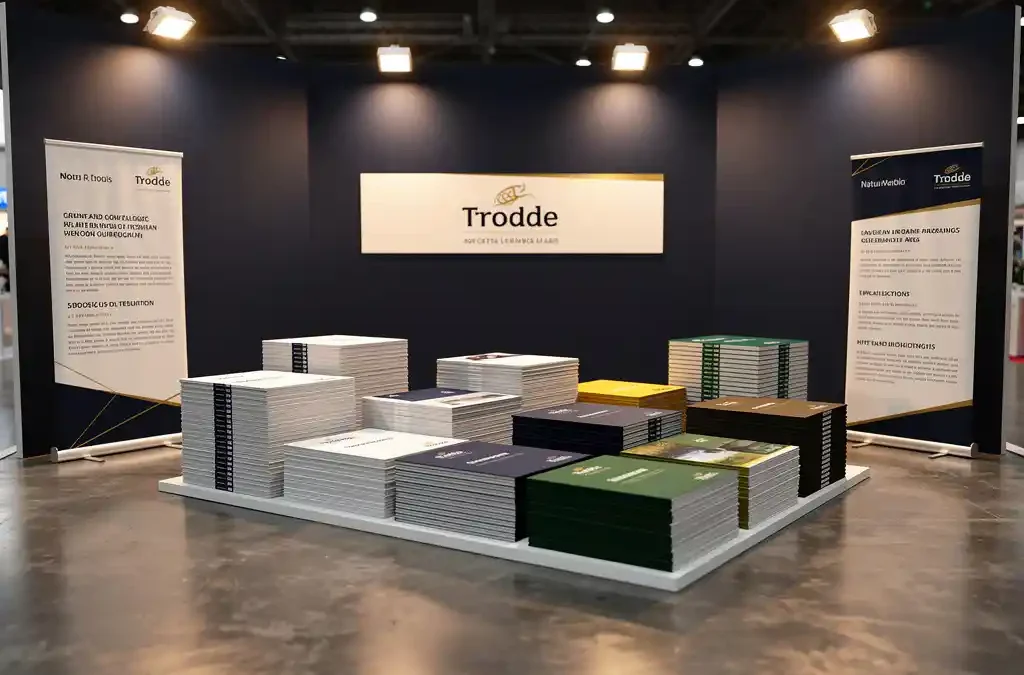
Trade show and event print materials are subject to specific technical requirements regarding file formats, resolutions, materials, and dimensions. The exact requirements depend on the type of print material, the size of the item, and the rules set by the trade show organizer itself. In this article, we answer the most frequently asked questions about trade show printing, so you can arrive fully prepared. Have questions about your specific situation? Feel free to get in touch and we’ll be happy to help.
What file formats and resolutions are required for trade show print materials?
For trade show printing, files are ideally submitted as PDF (preferably PDF/X-1a or PDF/X-4), EPS, or AI. The resolution for large-format items such as banners and displays should be at least 100 to 150 dpi at final size, while smaller printed materials such as flyers and brochures require a resolution of 300 dpi. All colors must be set to CMYK, not RGB.
One of the most common mistakes is submitting files in RGB color mode. Printers work in CMYK, and colors that look great on screen can shift significantly after conversion. Always build your design in CMYK from the start. Additionally, include crop marks and a bleed of at least 3 to 5 mm to prevent white edges after trimming.
Large display materials have a lower dpi requirement than paper print materials because they are viewed from a greater distance. A 2-by-1-meter banner displayed at 3 meters away will look sharp at 100 dpi at final size. Always check the file submission specifications provided by your printer or stand partner, as these can vary slightly between suppliers.
What materials are most commonly used for trade show printing?
The most commonly used materials for trade show printing are banner fabric (polyester or PVC) for banners and displays, coated paper for flyers and brochures, foam board or aluminum composite board for rigid panels, and cardboard for displays and stand constructions. The choice depends on the intended use, the desired look, and the budget.
Banner fabric is lightweight, foldable, and durable enough to withstand transport, making it ideal for roll-up banners and tension frames. For a premium look at exhibition stands, many companies opt for coated or laminated materials, which resist scratches and keep colors vibrant throughout the entire duration of the event.
Foam board and aluminum composite board are popular for wall panels and freestanding displays because they are rigid yet relatively lightweight. Cardboard constructions are widely used for temporary displays that are discarded after the event. For reusable materials intended to last across multiple trade shows, aluminum frames with interchangeable prints are a smart long-term investment.
What are the standard dimensions for trade show banners and displays?
The most commonly used standard sizes for trade show banners and displays are 85 x 200 cm or 100 x 200 cm for roll-up banners, 200 x 100 cm for horizontal banners, and 100 x 200 cm to 200 x 300 cm for pop-up displays. Backdrops and photo walls typically range from 2 by 2 meters to 3 by 3 meters.
Roll-up banners are the most common display item at trade shows due to their compact size and ease of assembly. The 85 cm or 100 cm width is an industry standard and fits most available standard frames. If you want to create a broader presence, you can place multiple roll-ups side by side or opt for a custom tension frame system.
Pop-up displays are available in fixed width units, usually expressed as a number of segments. A 3×3 pop-up display has a width of approximately 230 cm and a height of 230 cm. Always check the maximum permitted dimensions with the trade show organizer, as some events impose height restrictions on stand materials.
How far in advance should you order print materials for a trade show?
Plan your trade show printing at least three to four weeks before the event. For complex or large-scale orders — such as multiple displays, printed stand constructions, or multilingual materials — a lead time of six to eight weeks is more realistic. Factoring in revision rounds and approval time is essential.
The actual production time is usually manageable, but the preparation takes longer than most people expect. Design, proofreading, translations, print proofs, and final sign-off follow one after another, and each step requires time from multiple stakeholders. Starting too late risks additional costs for rush delivery or, worse, materials that don’t arrive on time.
At our print solutions, we integrate translation, DTP, and print production into one continuous process, which significantly reduces the overall lead time. By keeping all steps under one roof, handover time between disciplines is eliminated and you retain greater control over your schedule.
What rules and restrictions apply to print materials at trade shows?
Trade shows and event venues have their own rules governing stand materials. The most common restrictions relate to the maximum height of displays, prohibitions on freestanding structures outside the stand boundary lines, the use of lighting in combination with printed materials, and fire safety requirements for materials.
Fire safety is something organizers take seriously. In many cases, materials visible on the stand must comply with fire class B1 or an equivalent standard. Always ask your printer for a certificate or declaration if you are unsure, as trade show organizers can refuse or remove materials that do not meet the required standard.
In addition, some trade shows impose restrictions on sound production, moving images, or projections used in combination with physical print materials. Always review the stand regulations for the specific event in advance, and contact the organizer if in doubt. What is permitted at one trade show may be prohibited at another.
How do you ensure consistent brand identity across all your trade show materials?
Consistent brand identity across trade show materials is achieved by working from a central brand guidelines document that specifies color codes (CMYK and Pantone), typefaces, logo versions, and spacing rules. Ensure that all suppliers — both internal and external — work from the same source files and specifications. Have print proofs approved before the full print run is produced.
A common issue is color variation between different printers or material types. A logo that perfectly matches the brand color on paper may look different on banner fabric or foam board due to the material and printing technique. Whenever possible, have all your trade show materials produced by a single supplier, or explicitly align color calibration between multiple suppliers.
Multilingual trade show materials require extra attention to consistency. Translations affect text length and, consequently, the layout of your materials. A sentence in German is on average longer than its English equivalent, which has implications for the formatting of banners and brochures. By integrating translation and DTP into the same process, you prevent brand identity from being compromised when adapting text for different markets.
Want to make sure your trade show materials look professional in every language and at every size? Contact us and we’ll be happy to discuss how we can support your print materials from start to finish.
Frequently Asked Questions
Can I use my existing brand identity files directly for trade show printing, or do I need to adapt them?
Existing brand identity files are often created for digital use (RGB, low resolution) and need to be converted for print. Check whether the files are built in CMYK, whether they have a resolution of at least 300 dpi for paper printing, and whether the fonts are embedded or converted to outlines. Always have a print-ready file checked by your printer before placing a large print run order.
What is the difference between a print proof and a digital proof, and which one do I need?
A digital proof is a PDF preview on screen that shows your color and layout choices, but does not guarantee the exact color reproduction on the final material. A physical print proof is actually printed on the final material and gives an accurate representation of color, sharpness, and finish. For large or high-value orders, such as a complete stand fit-out, a physical print proof is strongly recommended to avoid unpleasant surprises.
How do I prevent my roll-up banner from looking blurry or pixelated when printed?
Pixelation is almost always caused by the source file having too low a resolution, or by images being digitally enlarged beyond what the image quality can support. For a roll-up banner, use images with a minimum of 100 to 150 dpi at the actual final size, and avoid scaling up small stock photos to large formats. Ask your printer to check a digital proof at actual size, or view the file at 25% screen size to get an impression of the printed quality.
Is it a good idea to reuse trade show print materials for multiple events, and what should I keep in mind?
Reuse is certainly a smart and cost-effective choice, provided you select materials that can withstand transport, storage, and repeated assembly. Choose aluminum frames with interchangeable prints rather than fixed constructions, and store materials in a dry, dark place to prevent discoloration. Avoid including specific dates, locations, or time-sensitive offers on reusable materials, so that the prints can be used for as long as possible.
What should I do if my print materials arrive damaged just before the trade show?
Document the damage immediately upon receipt with photographs and contact your printer and the carrier without delay. Many professional printers offer an express replacement service, but this requires you to report the damage promptly and be able to provide evidence of it. To reduce this risk, it is advisable to receive print materials at least five working days before the event, leaving room for an emergency reprint if necessary.
How do I determine how many flyers and brochures to bring to a trade show?
A general rule of thumb is to count on two to five copies per expected visitor to your stand, depending on how actively you distribute materials. Also consider the duration of the event, the type of audience, and whether you are distributing materials selectively or making them freely available. It is wiser to print a small reserve than to run out, but avoid overproducing time-sensitive materials that will no longer be usable after the event.
What are the benefits of integrating translation and print production with a single supplier?
When translation, DTP, and print production all take place under one roof, handover time between different parties is eliminated and direct coordination between translators and layout designers becomes possible. This prevents layout issues that arise when translated text is longer or shorter than the original, and ensures a consistent brand identity in every language. You also have a single point of contact for the entire process, which simplifies communication and reduces the risk of errors.