
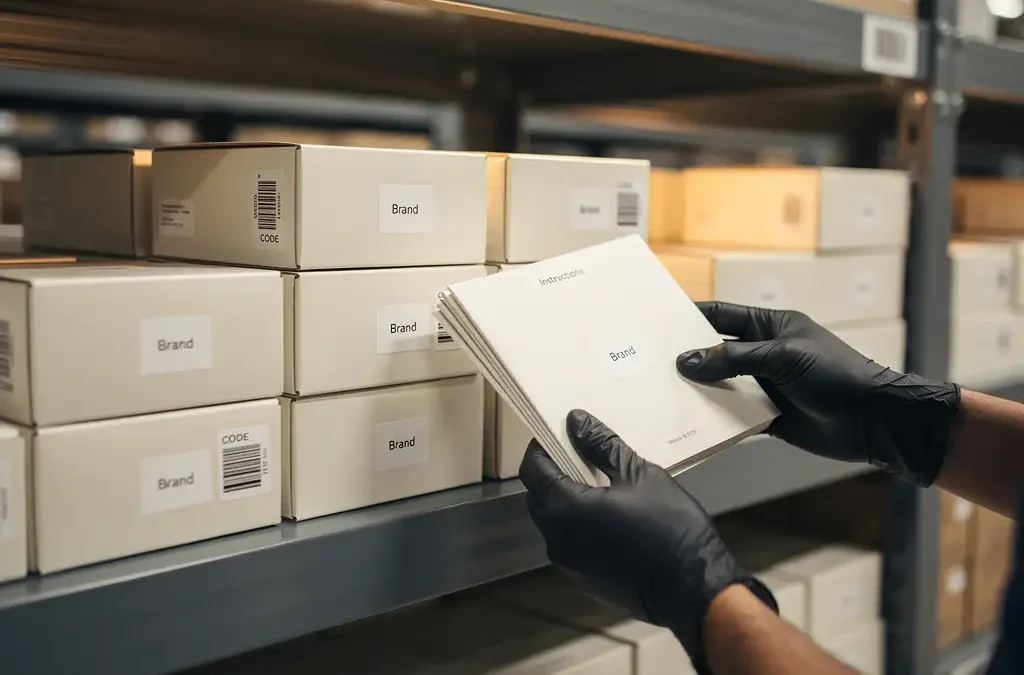
Warehousing, kitting, and print production work together as an integrated documentation pipeline: printed materials are produced, stored in a warehouse, assembled into kits based on specific requirements, and then shipped to their final destination. This is particularly valuable for companies distributing multilingual documentation to multiple markets or dealer networks. If you’d like to know how this works in practice, feel free to get in touch and we’ll be happy to help. The sections below answer the most frequently asked questions on this topic.
What is the difference between warehousing, kitting, and fulfillment?
Warehousing is the storage of (printed) materials in a warehouse until they are needed. Kitting is the process of assembling multiple individual items into a single, shipment-ready package. Fulfillment covers the entire process of storage, assembly, and delivery to the end customer or distributor. Together, these three steps form the logistical backbone behind the distribution of printed documentation.
It helps to look at each of the three concepts separately, as they each serve a different function in the chain:
- Warehousing ensures that your printed materials are stored safely and in an organized manner, ready for use whenever needed. Think product manuals, promotional materials, or packaging inserts.
- Kitting combines multiple documents or products into a single assembled package. For example: a manual in three languages, a warranty card, and a quick-start guide are brought together in one box that ships with a product.
- Fulfillment is the overarching service that manages the complete logistical process, from receiving the printed materials through to final shipment to dealers, retailers, or end users.
For companies with international product launches or large dealer networks, the distinction between these three steps is more than theoretical. A kitting error — such as including the wrong language version — can lead to complaints or returns. A well-structured fulfillment process prevents these kinds of mistakes on a structural basis.
How does kitting connect to the print production process?
Kitting connects directly to the print production process because printed materials are stored immediately after production and then assembled on demand. The link between printing and kitting is most efficient when both processes are managed under one roof, eliminating delays caused by external logistics handoffs.
In practice, the process works as follows: once documents have been translated, laid out in DTP, and approved for print, they are printed in a specific run and immediately logged into the warehouse. When an order comes in, the correct items are selected, combined, and packaged as a complete kit.
The connection between DTP, print, and kitting is particularly strong when multilingual documentation is involved. Suppose you are launching a product in five European countries: the manuals for each language are printed and stored separately, but at the point of shipment they are combined based on the destination. This requires accurate inventory management and a logistics system that correctly tracks language versions. We offer this as an integrated solution through our printing services, where translation, layout, and production flow seamlessly into one another.
What types of print materials are suitable for kitting?
Almost any type of printed material that is shipped as part of a larger package is suitable for kitting. This includes product manuals, quick-start guides, warranty cards, packaging inserts, promotional materials, and point-of-sale materials. Suitability depends on the extent to which the material can be standardized and produced in advance.
In the technology and manufacturing industries, where we serve many of our clients, these are the most common categories:
- Technical documentation: manuals, installation guides, and safety instructions that are required to ship with a product.
- Marketing materials: flyers, product sheets, and brochures used during a product launch or trade show presentation.
- Point-of-sale materials: displays, tags, and stickers used in retail environments to differentiate products.
- Administrative documents: warranty cards, registration forms, and compliance documentation.
Materials that are updated frequently — such as documents subject to regulatory requirements or product specifications — require extra attention in inventory management. In such cases, it is advisable to keep stock levels low and reprint more frequently, rather than storing large quantities that may quickly become outdated.
How do you manage inventory for multilingual print materials?
Managing inventory for multilingual print materials requires a system that tracks stock by language version, records consumption, and provides timely alerts when a reprint is needed. Without this kind of structure, it is easy to end up in a situation where some language versions are out of stock while others sit unused on the shelf for too long.
An effective inventory management process for multilingual print materials relies on several concrete measures:
- Separate SKUs per language version: each language version of a document is assigned a unique identifier, so that stock can be tracked accurately per version.
- Minimum threshold levels: set a minimum stock level per language version below which a reorder or reprint is automatically triggered.
- Regular audits: periodically check whether the stored versions are still current and do not contain outdated information.
- Integration with print planning: ensure that inventory data is directly available for scheduling reprints, so that unnecessary lead times are avoided.
With multilingual documentation, there is also the question of which language versions are needed in what quantities per destination. A dealer in Germany has different needs than a distributor in Spain. A well-configured system accounts for regional demand patterns and adjusts stock levels accordingly.
When does a one-stop solution for print and kitting make sense?
A one-stop solution for print and kitting makes sense when you are currently splitting multiple processes — such as translation, layout, print, storage, and shipping — across different suppliers, and are consequently dealing with coordination risks, longer lead times, or quality loss between handoffs. The more parties involved, the greater the chance of errors and delays.
Specific situations where an integrated approach offers clear advantages:
- You are launching a product in multiple countries simultaneously and need multilingual documentation available at the same time.
- Your documentation is updated regularly and you want to be able to act quickly without having to brief multiple suppliers each time.
- You have a dealer network that orders materials on demand, where speed and consistency are essential.
- You want assurance about information security in the handling of your documentation and business data.
A partner that manages translation, print production, warehousing, and dealer shipping under one roof reduces coordination risk and shortens the time between a product update and the moment updated materials reach the market. Our ISO 9001 certification confirms structured quality management throughout the entire production process, while ISO 27001 ensures that your documentation and business data are handled securely. Would you like to know how we can set this up for your organization? Get in touch and we’ll discuss the options.
Frequently Asked Questions
How long does it typically take to set up a kitting process for a new product?
The lead time for setting up a new kitting process depends on the complexity of the package and the number of language versions, but you should generally allow one to three weeks for the initial setup. This includes creating SKUs, defining kit composition per destination, and logging the initial stock. When translation and print are also handled by the same partner, the transition from production to storage and kitting is considerably faster, as there is no handoff between separate parties.
What are the most common mistakes in kitting multilingual documentation, and how do you prevent them?
The most common mistake is including the wrong language version — for example, a French-language manual in a kit intended for the Dutch market. This typically happens due to unclear labeling or a poor link between order data and warehouse locations. You can prevent this by assigning a unique SKU to each language version, automatically assembling kits based on destination rules, and closing out the kitting process with a visual or automated check before shipment.
Is kitting suitable for small print runs or one-off orders?
Yes, kitting is also worthwhile at lower volumes, especially when the assembled kits require a high degree of accuracy or when the contents vary by destination. For one-off orders, it is advisable to monitor stock levels per component closely, so you do not end up with large quantities of unused materials. A fulfillment partner with flexible minimum order quantities offers the most flexibility here.
How do you handle document updates when stock is still held in the warehouse?
This is one of the most practical challenges with printed documentation: a product update or regulatory change can render existing stock unusable. The best approach is to align stock levels with the expected rate of consumption and avoid holding large buffers for documents that change regularly. When an update does coincide with existing stock, it is important that your fulfillment partner can quickly identify the outdated versions, remove them from the kitting flow, and either destroy or return them — ensuring that no outdated materials are accidentally shipped.
Can dealers or distributors place orders directly from the warehouse?
Yes, many fulfillment solutions offer the ability to give dealers or distributors access to an ordering portal through which they can request materials directly from the central stock. This significantly speeds up lead times and reduces the administrative burden on the main organization. Stock levels are then updated in real time, and the system can automatically send an alert when a reprint is needed.
What are the advantages of ISO-certified warehousing and kitting compared to a standard logistics provider?
An ISO 9001-certified partner operates according to documented quality procedures, meaning that every step in the kitting process is traceable and verifiable. This is particularly relevant when documentation is legally required to ship with a product, such as safety instructions or compliance documents. ISO 27001 certification adds information security to that, which is essential if your documentation contains confidential product information or business data that must not fall into the wrong hands.
How do you calculate the optimal print run for materials stored for kitting?
The optimal print run is a balance between the cost per unit (which decreases with higher volumes) and the risk of obsolescence or overstock. Take into account the expected demand per language version over a period of three to six months, the likelihood of interim updates, and the cost of warehouse space. For documents that are stable and used in high volumes, a larger print run is worthwhile; for documents that change frequently, it is wiser to reprint more often in smaller quantities, even if the unit cost is slightly higher.
Related Articles
- How do I make my point-of-sale materials stand out in the store?
- What is the Triman logo and what does it mean for exporting my products and manuals to France?
- How do you scale software localisation operations?
- How do you handle software updates in localised versions?
- How do you handle version control in software localisation?