
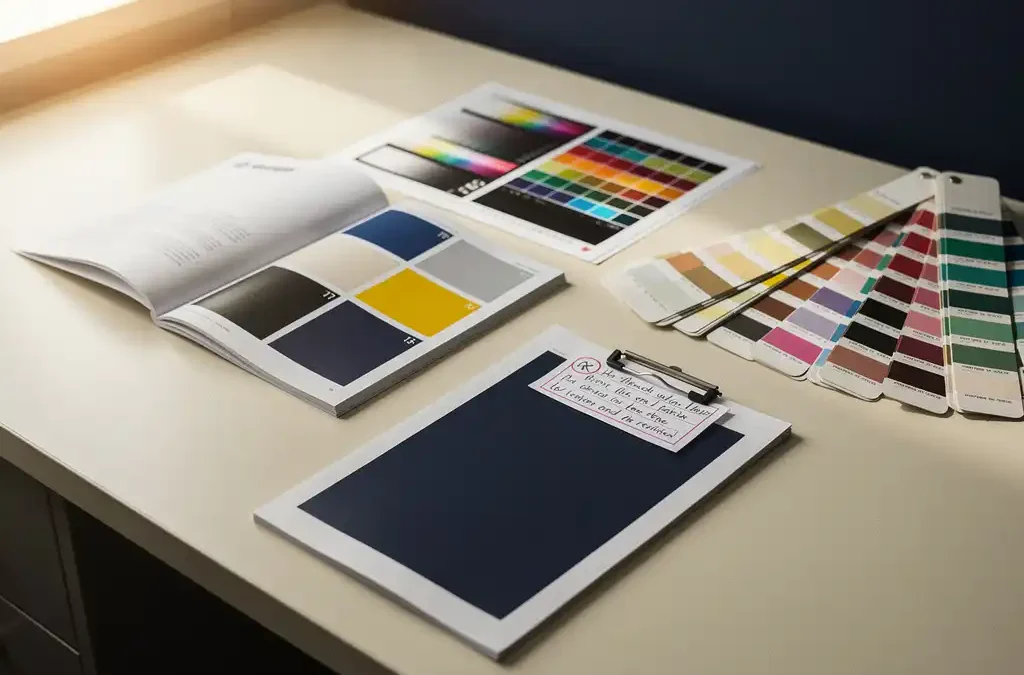
Make sure your print partner always has access to the most up-to-date version of your brand guidelines by using a centralized, shared system and communicating proactively with every update. This prevents printed materials from being produced based on outdated colors, fonts, or logos. In this article, we answer the most frequently asked questions about managing brand guidelines with your print partner, so you can enter the market in 2026 error-free and consistently. Have questions about how we handle this? Feel free to contact us.
What happens if your print partner uses outdated brand guidelines?
If your print partner works with outdated brand guidelines, you risk having printed materials that no longer match your current brand identity. Think of an old logo on a product manual, incorrect Pantone colors on packaging, or a typeface you replaced years ago. The result is inconsistent communication to your customers and potentially costly reprints.
The consequences go beyond aesthetics. Inconsistent print materials undermine customer trust in your brand, especially when visible differences appear between online and offline materials. In sectors such as technology and manufacturing, where documentation is an essential part of the customer experience, this can directly affect how customers perceive a product.
Practically speaking, it also leads to additional costs: reprints, delays in delivery, and extra coordination between you and your partner. The larger the print run, the greater the damage when an error occurs. Prevention therefore starts with a clear communication process around brand updates.
How do you share brand guidelines efficiently with a print partner?
The most efficient way to share brand guidelines with a print partner is through a centralized, always-accessible platform such as a shared cloud folder, a brand portal, or a project management system. This ensures your partner always has the latest version on hand, without you having to resend files with every new job.
A few concrete approaches that work well:
- Shared cloud storage (such as Google Drive or SharePoint) with a clear folder structure organized by brand version and date
- A brand portal that automatically displays the most recent guidelines and archives older versions
- Direct communication on updates via email or a project tool, with a brief summary of what has changed
- Version numbering on all documents, so your partner can always verify they are using the correct version
Also make sure the guidelines themselves are written clearly and practically. A document that is too long or too technical is less likely to be consulted. Use visual examples of correct and incorrect usage so your partner can quickly assess whether a design meets the guidelines.
What information should you always include when sending a brand update?
When sending a brand update, you should always include at minimum the following information for your print partner: an overview of exactly what has changed, the updated source files, the effective date of the new guidelines, and instructions on how to handle ongoing jobs that are still governed by the old guidelines.
In practice, this means sending an update message that includes:
- A change summary: what has changed compared to the previous version? Think color values, logo variants, typography, or style rules.
- Updated source files: vector files of the logo, color profiles (CMYK, Pantone, RGB), font licenses, and templates.
- An effective date: clearly indicate from when the new guidelines apply to new jobs.
- Instructions for ongoing jobs: should a job already in production be updated, or will it be completed under the old guidelines?
- A point of contact for questions about the update, so your partner does not have to guess when something is unclear.
The more specific you are in your communication, the lower the risk of errors in the final printed output.
How do you set up an approval process for print work after a brand change?
After a brand change, you set up an approval process by working with fixed review checkpoints: a proof or digital proof that is approved by the brand owner before a job goes into production. This is especially important for the first jobs after an update, when the risk of errors is greatest.
A workable approval process looks like this:
Step 1: Digital proof for approval
Ask your print partner to submit a digital proof for every new job following a brand change. Review it specifically for the elements that have been updated: color usage, logo placement, typography, and layout. Provide written approval before production begins.
Step 2: Physical proof for large print runs
For large print runs or materials where color accuracy is critical, request an additional physical proof. This provides a more reliable representation of the final result than a screen display. We work closely with our in-house DTP team to ensure documents meet print requirements before they go to press, preventing this kind of surprise.
Also establish the approval process contractually with your print partner, so there is no dispute about who is responsible if an error appears in the final product.
When does it make sense to outsource brand management to your print partner?
It makes sense to outsource brand management to your print partner when you regularly produce large volumes of print work, when you operate across multiple languages or markets, or when internal capacity is lacking to consistently maintain brand guidelines across all materials. A partner that combines translation, DTP, and print production under one roof reduces coordination risk and shortens the time between a brand update and the moment updated materials reach the market.
Outsourcing also makes sense when you work with materials in multiple formats and languages, where small brand errors can quickly multiply across a large number of documents. A partner with certified quality processes — such as ISO 9001 for quality management and ISO 27001 for information security — provides assurance that both your brand guidelines and your business data are handled with care.
Do keep the following in mind when outsourcing brand management:
- Establish clear boundaries regarding who holds final responsibility for brand approval
- Ensure there is an internal point of contact who coordinates communication with the partner
- Schedule periodic review moments to keep guidelines and processes up to date
Want to know how we can streamline brand management and print production for your organization? Get in touch and we’ll work together to find the best approach.
Frequently Asked Questions
How often should you officially update and communicate brand guidelines to your print partner?
There is no fixed frequency, but a good rule of thumb is to send an update immediately with every substantive brand change — no matter how small. In addition, it is wise to schedule a formal review at least once a year, during which you and your print partner verify that all files and guidelines in use are still current. This prevents small discrepancies from quietly accumulating into major inconsistencies.
What is the difference between a brand portal and a shared cloud folder, and which should I choose?
A shared cloud folder (such as Google Drive or SharePoint) is easy to set up and low-barrier, but requires discipline in folder management and naming conventions to avoid confusion over versions. A brand portal is a specialized solution that automatically handles version control, access permissions, and archiving, virtually eliminating the risk of outdated files being used. For organizations with multiple print partners or an extensive brand package, a brand portal is the most robust choice; for smaller operations, a well-structured cloud folder is sufficient.
How do I handle ongoing print jobs when a brand change occurs mid-project?
First, determine together with your print partner and internal brand team what impact the change has on the ongoing job: can the design still be updated without causing delays, or is it more efficient to complete the job under the old guidelines? Communicate the decision in writing and document which version of the guidelines applies to that specific job. This prevents disputes about responsibility after the fact and keeps the process transparent for all parties involved.
What common mistake should I absolutely avoid when supplying brand files to a print partner?
The most common mistake is supplying RGB files or screen-resolution logos for print work, when print requires CMYK or Pantone color profiles and vector files. This leads to color deviations and quality loss that only become visible in the final printed output. Always make sure your brand package for print contains at minimum vector files (.ai or .eps), correct CMYK and Pantone values, and fonts converted to outlines.
How do I ensure brand consistency when working with multiple print partners simultaneously?
Use one central platform as a single source of truth that all partners can access, and always communicate updates to all parties at the same time. Also consider creating a standard onboarding document that every new or active partner is required to review when starting a collaboration. Appointing an internal brand coordinator to manage all parties significantly reduces the risk of inconsistencies.
Can I hold my print partner liable if print materials are produced using outdated brand guidelines?
Liability depends heavily on what has been agreed contractually and whether you as the client provided the correct guidelines in a timely and demonstrable manner. If the print partner worked with files you supplied or approved, responsibility often lies partly with you. Therefore, establish in the contract who is responsible for keeping brand files up to date, who gives approval before production, and what happens in the event of errors resulting from outdated information.
How do I involve my internal marketing team in managing brand guidelines with the print partner?
Designate one person within the marketing team as the primary point of contact for the print partner, so that communication about brand updates runs smoothly and no conflicting information is passed on. Establish an internal process whereby every brand change is first approved and documented internally before being communicated externally. Regular brief alignment sessions between marketing, DTP, and the print partner — for example via a monthly check-in — keeps all parties on the same page.
Related Articles
- Can I have my printed manuals distributed directly to my dealers in Europe?
- How can I ensure that the brand identity comes through in all my documentation?
- What is the cost of having a professional instruction manual written?
- How do you choose software localisation vendors?
- How do you manage software localisation workflows?