
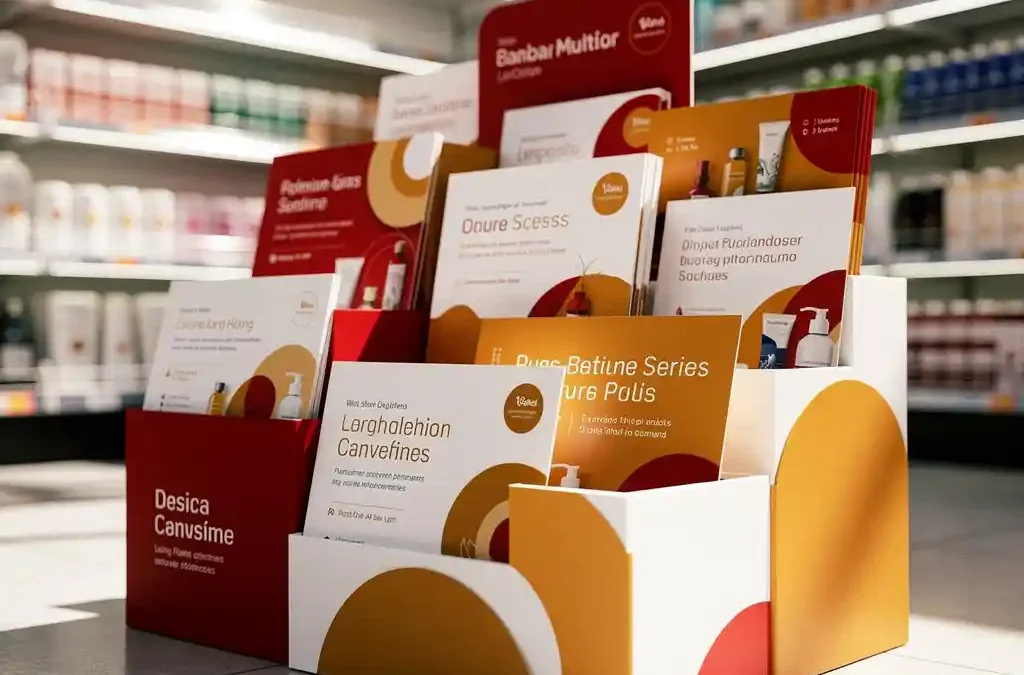
Point-of-sale materials stand out in a store through a combination of eye-catching size, a clear message, and strategic placement at the right moment in the customer journey. It’s about capturing attention at the precise moment a customer is making a purchase decision. In this article, we answer the most frequently asked questions about effective POS materials, from design to localization. Have questions about the possibilities? Feel free to get in touch and we’ll be happy to help.
What elements make point-of-sale materials effective?
Effective point-of-sale materials combine strong visual hierarchy, a clear message, and high-quality printing. The three pillars are brand recognition, readability from a distance, and a direct call to action that prompts the customer to act. Without these elements, even the most attractive display fades into the background.
Visual hierarchy means the customer’s eye is guided automatically: first to the product or offer, then to the price or benefit, and finally to the action you want them to take. Use contrasting colors that align with your brand identity while also standing out in a busy retail environment.
Print quality plays a bigger role than many brands realize. Faded colors, cheap paper, or blurry images subconsciously signal that a brand is less trustworthy. High-quality printing solutions ensure the message comes across professionally, whether it’s a small shelf card or a large freestanding display.
Where in the store does POS material have the greatest impact?
POS materials have the greatest impact in locations where customers naturally pause or make a decision: at the entrance, along the main route through the store, on the shelf directly next to the product, and at the checkout. These are the so-called “decision points,” where attention is at its highest and the likelihood of conversion is greatest.
A store entrance is ideal for branding and introducing a campaign. Every customer sees your message here, but purchase intent is still low. Shelf displays and shelf talkers work better at the moment of choice, right next to the product. At the checkout, impulse purchases are most likely, making compact displays with an attractive offer a smart investment.
Consider the traffic flow as well. Customers follow a predictable path in most stores. Displays positioned at corners or at the end of aisles catch the eye at the moment customers glance up. These are valuable positions for new products or promotions that deserve extra attention.
What size works best for point-of-sale displays?
The best size for a point-of-sale display depends on the available space, the communication objective, and the type of product. Freestanding displays work well for product launches and seasonal promotions, while shelf talkers and wobblers are effective for price communication and product benefits directly on the shelf.
- Freestanding displays: Suitable for large campaigns, new products, or premium positioning. They create their own space in the store and are visible from a distance.
- Shelf talkers and wobblers: Compact and cost-efficient. They guide the customer at the moment of the actual product selection.
- Floor stickers and banners: Ideal for directing customers through the store or marking promotional areas.
- Countertop displays: Perfect for the checkout, suited for small products and impulse purchases.
For large-scale campaigns or trade show materials, larger formats deliver more impact. We produce everything from small shelf cards to large exhibition displays, always tailored to the client’s budget and timeline.
How do you make the text on POS materials immediately compelling?
Text on point-of-sale materials is immediately compelling when it is short, concrete, and customer-focused. The message must be clear within two seconds. Use active verbs, highlight the benefit for the customer, and avoid jargon or long sentences that slow the reader down.
A proven approach is the so-called “benefit over feature” structure. Instead of “New size 500 ml,” you write “50% more for the same price.” The customer wants to know what’s in it for them, not what the product technically is. This applies to both promotional copy and informational displays.
Font size and readability are just as important as the content of the text. A powerful message printed too small loses its impact. Make sure the main message is readable from at least the distance at which a customer first sees the display. For shelf displays, that’s often 3 to 6 feet; for freestanding displays, it can be 10 to 16 feet.
When is it worth localizing POS materials?
It is worth localizing POS materials as soon as you deploy them in a market with a different language, culture, or regulatory environment. Localization goes beyond translation: it means adapting the message, tone of voice, and sometimes even the visual elements so they resonate with the local audience.
In a European context, localizing POS materials is almost always necessary. A campaign that works well in the Netherlands may require a different tone in Germany or Spain. Direct translations can sometimes sound unnatural or lack the cultural nuance that makes a message credible. Local customers notice this difference, even if they don’t consciously articulate it.
From a practical standpoint, it’s smart to integrate localization early in the production process. When translation, layout, and printing are handled by a single partner, you avoid the delays and errors that arise from passing files between multiple vendors. We offer a complete solution in which translation, DTP, and printing flow seamlessly together, ensuring localized materials reach the market quickly and without errors.
Ready to take your point-of-sale materials to the next level? Get in touch and we’ll be happy to discuss which solution best fits your brand and market.
Frequently Asked Questions
How long does it typically take to produce and deliver POS materials?
Lead times for POS materials vary depending on the type of material, the complexity of the design, and whether localization is required. For standard shelf displays and shelf talkers, you can expect a production time of 5 to 10 business days after approval of the print-ready file. For large-scale campaigns involving multiple languages or formats, it’s advisable to allow 3 to 4 weeks, providing sufficient time for revisions, translation, and quality control.
What are the most common mistakes when designing POS materials?
One of the most frequent mistakes is overloading the display with too much information, causing the core message to get lost. Other common pitfalls include using fonts that are too small, colors that don’t contrast with the retail environment, and the absence of a clear call to action. Always make sure your design is tested at the actual viewing distance, so you can be confident the message comes across as intended.
How do I determine which type of POS material best suits my campaign objective?
Start by defining your primary goal: is it brand awareness, a product launch, a price promotion, or driving impulse purchases? Branding and launch campaigns benefit from eye-catching freestanding displays or large banners, while price promotions work best with shelf talkers or wobblers placed directly on the shelf. Discuss your objective with a specialized production partner so that the format, material, and placement strategy are optimally aligned.
Can I easily adapt existing POS materials for a new market or campaign?
Yes, provided the original materials were created in editable files with sufficient margin for text changes and visual adjustments. It’s advisable to plan for future localization from the very first production run by keeping text and image layers separate in the design. When translation, DTP adjustments, and reprinting are handled by a single partner, adapting existing materials for a new market becomes significantly faster and less prone to errors.
Which materials and finishes are most durable for POS displays?
For POS materials intended for long-term in-store use, options such as laminated cardboard, PVC foam board, or aluminum composite are the most durable choices. Laminate coatings protect the print from dirt, moisture, and wear, significantly extending the lifespan of the display. Discuss with your print partner which finish suits the intended usage period and environment, so you don’t over-invest in heavy-duty materials for short-term promotions.
How do I measure the effectiveness of my POS materials after a campaign?
You can measure the effectiveness of POS materials by comparing sales data from periods with and without the materials at a specific location, combined with observations of customer behavior in the store. Additionally, mystery shopper studies and customer surveys provide insight into how the materials are perceived and whether the message is landing. For a more precise picture, you can run A/B tests by deploying different formats or copy variants in comparable stores and analyzing the results.
Is it cost-effective to produce POS materials in small print runs, for example for a regional promotion?
Small print runs are certainly cost-effective, especially when working with a production partner that offers flexibility on minimum order quantities and provides digital printing. Digital printing makes it possible to produce short runs cost-efficiently without the high setup costs associated with offset printing. This is ideal for regional campaigns, test markets, or seasonal promotions where you need to move quickly without building up large inventories.