
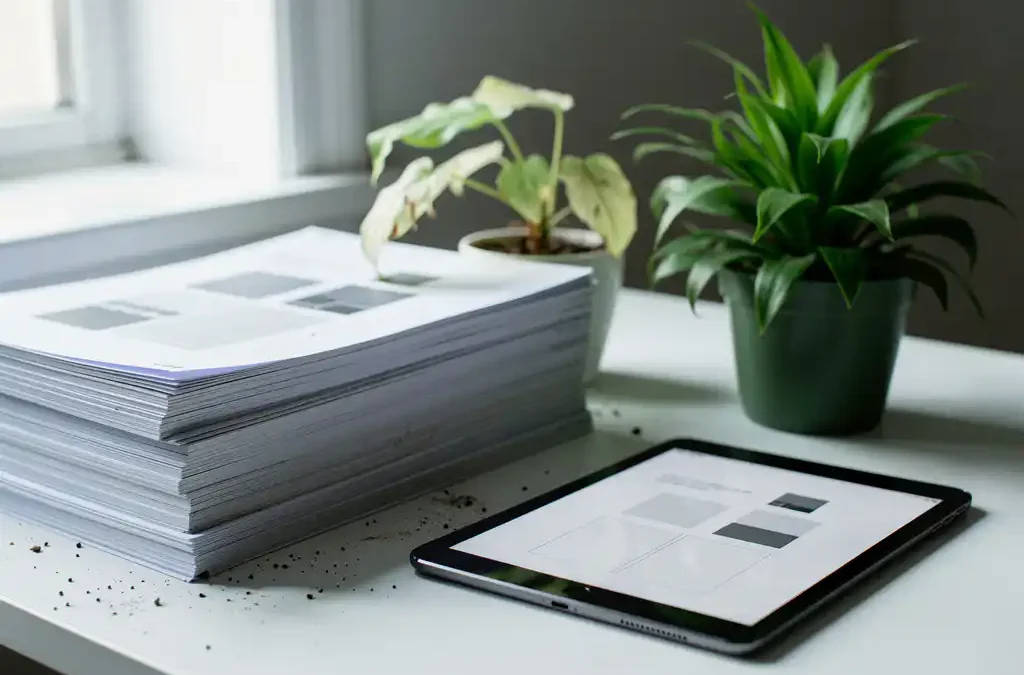
Printing manuals is generally more harmful to the environment than offering them digitally, but the difference is more nuanced than it appears. Printed manuals consume paper, ink, and energy during production and transport, while digital versions require energy for servers, devices, and data storage. The most sustainable choice depends heavily on how, how often, and by whom a manual is used. In this article, we answer the most frequently asked questions on this topic so you can make an informed decision. Do you have questions about your specific situation? Feel free to contact us — we’re happy to help.
How much CO₂ does printing a manual actually emit?
The CO₂ emissions of a printed manual depend on factors such as the number of pages, paper type, print run, and transportation. An average 20-page A5 manual printed in black and white via offset printing can easily emit several hundred grams of CO₂ per copy, including paper production and distribution. For large print runs, total emissions add up significantly.
Paper production accounts for the largest share of the environmental impact of printed materials. Extracting wood pulp, bleaching paper, and drying it all require large amounts of energy and water. On top of that come ink production, the printing process itself, and the logistics from printer to end user. When manuals are shipped internationally, transport emissions increase further.
One factor that is often underestimated is waste. If part of a print run goes unused — for example because products are updated or return flows are incomplete — the environmental impact per manual actually read becomes even higher. Smart inventory management and print-on-demand can significantly reduce this problem.
What is the environmental impact of digital manuals?
Digital manuals also have an environmental footprint, but it is generally lower than that of printed versions. The main sources of emissions are the energy servers consume for storage and distribution, the energy used by the devices on which users access the manual, and the production of those devices themselves.
A PDF offered through a website consumes a small amount of server energy with each download. That may sound negligible, but across millions of downloads it adds up. Even so, emissions per consultation remain significantly lower in most cases than for a printed copy — especially when the digital infrastructure runs on renewable energy.
What makes digital manuals even more sustainable is that they can be updated easily without printing and shipping new copies. A product update simply means uploading a new version, whereas printed manuals would need to be partially or fully replaced.
What factors determine which option is more sustainable?
Whether a printed or digital manual is more sustainable depends on several variables: print run size, the usage patterns of the target audience, the lifespan of the manual, and the source of the energy used. There is no universal answer, but there are clear guidelines.
- Print run size: Small print runs have a higher environmental impact per copy with offset printing. Digital printing or going fully digital is often the more sustainable choice in these cases.
- Usage frequency: A manual consulted only once carries a lighter digital footprint than one used regularly and downloaded or streamed multiple times.
- Target audience and accessibility: In regions with limited internet access, or for users who are less digitally literate, a printed manual may in practice be the more sustainable option because digital alternatives are used less effectively.
- Update frequency: Products that are regularly updated make printed manuals obsolete more quickly, increasing the risk of waste.
- Paper and ink type: Recycled paper and plant-based inks significantly reduce the environmental impact of printed manuals.
How can companies reduce the environmental impact of printed manuals?
Companies that need printed manuals can structurally reduce their environmental impact in several ways. The most effective approach combines smart production decisions with a well-thought-out distribution process.
First, switching to FSC-certified or recycled paper helps. This type of paper has a lower CO₂ footprint than standard wood pulp and supports responsible forest management. Combined with plant-based or water-based inks, the environmental impact of the printing process decreases noticeably.
Second, print-on-demand is a powerful way to prevent waste. Rather than building up large inventories that may never be used, manuals are only printed when there is actual demand for them. At our print solutions, we offer both offset printing for larger runs and digital printing for smaller quantities, tailored to your needs and sustainability goals.
Third, distribution plays a major role. Printing locally in the region where the manual will be used reduces transport emissions. A partner that combines translation, printing, and fulfillment under one roof shortens the logistics chain and thereby lowers emissions per end product.
When is a hybrid approach the most sustainable choice?
A hybrid approach — combining a concise printed manual with a comprehensive digital version — is in many situations the most sustainable and practical choice. This model significantly reduces paper consumption while still meeting the need for tangible documentation for users who prefer it.
In practice, this often means a small printed quick-start guide or safety instructions included with the product, supplemented by a full digital manual accessible via a QR code or web link. This way, users benefit from the advantages of both formats while the overall environmental impact remains lower than that of a fully printed manual.
The hybrid approach is also commercially attractive. Less print work means lower production costs, while the digital version can be updated easily without additional printing expenses. For companies operating across multiple languages and markets, this model also offers flexibility: the digital manual can be quickly localized and updated, while the printed component remains compact and cost-efficient.
Want to know which approach best suits your product and target audience? Contact us and we’ll be happy to think through a solution with you that is both sustainable and practical.
Frequently Asked Questions
How do I get started with switching from printed to digital manuals?
Start with an audit of your current manuals: how many copies are being printed, how many go unused, and how often are they updated? Based on that, you can prioritize which manuals are most suitable for digitization. A good first step is offering a PDF via a QR code on the packaging, so you can immediately reduce your print run without compromising the user experience.
What if my target audience isn't digitally literate — should I still choose print?
Not necessarily. In that case, a hybrid approach is often the best solution: a concise printed basic manual for immediate usability, supplemented by a digital version for those who prefer it. This way you serve both user groups without consuming unnecessarily large amounts of paper. It’s also worth exploring whether digital accessibility in your target market can be improved — for example through simple QR codes linking to mobile-friendly pages.
What common mistakes should I avoid when making my manuals more sustainable?
A common mistake is switching entirely to digital without considering the target audience, which leads to a poor user experience and ultimately more inquiries and returns. Another pitfall is printing large runs ‘just in case,’ when print-on-demand is in many cases both cheaper and more sustainable. Don’t forget to factor in update frequency as well: a printed manual for a product that is regularly updated quickly becomes outdated and creates unnecessary waste.
Does FSC certification really count as a sustainability measure, or is it mostly marketing?
FSC certification is a recognized and independently audited standard that guarantees responsible forest management, so it is certainly more than just marketing. It means that the wood used comes from forests managed in a way that respects biodiversity, labor rights, and reforestation. Combined with recycled paper and plant-based inks, FSC-certified printing delivers a measurably lower environmental impact compared to conventional printing.
How do I measure the actual CO₂ savings from switching to a more sustainable manual strategy?
You can calculate CO₂ savings by comparing the emissions of your current situation with those of the new approach, based on factors such as paper consumption, print run size, transport distance, and the energy source of the digital infrastructure. Many printers and digital platforms now offer CO₂ reporting or carbon footprint calculators. For an accurate comparison, it is advisable to commission a lifecycle assessment (LCA), especially if sustainability reporting is a requirement within your organization or sector.
Can I dispose of existing printed manuals more sustainably if they've already been produced?
Yes, there are more sustainable options even for manuals that have already been printed. First and foremost, ensure that unused copies are collected and recycled through the appropriate paper stream. Prevent outdated versions from being discarded by setting up smart return logistics. Additionally, consider making all future updates digital only, and limiting the printed version to information that rarely changes, such as safety instructions.
Is local printing always more sustainable than central printing and international shipping?
In most cases yes, but it depends on the scale and the printing infrastructure available locally. Local printing eliminates long-distance transport emissions, which can be substantial for international shipments by air or sea freight. However, if a local printer uses less efficient equipment or lacks access to sustainable paper and ink options, the advantage may be partially offset. A partner that combines local production with standardized sustainability standards generally offers the best balance.
Related Articles
- What is the role of DTP in preparing print-ready files?
- How does the proofreading process work for multilingual print materials?
- Do I need to have translated PDF manuals available for the countries I export to?
- How do I create one source of documentation that works across all my product versions?
- How do you automate software localisation processes?