
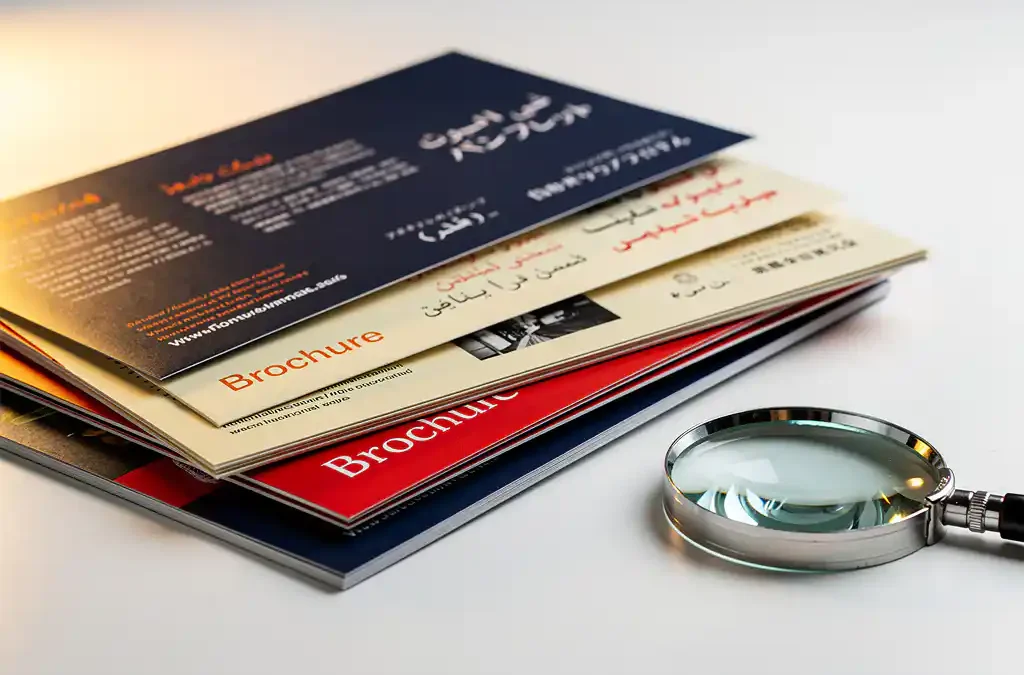
To find a reliable printing partner for multilingual marketing materials, look for a provider that combines in-house translation, localisation, and print production under one roof. The most dependable partners hold quality certifications, work with native-language specialists, and have demonstrated experience across multiple languages and markets. This article walks through the key qualities, red flags, and questions that help you make a confident choice.
If you are already evaluating options, our translation and localisation services page gives a clear overview of how we approach multilingual print projects from first word to finished product.
What qualities separate a reliable multilingual print partner from a standard printer?
A reliable multilingual print partner combines linguistic expertise with production capability, whereas a standard printer only handles the physical output. The key differentiator is whether the partner understands how language affects layout, text expansion, reading direction, and cultural context before a single sheet goes to press. Without that understanding, costly reprints and brand inconsistencies are almost inevitable.
Beyond technical skill, reliability shows up in process. Look for partners who follow structured workflows, assign approved translators to each language pair, and use native speakers rather than general-purpose translators. A partner worth trusting will also hold recognised quality certifications such as ISO 9001, which signals that their processes are audited and consistently applied rather than improvised project by project.
Cultural sensitivity is another quality that separates the best from the rest. Colours, imagery, and phrasing that work well in one market can carry unintended meanings in another. A partner with genuine localisation experience will flag these issues proactively rather than waiting for a client to spot them after delivery.
Why does DTP matter when printing multilingual marketing materials?
Desktop publishing, or DTP, matters in multilingual print because translated text rarely fits the original layout. German text, for example, can run 30 percent longer than its English source, while Arabic and Hebrew require right-to-left formatting that completely restructures a page. Without skilled DTP work between translation and print, the finished piece looks unprofessional or, worse, becomes unreadable.
DTP specialists who work alongside translators can adapt spacing, font choices, text boxes, and visual hierarchy so that each language version looks as intentional as the original. This is not simply a cosmetic concern. Marketing materials that look poorly assembled undermine brand credibility in the very markets you are trying to reach.
When translation and DTP are handled by the same team or tightly integrated partners, feedback loops are shorter, errors are caught earlier, and the overall production timeline shrinks. Separating these steps between different vendors almost always introduces delays, miscommunication, and additional rounds of revision.
What should you check before signing a contract with a print partner?
Before signing a contract with a multilingual print partner, verify their language coverage, quality certifications, and experience with your specific industry. A partner who handles 20 languages confidently is not automatically equipped to handle 60, and a partner experienced in consumer brochures may not understand the precision required for technical documentation or regulated industries.
Specifically, check the following before committing:
- Language coverage: Do they cover all the markets you need, including less common European, Middle Eastern, or Asian languages?
- Certification status: Do they hold ISO 9001 for quality management and ISO 27001 for information security? These are especially important if your materials contain proprietary or sensitive content.
- Translator qualifications: Do they use native speakers as standard, or do they rely on non-native translators for cost savings?
- In-house DTP capability: Is layout work done internally alongside translation, or outsourced to a third party?
- Print and fulfilment integration: Can they manage inventory, kitting, and distribution, or do they hand off after translation?
- Revision and approval process: How are client reviews structured, and what happens if errors are found after print?
Asking to see examples of completed multilingual projects in your sector is always a reasonable request. A confident partner will welcome it.
How does a one-stop translation and printing service save time and cost?
A one-stop translation and printing service saves time and cost by eliminating the handoff friction between separate vendors. When translation, DTP, and print production all happen within the same workflow, there are fewer briefings to manage, fewer files to transfer, and fewer opportunities for errors to slip through the gaps. Each additional vendor in a chain adds coordination overhead and a potential point of failure.
The financial savings are both direct and indirect. Direct savings come from consolidated pricing and the removal of duplicate project management fees. Indirect savings come from faster turnaround, which reduces the cost of delayed campaigns, and from fewer reprints caused by layout errors that a siloed process would have missed.
For companies running campaigns across multiple markets simultaneously, the time advantage is particularly significant. A single partner who understands the full scope of a project can schedule translation, layout, and print in parallel rather than in sequence, compressing timelines that might otherwise stretch across weeks. When fulfilment and inventory management are also included, the entire supply chain from source text to delivered printed materials sits under one accountable relationship.
What questions should you ask a potential multilingual print partner?
The right questions reveal whether a multilingual print partner genuinely has the capability they claim or whether they rely on subcontractors and workarounds that introduce risk. Start by asking how they handle the languages you specifically need, who does the translation work, and how quality is checked at each stage.
Here are the most useful questions to ask during an evaluation:
- How many languages do you support in-house, and which do you subcontract? Understanding this tells you where accountability is strongest and where it may be diluted.
- Do you use native translators for every language? Native-speaker localisation is the industry standard for marketing content, where tone and cultural nuance matter as much as accuracy.
- How is DTP handled, and is it integrated with your translation workflow? The answer reveals whether layout is treated as part of localisation or as an afterthought.
- What certifications do you hold, and when were they last renewed? Current ISO 9001 and ISO 27001 certifications provide independent assurance of process quality and data security.
- Can you manage print, kitting, and fulfilment as well as translation? This question identifies whether the partner can genuinely simplify your supply chain or only part of it.
- What does your revision process look like if we find an error after files go to print? How a partner answers this question tells you a great deal about how they handle accountability.
A strong partner will answer these questions with specifics rather than generalities, and they will not hesitate to point you toward references or sample work. If you are ready to explore what a fully integrated multilingual print solution looks like for your business, request a quote or get in touch with us directly, and we will be happy to walk you through the options.
Frequently Asked Questions
How do I know if a multilingual print partner is genuinely handling my project in-house versus outsourcing it to subcontractors?
Ask directly which languages and services are handled by their own staff and which are passed to third parties — a trustworthy partner will answer this without hesitation. You can also request a walkthrough of their production workflow and ask to see the physical or digital environment where translation and DTP work takes place. If answers are vague or the partner avoids specifics about their team structure, treat that as a strong signal that accountability may be diluted across multiple unnamed subcontractors.
What are the most common mistakes companies make when sourcing multilingual print for the first time?
The most frequent mistake is treating translation as the last step rather than an integral part of the design and production process, which almost always leads to layout problems, reprints, and delays. Another common error is choosing a partner based on price alone without verifying language coverage, translator qualifications, or DTP capability — savings at the quoting stage are quickly lost through revision cycles and missed campaign deadlines. Finally, many first-time buyers underestimate how much cultural localisation matters, assuming a direct translation is sufficient when imagery, colour choices, and phrasing may need to be adapted for each target market.
How far in advance should we brief a multilingual print partner before a campaign launch?
As a general rule, the more languages and markets involved, the earlier you should begin — for campaigns spanning five or more languages, briefing your partner six to eight weeks before your intended launch date gives adequate time for translation, DTP, client review, print production, and fulfilment. For smaller projects covering two or three languages with straightforward layouts, a three to four week lead time is often workable, though this depends on print quantities and distribution requirements. The safest approach is to discuss your specific timeline with your partner at the briefing stage so that any bottlenecks can be identified and planned around before they become problems.
Can a multilingual print partner handle materials in languages that use non-Latin scripts, such as Arabic, Japanese, or Chinese?
Yes, but not all partners have genuine in-house capability for complex scripts — this is exactly the kind of detail you should verify before signing a contract. Non-Latin scripts introduce specific DTP challenges including right-to-left text flow for Arabic and Hebrew, character-based typesetting for Chinese and Japanese, and font licensing requirements that differ from standard Latin typefaces. When evaluating a partner for these languages, ask to see completed print samples and confirm that native-speaking translators and script-specialist DTP operators are part of their regular workflow rather than brought in on an ad hoc basis.
What happens if an error is discovered after the materials have already been printed?
How a partner handles post-print errors is one of the clearest indicators of their accountability and process maturity, which is why it is worth asking about this scenario explicitly before you commit. A reputable partner will have a clearly defined revision and escalation process, will acknowledge errors transparently, and will work with you to determine the fastest and most cost-effective resolution — whether that means a partial reprint, an insert correction, or another agreed remedy. Partners who hold ISO 9001 certification are required to document non-conformances and corrective actions, which provides an additional layer of assurance that errors are treated as process improvements rather than one-off incidents to be quietly managed.
Is it worth using a multilingual print partner for a small project, or does the integrated approach only make sense at scale?
An integrated partner adds value even on smaller projects, primarily because the risk of layout errors, cultural missteps, and vendor miscommunication does not scale down proportionally with project size — a poorly localised brochure in a single market can still damage brand credibility. That said, if your project involves only one or two languages and a simple layout, the efficiency gains are more modest than they would be for a large multi-market campaign. The most practical approach is to discuss your project scope openly with a potential partner; a good one will give you an honest assessment of where their integrated model delivers the clearest return for your specific situation.
How should we manage brand consistency across multiple language versions of the same printed material?
Brand consistency across language versions starts with providing your print partner with a comprehensive set of brand assets and guidelines upfront — including approved colour values, typefaces, logo usage rules, and any market-specific variations already in use. Partners who work with translation memory tools and style guides can ensure that approved terminology, tone of voice, and brand language are applied consistently across all language versions rather than being re-interpreted from scratch each time. It is also worth building a client review stage into the workflow for each language version before files go to print, ideally involving a reviewer who is a native speaker of the target language and familiar with your brand standards.
Related Articles
- What is DTP and do I need it after translation?
- What information is mandatory on printed product labels for the European market?
- Can I print small runs of my product manuals per target market?
- Do my manuals need to be translated into all European languages?
- Should I write my own technical manual or hire someone?