
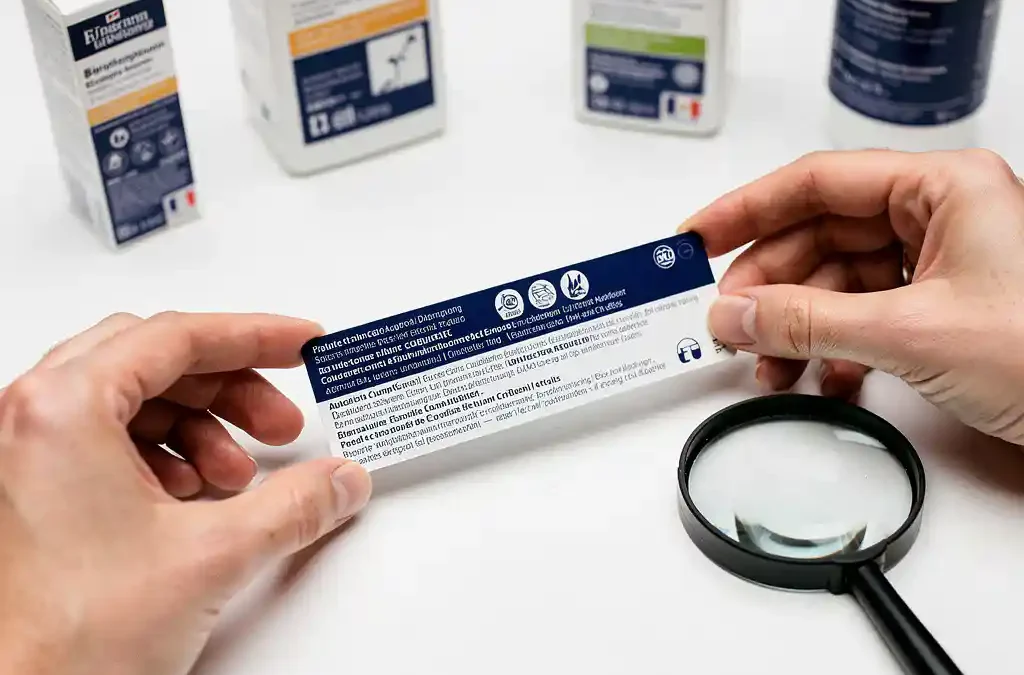
Printed product labels for the European market are required to include a number of key details, such as the name and address of the responsible party, the product name, the country of origin, and any relevant safety or usage information. The specific details required depend on the product category and the applicable EU legislation. Do you have questions about how to handle this in practice? Feel free to contact us and we will be happy to help. In this article, we answer the most frequently asked questions about EU labeling requirements, so you know exactly where you stand.
Which EU regulations determine what must appear on product labels?
The content of product labels for the European market is governed by a combination of general EU regulations and product-specific directives. The General Product Safety Regulation (GPSR), which came into force in December 2024, sets the baseline standard for consumer products. In addition, sector-specific rules apply to areas including food, cosmetics, chemicals, and electrical equipment.
The GPSR requires manufacturers and importers to provide clear information on every product identifying the responsible party and any safety risks. For chemical products, the CLP Regulation applies, which mandates specific hazard pictograms and hazard statements. Electrical equipment falls under the Low Voltage Directive and must carry a CE marking.
It is important to recognize that EU regulations are continuously evolving. Additional requirements are expected in 2026 across various areas, particularly around sustainability information and digital product passports. Anyone placing products on the European market would be wise to actively monitor the relevant regulations and make timely adjustments.
What information is mandatory on every product label in the EU?
Although the exact requirements vary by product category, there are several pieces of information that are mandatory on virtually every product label in the EU: the name or trade name of the manufacturer or importer, a contact address, the product name or description, the country of origin, and any safety warnings relevant to the product’s use.
In practical terms, this means that a consumer must always be able to identify who is responsible for the product and how to reach them based on the label alone. This is a direct requirement of the GPSR. In addition, the label must be legible, durably affixed to the product or packaging, and the information must be understandable to the end user.
For products sold online, additional rules apply: the mandatory label information must also be visible in digital product listings before the consumer makes a purchase. A label is therefore not merely a physical document, but also a legal instrument that establishes the liability of the producer.
Do labeling requirements differ by product category?
Yes, labeling requirements differ significantly by product category. The general EU rules establish a baseline standard, but specific product groups are subject to additional or deviating obligations set out in sector-specific legislation.
Food and beverages
Food products are governed by Regulation (EU) No. 1169/2011 on the provision of food information to consumers. This requires, among other things, a full list of ingredients, allergen information, nutritional values, the net quantity, the best-before or use-by date, and storage instructions. The name and address of the food business operator are also mandatory.
Cosmetics and chemical products
Cosmetic products fall under the EU Cosmetics Regulation and must include, among other things, the ingredient list (INCI names), the name of the responsible person, the product’s function, and a minimum durability date. Chemical products are subject to the CLP Regulation, which mandates standardized hazard pictograms, signal words, and safety recommendations.
In which languages must product labels be written?
Product labels must be written in the official language or languages of the country or countries where the product is placed on the market. This means that a product sold in multiple EU member states must carry a label containing all relevant languages, or a separate label must be used for each market.
In practice, many manufacturers opt for multilingual labels to reduce costs and simplify logistics. This is permitted, provided that all mandatory information is present in the required languages and legibility is maintained. A label that is overly crowded with text in ten languages can compromise readability, which in itself may constitute a violation.
Accurate translation is essential in this regard. An incorrect translation of a safety warning or an allergen declaration can not only lead to legal problems, but also to serious risks for the consumer. Professional translation by native speakers with sector expertise is therefore not a luxury, but a necessity.
What are the consequences of incorrect or incomplete labels?
Incorrect or incomplete product labels can lead to serious legal and commercial consequences. Market surveillance authorities in EU member states can remove products from the market, impose fines, or demand a product recall. In serious cases, the responsible party may face criminal liability.
Beyond the direct legal risks, there is also the damage to reputation and financial losses. A product recall not only costs money, but also erodes the trust of consumers and retailers. In sectors such as food, cosmetics, and chemicals, regulators are particularly active and carry out inspections on a regular basis.
It is also important to know that importers within the EU share responsibility for the accuracy of labeling. If a product from outside the EU does not comply with EU labeling requirements, the importer is liable — not just the foreign manufacturer. This makes thorough label checks at the point of import an absolute priority.
How do you ensure your labels remain compliant when expanding into new markets?
Keeping labels compliant when expanding into new European markets requires a structured approach: map out the applicable labeling requirements for each target market, arrange professional translations in the required languages, and establish an internal process for reviewing labels whenever regulations or product information change.
A practical first step is to create a label matrix for each market, tracking which languages and mandatory elements apply per country. This prevents you from reinventing the wheel with every new market entry. Combine this with a fixed review process in which labels are checked whenever products change, new regulations are introduced, or a new market is entered.
Working with a partner that combines translation, printing, and production under one roof significantly reduces lead times and minimizes the risk of coordination errors. We offer an integrated approach in which translation, layout, and printing are seamlessly aligned, ensuring your labels always meet current requirements and reach the market on time. Contact us to find out how we can guide your labeling process from start to finish.
Frequently Asked Questions
Do I need to reprint my product labels when EU regulations change?
Not always immediately, but you are required to update your labels once new regulations come into force. When designing labels, it is wise to take planned regulatory changes into account so you do not incur unnecessary costs from interim reprints. Keep a close eye on publications from the European Commission and schedule an annual label review as a fixed part of your compliance process.
What is a digital product passport, and do I need to account for it now?
A digital product passport is a digital data source containing comprehensive information about a product — such as sustainability and recycling data — made accessible via a QR code or NFC tag on the label. The EU is introducing this instrument in phases from 2026 onwards as part of the Green Deal and the Ecodesign Regulation, starting with sectors such as textiles and electronics. It is advisable to investigate now whether your product category falls within the first rollout groups, so you can prepare in good time.
How do I know which hazard pictograms are required for my chemical product?
The mandatory hazard pictograms for chemical products are determined based on the classification of your substance or mixture under the CLP Regulation (EC No. 1272/2008). You classify the product according to its physical, health, and environmental hazards, after which the corresponding GHS pictograms, signal words, and hazard statements follow automatically. If you are unsure about the correct classification, you can have a Safety Data Sheet (SDS) drawn up by a specialized agency or consult the ECHA databases.
Can I replace mandatory label information with a QR code to save space on the label?
No, mandatory label information cannot in most cases be replaced by a QR code or any other digital reference. EU regulations require that essential information — such as safety warnings, ingredients, and contact details — be directly readable on the physical label without requiring any additional action from the consumer. QR codes may be used as a supplementary channel for additional information, but they do not replace legally required disclosures.
What should I do if I import a product from outside the EU and the label does not meet EU requirements?
As the importer, you are the responsible party for the EU market and bear full liability for the accuracy of the labeling, regardless of what the foreign manufacturer has supplied. You are required to update the label before the product is placed on the market, which in practice means having a new compliant label designed, translated, and applied. Make clear agreements with your supplier on this matter and include label compliance as a standard clause in your purchasing contracts to avoid delays and additional costs.
How do I handle small packaging where not all mandatory information fits?
For small packaging, EU regulations in some cases provide limited exemptions, whereby a selection of the most critical information appears on the label and additional details are made available via a package insert or QR code. Which exemptions apply depends heavily on the product category: cosmetics and medicinal products, for example, have specific rules governing minimum disclosures on small packaging. Consult the sector-specific regulation for your product category or engage a compliance specialist to determine what is the minimum required on the label itself.
What common mistakes should I avoid when creating multilingual labels?
The most common mistakes with multilingual labels are: using machine translation for safety-critical information, omitting mandatory disclosures in one or more languages, and using a font size that is too small due to space constraints, which compromises legibility. Also ensure that the translation is not only linguistically correct, but also aligned with the sector-specific terminology commonly used in the target country. Always work with professional translators who are familiar with both the language and the regulations of the relevant market.
Related Articles
- What is the role of DTP in preparing print-ready files?
- What EU safety documentation is required before I can sell a machine in Europe?
- How do you manage software localisation for multiple markets?
- How does mobile localisation differ from web software?
- What is localisation testing and why is it important?