
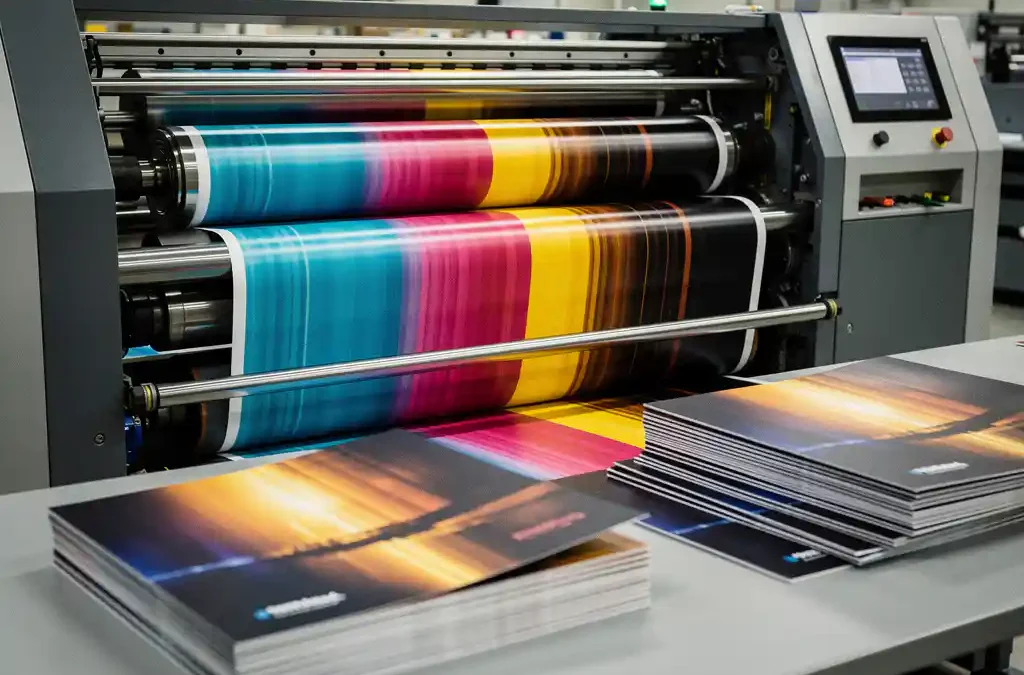
The most important difference between digital printing and offset printing for large print runs lies in the cost structure: offset printing becomes significantly cheaper per unit at higher quantities, while digital printing is more economical for small to medium print runs. The break-even point typically falls somewhere between 500 and 1,000 copies, depending on the size, number of colors, and finishing. In this article, we answer the most frequently asked questions about both printing techniques, so you can make the right choice for every situation. Do you have questions about your specific situation? Feel free to contact us and we’ll be happy to help.
When does offset printing become cheaper than digital printing?
Offset printing becomes cheaper than digital printing once the print run is large enough to offset the high setup costs. With offset printing, the preparation costs — such as making printing plates and setting up the press — are relatively high. But once the press is running, the cost per additional copy is very low. In practice, the break-even point is usually between 500 and 1,000 copies.
With digital printing, there are no setup costs for plates or press configuration. Each copy costs virtually the same, regardless of the print run. This makes digital printing ideal for smaller quantities, but relatively more expensive as the print run increases. For a print run of 5,000 or more copies, offset printing is in most cases the more cost-efficient choice.
The exact break-even point varies by project. Factors such as the number of pages, size, paper weight, and finishing all play a role. A full-color brochure in a large format reaches the break-even point sooner than a simple black-and-white document.
What are the quality differences between the two printing techniques?
Offset printing traditionally delivers higher and more consistent print quality than digital printing, particularly for large print runs. The inks are transferred directly onto the paper via an offset plate, resulting in sharp lines, rich colors, and excellent color consistency across thousands of copies. However, digital printing has made enormous strides in recent years and offers comparable quality for many applications.
Color accuracy and consistency
With offset printing, Pantone colors and special inks are easy to apply, which is essential for brand identity and corporate identity materials. Color reproduction also remains stable throughout the entire print run. With digital printing, slight color variations can occur between batches, although modern digital presses have become increasingly better at maintaining color consistency.
Paper and finishing
Offset printing is compatible with a wider range of paper types and finishes, including uncoated paper with a rough texture or specialty cardstock. Digital presses work best with coated paper types and sometimes have limitations with heavy or uncoated materials. For premium print work with special finishes such as embossing or foil, offset printing remains the preferred technique.
How does turnaround time differ between digital and offset printing?
Digital printing has a shorter turnaround time than offset printing, because no startup procedure involving plates or press setup is required. A digital print order can often be delivered within one to three business days. Offset printing requires more preparation time, meaning the turnaround is typically five to ten business days, depending on the complexity of the job.
For time-sensitive projects, such as last-minute marketing campaigns or product launches, digital printing is therefore the logical choice. Offset printing requires more lead time, but delivers a better price-to-quality ratio for large print runs. For well-planned projects with sufficient lead time, the advantages of offset printing carry more weight.
We seamlessly integrate printing, translation, and DTP processes into a single workflow, significantly reducing the total turnaround time for multilingual print projects. Want to learn more about our approach? Visit our printing services.
Which printing technique is better for variable data and personalization?
Digital printing is the best choice for variable data and personalization. With digital printing, each copy can contain unique information — such as a name, address, personalized offer, or QR code — without incurring additional costs or delays. This makes it ideal for personalized direct mail, personalized brochures, and variable product labels.
Offset printing is not suitable for this purpose. Every change in content requires a new printing plate, making the cost of personalization with offset printing prohibitive. For campaigns where each recipient receives a customized copy, digital printing is the only practical option.
The combination of variable data with professional layout and high print speeds also makes digital printing attractive for the retail sector, where promotional materials are regularly updated with new prices, offers, or seasonal content.
When should you choose digital printing for large print runs?
Digital printing for large print runs makes sense when the content changes frequently, when personalization is required, or when turnaround time is critical. Even at higher quantities, digital printing may be preferable if the cost of outdated materials or the risks of holding large inventory outweigh the price advantage of offset.
A good example is technical documentation for products that is updated frequently. Printing large quantities via offset can mean that some of the material is already outdated before it is used. Digital printing on demand — also known as print-on-demand — prevents this problem and reduces waste.
For multilingual projects, digital printing at larger quantities can also be an attractive option. When content differs per language but the print run per language version is limited, digital printing per language variant is more efficient than setting up multiple offset presses for each version separately.
What are the environmental considerations when choosing between the two techniques?
From an environmental perspective, digital printing for smaller print runs typically has a lower ecological footprint than offset printing, as there are no chemical printing plates, less ink waste, and less paper waste during the startup phase. For large print runs, the difference narrows and offset printing can actually be more efficient due to its lower ink consumption per page.
Offset printing requires the use of printing plates and solvents for cleaning the press, which carries an environmental impact. However, modern offset presses have become increasingly cleaner, with water-based inks and improved waste management. Digital presses use less water and produce less chemical waste, but sometimes consume more energy per printed page.
Another relevant environmental factor is inventory. Printing large quantities that remain partially unused and are ultimately discarded is always a waste of materials and energy, regardless of the printing technique. Print-on-demand via digital printing aligns better with a sustainable documentation strategy, where only what is actually needed is printed.
The right choice between digital printing and offset printing therefore depends on print run, quality requirements, turnaround time, personalization needs, and sustainability goals. Want to find out which approach best suits your project? Contact us and we’ll be glad to think it through with you.
Frequently Asked Questions
How do I request a quote for a print project and what do I need for that?
To receive an accurate quote, it helps to have the following information on hand: the desired print run, the size, the number of pages, the color setup (full color or black and white), the paper type, and any finishing requirements such as stapling, gluing, or laminating. The more details you provide, the more targeted the advice you’ll receive. At Crestec, you can easily request a quote through our contact form, and we’ll actively help you determine the most suitable printing technique for your project.
Can I use a combination of digital and offset printing for one project?
Yes, a hybrid approach is certainly possible and can in some cases be the most cost-efficient solution. For example, you can have the base version of a brochure printed in a large offset run and then digitally add a personalized insert or enclosure card per recipient. This combination gives you the best of both worlds: the low unit costs of offset for the static portion and the flexibility of digital printing for the variable content.
What exactly is print-on-demand and what situations is it suitable for?
Print-on-demand means that you only print documents or marketing materials at the moment there is an actual need for them, in the exact quantity required. This is ideal for technical manuals, product catalogs, or training materials that are updated regularly, as it helps you avoid outdated inventory. It is also an excellent choice for companies operating internationally that need multilingual materials in varying quantities per region.
What common mistake should I avoid when choosing between digital and offset printing?
A common mistake is basing the decision solely on the cost per unit, without taking into account the total project costs and the risk of waste. For example, someone who prints 10,000 copies via offset because it is cheaper per unit, but ultimately only uses 4,000 copies, ends up paying more than they would have with a smaller digital print run. Always consider your realistic distribution needs and the shelf life of the content before choosing a print quantity.
How do I ensure my Pantone colors are reproduced correctly with digital printing?
Digital presses cannot always reproduce Pantone colors with the same precision as an offset press, because they use CMYK inks rather than special spot colors. To minimize color deviations, it is important to submit your files with the correct CMYK conversions of your Pantone values and to use an approved color profile. When in doubt, always request a digital proof or a physical proof print before the full run is printed, so you can correct any color differences in time.
Is digital printing also suitable for large formats such as posters or banners?
For standard large formats such as A2 or A1 posters, digital printing is certainly possible and widely available. However, for very large formats such as banners, exhibition walls, or outdoor advertising, wide-format printers are used, which is a separate specialization distinct from traditional digital and offset printing. Get in touch to discuss which technique best suits your format requirements and the intended use of the materials.
How can I keep the turnaround time for a multilingual print project as short as possible?
The key to a short turnaround time for multilingual print projects is integrating translation, DTP, and printing into one streamlined workflow, rather than outsourcing these steps sequentially to different parties. By working with a partner that has all disciplines in-house, handover times and communication delays are kept to a minimum. Also, submit your source files as early as possible and ensure that texts are approved before the DTP phase begins, to avoid time-consuming revision rounds.