
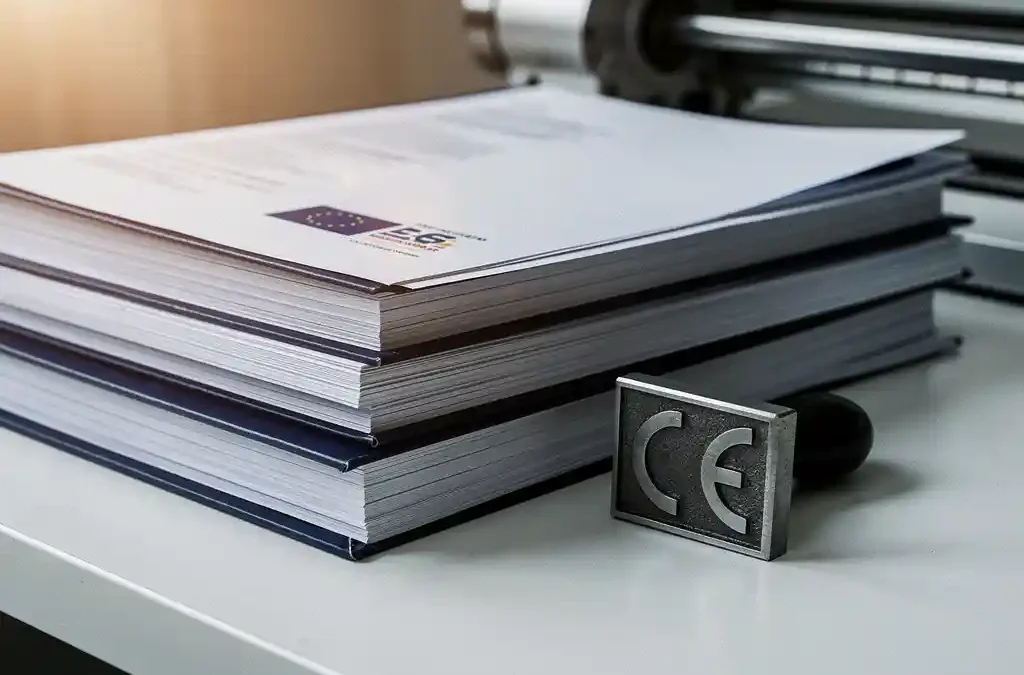
Before you can sell a machine in Europe, EU law requires you to prepare a technical file, draw up a Declaration of Conformity, affix the CE marking, and provide safety documentation in the official language of each country where the machine is placed on the market. These requirements apply to virtually all machinery sold in the EU, whether you are a manufacturer based inside or outside the European Economic Area. The sections below walk through each requirement in detail, from applicable directives to the consequences of non-compliance.
Getting your documentation right is both a legal obligation and a commercial necessity, and professional translation and localisation of that documentation plays a central role in meeting EU market access rules. Here is what you need to know.
Which EU directives and regulations apply to your machine?
The directive or regulation that applies to your machine depends on what the machine does and what risks it presents. For most general machinery, the Machinery Directive 2006/42/EC has been the governing framework, but from January 2027 it will be replaced by the Machinery Regulation (EU) 2023/1230, which introduces stricter requirements for digital and autonomous equipment. Additional legislation may apply in parallel depending on your machine’s characteristics.
Common frameworks that apply alongside or instead of the Machinery Directive include the Low Voltage Directive (2014/35/EU) for electrical equipment, the Electromagnetic Compatibility Directive (2014/30/EU), the ATEX Directive (2014/34/EU) for equipment used in explosive atmospheres, and the Pressure Equipment Directive (2014/68/EU) for pressurised systems. If your machine falls under more than one directive, you must satisfy all of them simultaneously.
Identifying the correct legal framework is the essential first step. Misidentifying the applicable directive means your entire documentation package is built on the wrong foundation, which creates compliance risk at every stage that follows.
What documents make up the required technical file?
The technical file is the complete body of evidence that demonstrates your machine meets all applicable EU safety requirements. It must be compiled before the machine is placed on the market and kept available for at least ten years after the last unit is manufactured. The file does not need to be submitted to authorities upfront, but it must be produced on request.
A complete technical file for machinery typically contains the following elements:
- A general description of the machinery
- Overall drawings and diagrams of circuits
- Detailed drawings and calculation notes, test results, and certificates
- A list of the essential health and safety requirements addressed
- A list of harmonised standards and other technical specifications applied
- A copy of the instructions for use
- A copy of the Declaration of Conformity
- The risk assessment documentation
The risk assessment is particularly important. It must identify all hazards associated with the machine across its entire lifecycle, from installation and operation through to maintenance and disposal, and demonstrate that risks have been reduced to an acceptable level through design, safeguarding, and information measures. Without a thorough risk assessment, the rest of the technical file lacks its evidential foundation.
What is a Declaration of Conformity and when is it required?
A Declaration of Conformity (DoC) is a formal legal document in which the manufacturer declares that the machine meets all applicable EU requirements. It is required for every machine that falls within the scope of a CE marking directive before that machine can be placed on the EU market. The CE mark cannot legally be affixed without it.
The declaration must include the manufacturer’s name and address, a description and identification of the machinery (including serial number or batch number where relevant), a list of all applicable directives, references to the harmonised standards applied, the name and address of any notified body involved, and the signature of an authorised representative. It must be issued in the official language or languages of the country where the machine is sold.
One common misconception is that the DoC is optional for simpler machines. It is not. Every machine within scope requires one, regardless of complexity. What varies is whether an independent notified body must be involved in the conformity assessment process before the declaration can be signed.
When does a machine need a notified body assessment?
A notified body assessment is required when a machine is listed in Annex IV of the Machinery Directive (or the equivalent annex under the incoming Machinery Regulation) and the manufacturer has not applied harmonised standards that fully cover the essential safety requirements. For these higher-risk machine categories, self-certification is not sufficient, and an accredited third party must verify conformity.
Annex IV covers machine types considered to present higher inherent risks, including circular saws, hand-fed surface planing machines, thicknessing machines, band saws, presses, injection or compression moulding machines, underground working machines, and several others. If your machine type appears on this list, you have two options: apply all relevant harmonised standards fully and self-certify, or engage a notified body to conduct either a type examination or a full quality assurance procedure.
For machines not listed in Annex IV, the manufacturer carries out a self-assessment, compiles the technical file, issues the DoC, and affixes the CE mark without third-party involvement. This does not mean the process is informal. The documentation standards are identical; only the involvement of an external assessor differs.
What language must safety documentation be in for the EU market?
Safety documentation, including the instructions for use and the Declaration of Conformity, must be provided in the official language or languages of each EU member state where the machine is sold or put into service. This is a hard legal requirement under the Machinery Directive and the incoming Machinery Regulation. Providing documentation only in English or only in the manufacturer’s home language does not satisfy this obligation across multilingual markets.
In practice, this means that a machine sold in Germany requires German documentation, one sold in France requires French documentation, and one distributed across multiple EU countries requires a full set of localised materials for each relevant market. The translation must be accurate and technically precise. Errors in safety instructions can not only create compliance failures but also expose the manufacturer to liability if an accident occurs.
This is where working with an experienced language service provider makes a meaningful difference. We provide technical translation and localisation into all European languages, using native translators with domain expertise in machinery and manufacturing. Accurate localisation of safety documentation is not just a regulatory formality; it is a direct contribution to user safety and brand trust across markets.
What happens if your machine documentation is non-compliant?
If your machine documentation does not meet EU requirements, market surveillance authorities can prohibit the machine from being placed on the market, order its withdrawal from sale, or require a recall of units already sold. These authorities operate in every EU member state and have the power to act on complaints, conduct inspections, and share findings across borders through the EU’s RAPEX rapid alert system.
Beyond enforcement action, non-compliant documentation creates serious commercial and legal exposure. If a machine causes injury and the documentation is found to be deficient, the manufacturer’s liability position is significantly weakened. Distributors and importers can also face liability if they place a non-compliant machine on the market, which means documentation quality affects your entire supply chain relationships.
The most common documentation failures identified by market surveillance include missing or incomplete risk assessments, instructions that have not been translated into the required languages, Declarations of Conformity that reference outdated or inapplicable standards, and technical files that cannot be produced on request. All of these are avoidable with a structured compliance process and the right professional support.
If you are preparing to enter the EU market and want to make sure your safety documentation is complete, accurate, and fully localised for every target country, we are here to help. Get in touch with us to discuss your documentation needs, or go straight to our quote request page to get started.
Frequently Asked Questions
How long does it typically take to prepare a compliant technical file for a new machine?
The timeline varies significantly depending on the complexity of the machine and whether a notified body is involved. For a straightforward machine with no Annex IV classification, a well-prepared manufacturer can compile a technical file in a few weeks, provided the risk assessment, drawings, and test results are already in order. For higher-risk machines requiring notified body involvement, the process can take several months, so it is worth building compliance timelines into your product launch schedule from the outset.
Can I use the same technical file for all EU countries, or does each market require its own version?
The core technical file — drawings, risk assessment, test results, and engineering documentation — is a single document set that covers all EU markets. What must be adapted for each country is the user-facing documentation, particularly the instructions for use and the Declaration of Conformity, which must be provided in the official language of each country where the machine is sold. Think of the technical file as the master evidence package and the localised documentation as the market-specific deliverables that sit within or alongside it.
What is the difference between the current Machinery Directive and the incoming Machinery Regulation, and do I need to act now?
The Machinery Directive 2006/42/EC is being replaced by the Machinery Regulation (EU) 2023/1230, which becomes mandatory from 20 January 2027. Unlike a directive, a regulation applies directly in all EU member states without needing national transposition, and the new regulation introduces updated requirements for software-driven, autonomous, and interconnected machinery. If you are developing products that will still be on the market after January 2027, it is worth reviewing your compliance approach against the new regulation now rather than waiting, as retrofitting documentation to meet revised requirements is considerably more costly than designing for compliance from the start.
What are the most common mistakes manufacturers make when translating safety documentation for EU markets?
The most frequent issues are using general-purpose translation tools or non-specialist translators who lack the technical vocabulary for machinery and manufacturing, which can result in instructions that are linguistically correct but technically misleading or ambiguous. Another common mistake is translating only the main body of instructions while overlooking safety warnings, labels, and the Declaration of Conformity itself. A third pitfall is treating translation as a final-stage task rather than integrating it into the documentation workflow, which creates pressure to cut corners when launch deadlines approach.
If I am a non-EU manufacturer selling into Europe through a local distributor, who is responsible for the CE documentation?
Responsibility for CE compliance rests with whoever places the machine on the EU market. If you are a non-EU manufacturer selling through an EU-based distributor or importer, the importer typically assumes the role of the responsible party and their name and address must appear on the machine and in the Declaration of Conformity. However, the underlying technical file, risk assessment, and conformity evidence still need to be prepared to the same standard — the importer cannot create compliance documentation that does not exist. It is strongly advisable to agree in writing who holds and maintains the technical file and who is responsible for keeping documentation current.
Does the CE marking requirement apply to second-hand or refurbished machinery sold in the EU?
Second-hand machinery sold within the EU between its original purchase and subsequent resale is generally not subject to re-certification, provided it has not been substantially modified. However, if a machine has been significantly rebuilt, its safety systems have been altered, or it is being imported into the EU for the first time as used equipment, it may be treated as a new machine for CE purposes and full compliance documentation will be required. The threshold for what constitutes a substantial modification is a grey area, so if you are dealing in refurbished equipment it is worth seeking a formal assessment rather than assuming existing certification still applies.
How should I handle documentation updates if I make changes to a machine after it has already been CE marked?
Any design change, component substitution, or modification to safety-relevant systems should trigger a review of the existing risk assessment and technical file to determine whether the change affects conformity. Minor changes may require only a documentation update, while significant changes — particularly those that introduce new hazards or alter how existing hazards are controlled — may require a new or revised conformity assessment and an updated Declaration of Conformity. Keeping a change log as part of the technical file is good practice and makes it much easier to demonstrate to market surveillance authorities that modifications were assessed and managed properly.
Related Articles
- How does warehousing and kitting work together with my printed materials?
- Which paper quality is most suitable for product manuals?
- What is the Triman logo and what does it mean for exporting my products and manuals to France?
- How do I distribute printed product manuals to dealers across Europe?
- How do you localise e-commerce software?