
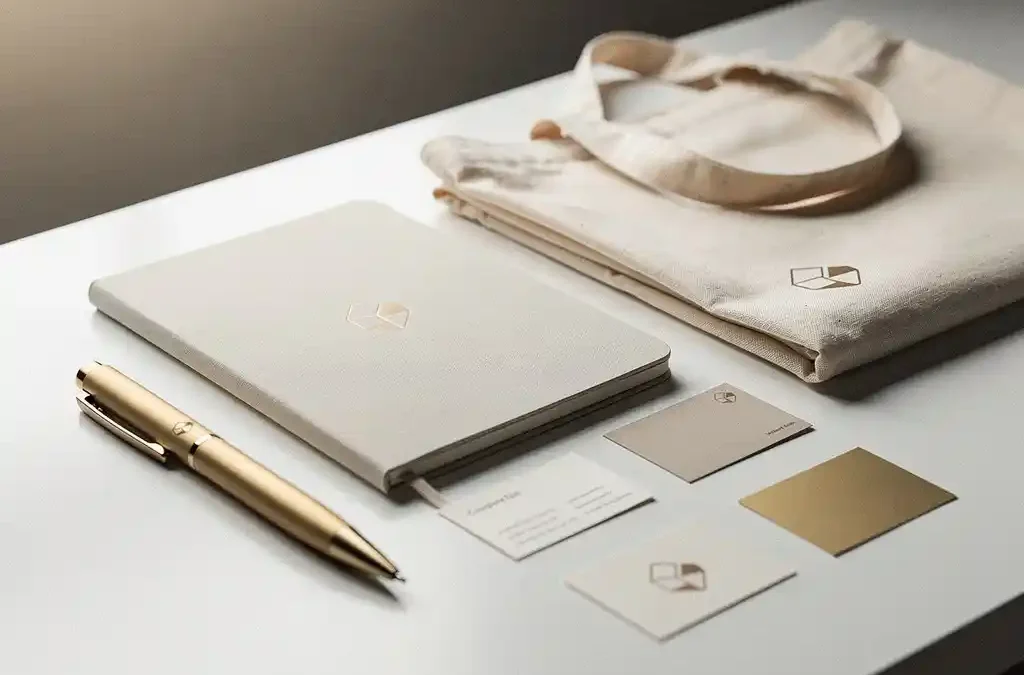
Yes, you can have your logo and corporate identity printed on promotional gifts and office supplies. From pens and mouse pads to large trade show materials: virtually any promotional item can be printed with a company logo or brand identity elements. The quality of the final result depends on proper file preparation, the chosen printing technique, and consistent application of your brand identity. In this article, we answer the most frequently asked questions about printing promotional gifts, so you can get started fully prepared. Have questions about a specific project? Feel free to contact us — we’re happy to help.
Which products are suitable for logo printing?
Almost any physical product can be printed with a logo, provided the surface is compatible with the appropriate printing technique. Popular choices include pens, notebooks, mouse pads, coffee mugs, bags, USB drives, T-shirts, and wristbands. Larger formats such as roll-ups, banners, and trade show materials are also excellent options for logo printing.
The choice of product depends on the purpose of the promotional gift. If you want to hand out something useful at a trade show, practical items like pens or notepads tend to go down well. For a more valuable gift for a loyal client, premium items such as engraved accessories or high-quality printed materials are more appropriate.
Office supplies like pens and mouse pads are classic choices because they are used every day. This creates repeated brand visibility at no additional cost. Trade show materials and point-of-sale displays serve a different purpose: they attract attention on the shop floor or in-store and make your brand visible to a wider audience.
What file formats are required for logo printing?
Vector files are the standard for logo printing. Formats such as AI (Adobe Illustrator), EPS, and SVG are ideal because they can be scaled up or down without any loss of quality. PDF files are also suitable, provided they are vector-based. Avoid raster images such as JPEG or PNG for logo printing unless the resolution is at least 300 dpi at the final print size.
The difference between vector and raster is crucial in print work. A vector file describes shapes mathematically, meaning a logo looks just as sharp on a pen as it does on a two-meter-wide banner. A raster file is made up of pixels and loses quality as soon as it is enlarged.
In addition to the file format, it is important that color codes are specified correctly. For print work, use Pantone (PMS) color codes for precise color reproduction, or CMYK values if Pantone is not available. RGB colors are intended for screens and may appear differently when printed on paper or fabric. Always supply any fonts used as outlines or embed them in the file to prevent substitution.
What is the difference between offset printing, digital printing, and screen printing?
Offset printing, digital printing, and screen printing are three different techniques, each with its own area of application. Offset printing is suited to large print runs on paper with high color quality. Digital printing is flexible and cost-effective for smaller runs. Screen printing is used for textiles and hard objects such as pens or mugs, where ink is applied layer by layer.
Offset printing: high quality at large volumes
Offset printing uses printing plates and is the most widely used technique for flyers, brochures, and catalogs in large print runs. Setup costs are higher, but the cost per unit drops quickly at larger volumes. Color accuracy is excellent, especially when combined with Pantone colors. This makes offset printing ideal for brand materials where color consistency is essential.
Digital printing: fast and flexible
With digital printing, the file is sent directly to the printer without the need for printing plates. This makes the technique well-suited to small print runs, personalized print work, and fast turnaround times. Quality has improved significantly in recent years and is comparable to offset for most applications. Digital printing is therefore the most widely used method for on-demand print work.
Screen printing: durable on non-paper materials
Screen printing is the go-to technique for printing on textiles, mugs, pens, and other hard or flexible materials. A separate screen is created for each color, making screen printing most cost-effective for simple logos with few colors and larger production runs. The ink bonds deeply into the material, resulting in a durable finish that withstands heavy use.
How do I keep my brand identity consistent across all materials?
Consistency in brand identity is achieved by working with a brand style guide and fixed color codes, fonts, and logo versions for all applications. Specify which version of your logo is used on dark backgrounds, which Pantone colors apply, and what clear space must be maintained around the logo. This ensures your brand looks the same on a pen as it does on a trade show banner.
A brand style guide does not need to be extensive. Even a simple document containing the correct color codes (Pantone, CMYK, and RGB), fonts, and logo files in the right formats can prevent a great deal of inconsistency. Include this document with every print order so the printer knows exactly what the standard is.
When working with multiple suppliers or across multiple countries, maintaining consistency becomes even more challenging. A partner that combines translation, layout, and printing under one roof significantly reduces the risk of discrepancies. Our print solutions are closely integrated with our DTP services, ensuring that brand identity and layout are always aligned.
Can I order small print runs, or is there a minimum order quantity?
Yes, small print runs are possible, especially with digital printing. For paper-based print work, there are often no strict minimum order quantities, though the cost per unit may be higher for very small quantities. For printing promotional gifts such as pens or mugs, most suppliers do require a minimum order, which varies from a few dozen to several hundred units depending on the product.
The reason for minimum order quantities on promotional gifts lies in the setup costs of the printing process. Setting up a screen printing screen or creating a mold takes time and money, regardless of how many units are ultimately printed. For digital printing on textiles or paper, the minimum thresholds are generally lower.
For businesses that regularly need small quantities, on-demand printing is a great solution. Materials are only printed and dispatched when needed, without having to maintain a large inventory. This saves storage space and reduces waste from outdated materials.
Who can I turn to for printing and shipping promotional gifts?
For printing and shipping promotional gifts, you can work with a specialized supplier that handles both print production and fulfillment. A partner that combines production, storage, and shipping saves you the effort of coordinating between multiple parties and shortens the time between placing an order and delivery to the final destination.
At Crestec Europe, we offer a complete package: from file preparation and printing to storing and shipping materials to clients, dealers, or trade shows worldwide. We work with partners across Europe and beyond, enabling us to handle both small and large print runs within the desired budget and timeline. Our ISO 9001 certification guarantees a structured quality process throughout the entire production chain.
Whether it’s a small run of personalized promotional gifts or a large-scale campaign with printing in multiple languages: we handle everything from start to finish. Request a quote and find out what we can do for your project.
Frequently Asked Questions
How long does it take for my printed promotional gifts to be delivered?
Delivery time depends on the chosen printing technique, the product, and the print run. Digital print work can sometimes be ready within a few business days, while screen printing on promotional gifts typically requires a production time of one to three weeks. Also allow for any approval rounds for proofs, as these can add extra days. For time-sensitive projects such as trade shows, always plan well in advance.
Can I request a proof or sample before the full print run is produced?
Yes, most suppliers offer the option to request a proof or physical sample, especially for larger or higher-value orders. This is strongly recommended when having a new product printed for the first time, so you can assess the color rendering, placement, and quality before full production begins. Keep in mind that a proof may involve additional costs and time. Always ask about this explicitly when requesting a quote.
What if I don't have a vector file of my logo? Can I still have something printed?
If you only have a raster file such as a JPEG or PNG, there are a few options. A graphic designer or your print partner can in many cases redraw the logo as a vector file — a process known as retracing — making it suitable for printing. This involves a one-time cost, but you will then have a future-proof file that can be used for all print applications. Also check with your current supplier or designer whether they still have the original vector file in their archive.
What common mistakes should I avoid when submitting my artwork?
The most common mistakes are submitting files at too low a resolution, using RGB colors instead of CMYK or Pantone, and not embedding fonts as outlines. Many clients also forget to allow sufficient clear space (margin) around the logo, which causes problems when printing on small surfaces such as pens. Always check that the file name and version match the most recently approved brand identity, so that an outdated logo does not accidentally go into production.
Is it possible to have promotional gifts printed in multiple languages or variants?
Yes, it is certainly possible to have the same product line printed in multiple language variants — for example, for different markets or office locations. Digital printing is particularly well-suited to this, as no fixed printing plates are used and each variant can be set up separately. Make sure all text variants are approved in advance by a native speaker or translator, as corrections after production are costly. A partner that combines printing and translation can simplify this process considerably.
What is the best way to store printed promotional gifts if I don't need them right away?
Printed promotional gifts are best stored in a dry, cool, and dark location, away from direct sunlight and moisture, to prevent discoloration or material damage. Textile products such as T-shirts or bags are best stored folded in sealed boxes, while hard products such as pens and mugs can be stacked or kept in their original packaging. If you regularly need small quantities, on-demand printing is a smarter alternative to maintaining large stocks. Some suppliers also offer storage services as part of a fulfillment package.
What does it cost on average to have promotional gifts printed?
Costs vary considerably depending on the product, the print run, the number of colors, and the chosen printing technique. As a general guideline, the cost per unit decreases as the print run increases, because setup costs such as creating screen printing screens are spread across more units. For an accurate estimate, it is advisable to request a quote specifying the product type, desired quantity, and print requirements, so you receive a comparable and transparent price.
Related Articles
- How does the proofreading process work for multilingual print materials?
- How does my printed material help create a premium brand?
- What should I keep in mind when translating and printing multilingual documentation?
- What is the difference between print-on-demand and offset printing, and which solution is right for my business?
- What tools are essential for software localisation?