
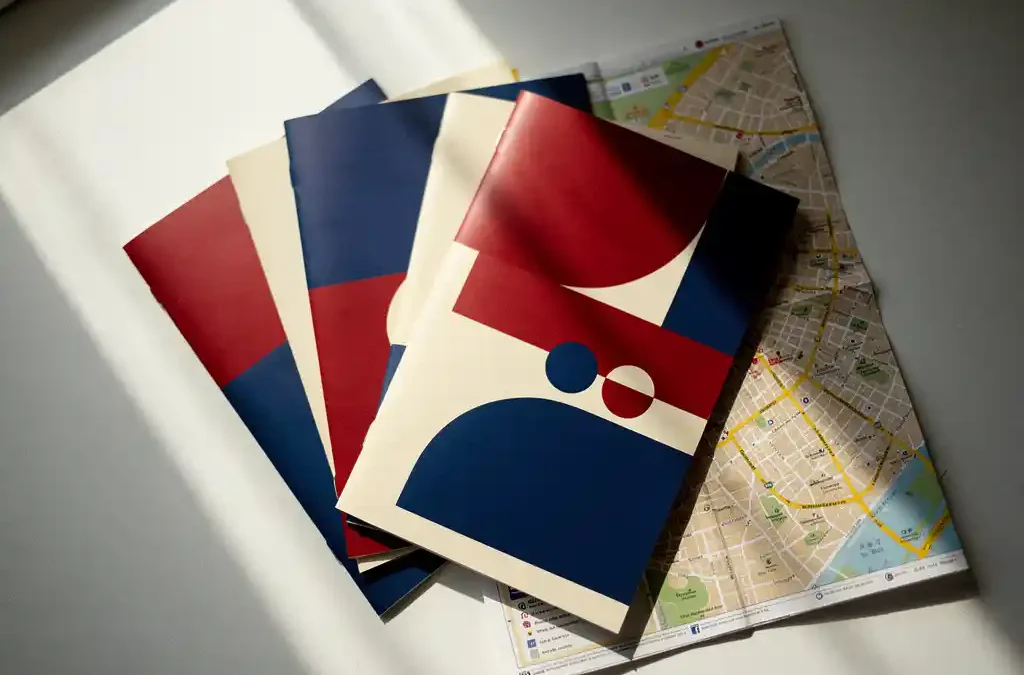
Promotional print materials for European retail are best handled by a specialized supplier that combines translation, layout, and print production under one roof. Standard printers often lack the multilingual expertise needed to correctly adapt materials for different European markets. In this article, we answer the most important questions about the process, the requirements, and how to choose the right partner. Already have a specific question? Feel free to get in touch — we’re happy to help.
What types of promotional print materials are common in European retail?
Common promotional print materials in European retail include product leaflets, displays, price tags, packaging inserts, in-store posters, receipts, and point-of-sale materials such as standees and wobblers. In addition, brochures, catalogs, and seasonal promotions are widely used to reach and engage consumers on the shop floor.
The variety of print materials reflects the breadth of the retail sector itself. An electronics chain has different needs than a fashion retailer or a supermarket, but all three share the fact that printed materials play a direct role in the purchasing decision. Point-of-sale materials are particularly valuable in this regard: they capture attention at the very moment the consumer is already in the store and ready to buy.
Beyond traditional paper-based print, the range also includes branded office items such as pens and mouse pads, large-format trade show materials, and merchandise featuring company logos. The scale varies considerably — from a single print run on request to bulk productions of thousands of units for a European network of stores or dealers.
Why is multilingual adaptation of print materials essential for European markets?
Multilingual adaptation of print materials is essential for European markets because consumers make purchasing decisions based on information in their own language. Incorrect or missing translations lead to a loss of trust, legal risks, and missed sales opportunities. Europe has dozens of official languages, and each country has its own specific laws and regulations governing product information and advertising.
Language, however, is not the only consideration. Cultural nuances also shape how a message is received. A slogan that sounds powerful and compelling in Dutch may carry a different meaning in German or Polish. Professional localization goes beyond word-for-word translation: it involves adapting tone, imagery, and layout to match the expectations of the local audience.
Furthermore, many European retailers require as a purchasing condition that suppliers deliver their materials in the language of the country of sale. Those who cannot meet this requirement miss out on distribution opportunities. Multilingual print materials are therefore not a luxury — they are a basic requirement for operating successfully in European retail.
What does a specialized supplier do differently from a standard printer?
A specialized supplier combines translation, desktop publishing, and print production into one integrated process, whereas a standard printer handles only the printing itself. This distinction is crucial: with a standard printer, you are responsible for supplying print-ready files in all required languages, including correct layout and text flow.
With a specialized partner like Crestec Europe, the in-house DTP team works closely with translators to make documents print-ready directly. Texts that become longer or shorter after translation are automatically reformatted without losing the visual identity. This saves multiple rounds of revision and significantly reduces turnaround time.
In addition, a specialized supplier offers complementary services that streamline the entire chain:
- Quality assurance through certified processes (ISO 9001 and ISO 27001)
- Inventory management and fulfillment from a central warehouse
- Distribution to dealers and stores throughout Europe
- Print on demand or bulk runs, depending on requirements
A partner who manages all these links reduces coordination risk and ensures that updated materials reach their destination faster after a product update or campaign change.
How does the process work from translation to finished printed product?
The process from translation to finished printed product follows a series of sequential steps: intake and briefing, translation and editing, DTP and layout review, print proof approval, and finally production and delivery. With an integrated supplier, these steps take place within a single workflow, preventing errors that can occur when handing off between separate parties.
From source file to translated layout
The process begins with the submission of the source file, typically in a standard layout application such as InDesign or a comparable format. The text is extracted, translated, and — after editorial review — placed back into the original layout. The DTP team adjusts the design where text lengths have changed and verifies that fonts, colors, and images are correct across all language versions.
From approved proof to physical product
Once the digital proof is approved, the file is sent to the print partner. Depending on the print run and the desired end result, either offset printing or digital printing is used. Offset printing is cost-efficient for large quantities and delivers high color quality; digital printing is more flexible for smaller runs or personalized variants. After production, the materials are stored, packaged, and distributed to the specified addresses across Europe.
Want to learn more about our approach? Visit our printing services page for a complete overview of what we offer.
Who is the right partner for promotional print materials across Europe?
The right partner for promotional print materials across Europe is a supplier that combines multilingual expertise, certified quality processes, and a fully integrated production chain. That means translation into all required European languages, in-house DTP, print production, and distribution — all managed through a single point of contact.
Crestec Europe has been delivering complete documentation solutions in more than 90 languages since 1995, serving clients in the technology, manufacturing, and retail sectors. From Amsterdam, we coordinate translation, layout, and print production through a team of 30 specialists, supported by a network of print partners across Europe and beyond. Our ISO 9001 certification guarantees structured quality management throughout the entire production process, while ISO 27001 ensures the security of your documents and business data.
When choosing a partner for European promotional print materials, these are the criteria that matter most:
- Language coverage: can the supplier deliver all the languages your markets require?
- Integrated workflow: are translation, DTP, and printing coordinated internally?
- Quality certification: are documented quality processes in place?
- Fulfillment and distribution: can the partner also handle storage and delivery?
- Scalability: does the supplier work with both small and large print runs?
A partner who masters all these elements saves you not only time and coordination effort, but also reduces the risk of errors that only become apparent on the shop floor. Ready to put your European promotional print materials in good hands? Get in touch and we’ll discuss the options.
Frequently Asked Questions
How long does it typically take to produce multilingual promotional print materials?
The turnaround time depends on the number of languages, the complexity of the layout, and the desired print run, but you should generally allow one to three weeks from source file to finished printed product. With an integrated supplier that coordinates translation, DTP, and printing in-house, this process is considerably faster than working with multiple separate parties. Rush jobs can be arranged by agreement, but it is always advisable to plan sufficient lead time to accommodate revision rounds.
What file formats do I need to supply for multilingual print materials?
The most common and recommended formats are Adobe InDesign files (.indd) or well-structured PDFs with embedded fonts and bleed. The better the source file is built, the more efficiently the DTP team can process the translated text without compromising the visual identity. Ideally, also supply the individual assets, such as high-resolution images and the color profile used (CMYK), so that print production can begin without delay.
What if my brand style guide is not available in all languages — how is consistency ensured?
A professional DTP partner works from your existing source materials and brand guidelines to ensure consistency across all language versions. Fonts, color codes, logo placement, and layout principles are captured in a language-specific template that is applied anew for each market. If a complete brand style guide is not available, a specialized supplier can create a working document based on existing materials to serve as a reference for future productions.
What are the most common mistakes when coordinating multilingual print materials in-house?
The most frequent mistake is outsourcing translation and printing to separate parties without a central coordinator overseeing the handoff — this almost always results in layout errors, text truncation, or color discrepancies between language versions. A second common issue is underestimating text expansion after translation: a Dutch text can become ten to thirty percent longer in German or French, which disrupts the entire layout. Finally, legally required statements — such as safety warnings or mandatory product information — are regularly overlooked or incorrectly translated when self-coordinating, potentially resulting in fines or product recalls.
Can I have promotional print materials produced on demand rather than in large print runs?
Yes, digital printing makes it possible to produce small and medium-sized print runs cost-efficiently without the high setup costs associated with offset printing. This is particularly useful for market tests, seasonal campaigns, or region-specific promotions where you don’t know in advance how many copies you’ll need. A supplier offering both digital and offset printing can advise you on which method is most suitable based on print run, desired quality, and budget.
How is translation quality checked before print materials go into production?
At a professional specialized supplier, every translation goes through a multi-stage quality check: the initial translation is followed by an editorial review by a second linguist, then a DTP review in which the text is assessed in the context of the layout. Only after approval of a digital proof — submitted to the client or a local contact for validation — is the file sent to the printer. At ISO 9001-certified suppliers, this process is documented in formal procedures to ensure no step is skipped.
What does multilingual promotional print cost and how is the price determined?
The price is determined by a combination of factors: the number of target languages, the word count of the texts to be translated, the complexity of the layout, the print specifications (size, paper type, finishing), and the desired print run. For an accurate quote, it is advisable to submit a source file or dummy along with an overview of the required languages and markets. Most specialized suppliers offer a no-obligation quote based on this information, giving you a clear picture of the total investment upfront.
Related Articles
- How do I ensure my printed materials align with the cultural expectations of each market?
- How do I print large quantities of manuals for my product launch in Europe?
- Am I required to provide my manuals in print, or is digital sufficient?
- What EU safety documentation is required before I can sell a machine in Europe?
- How does software localisation impact user experience?