
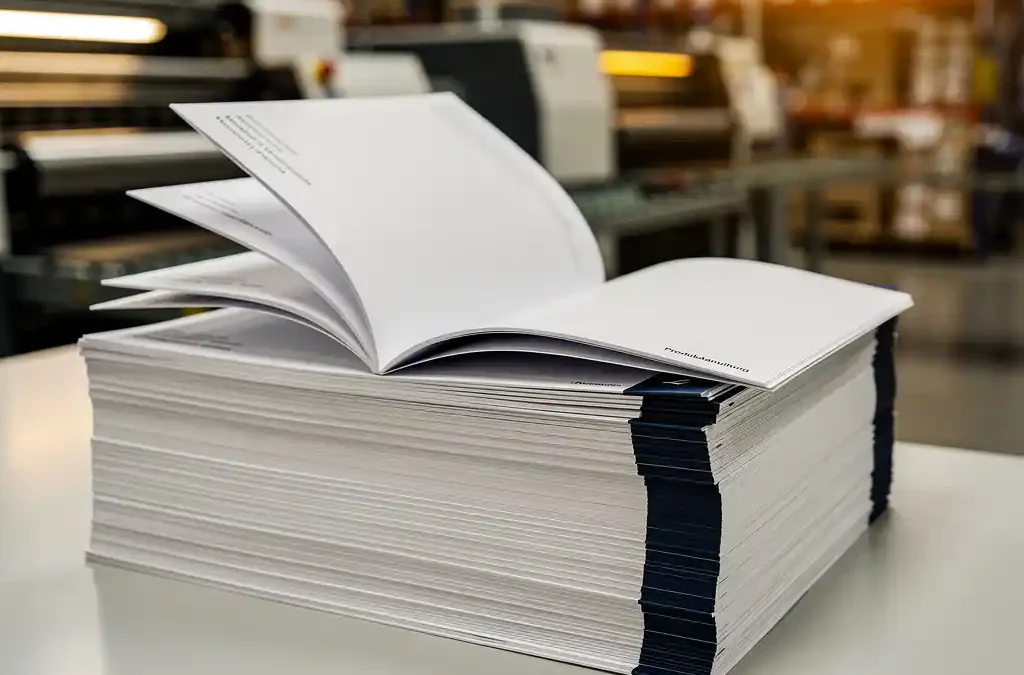
For a European product launch, printing large quantities of manuals is most efficient through a combined approach of offset printing for high print runs and digital printing for smaller or variable runs. The key lies in aligning translation, layout, and printing early on within a single integrated workflow, preventing lost time and coordination errors. In this article, we answer the most frequently asked questions about printing manuals at a European scale. Do you have an immediate question? Feel free to contact us and we’ll be happy to help.
What options are available for printing manuals at scale?
For printing large quantities of manuals, there are two main options: offset printing and digital printing. Offset printing is cost-efficient for print runs of thousands of copies and delivers consistent, high print quality. Digital printing is more flexible, suited for smaller runs or when you need to make quick changes without high setup costs.
The choice between the two methods depends on your print run, turnaround time, and the degree of variation in the content. For a large European launch with multiple language versions, you will often combine both methods: a main print run via offset and a limited run per language via digital printing. This keeps costs under control without compromising on quality or flexibility.
Beyond the printing technique, paper selection plays an important role. Manuals are typically printed on uncoated paper for readability, but the binding, format, and finishing are equally decisive for the user experience. A well-prepared print-ready file, aligned with the printer’s specifications, prevents costly corrections during the production phase.
How do you determine the right print run for a European product launch?
You determine the right print run for a European product launch based on your expected sales volume per market, the required language versions, and a buffer for reorders or return flows. Start with a realistic sales forecast per country and add a margin of ten to twenty percent for unforeseen demand or distribution errors.
Europe encompasses dozens of markets, each with its own language and sometimes its own legal requirements for documentation. It is advisable to calculate a separate print run for each language version. A launch in Germany, France, and the Netherlands requires three separate print orders, each tailored to local market demand.
Overprinting is costly in terms of storage and logistics, but too few copies can delay a launch. A partner that also handles warehousing and fulfillment helps you manage inventory flexibly and process reorders quickly. This prevents both shortages and unnecessary storage costs.
What are the multilingual requirements for manuals in Europe?
In Europe, multilingual manuals are legally required for many product categories. EU directives for electrical equipment, medical devices, and machinery, for example, stipulate that documentation must be available in the official language of the country where the product is sold. In practice, this means that for a launch in five countries, you need at least five language versions.
In addition to language requirements, there are also content-related requirements: safety warnings must be prominently present, pictograms must comply with European standards, and the layout must be readable for the target audience. It is not sufficient to simply translate a manual; the layout must also be adapted to the length and readability of the target language.
Languages such as Finnish, German, and Polish typically produce longer texts than English. This has a direct impact on layout: a manual that fits in twenty pages in English may run to twenty-five pages in German. This must be factored into the print planning and cost calculation.
How do you combine translation, layout, and printing in a single workflow?
You combine translation, layout, and printing most efficiently by working with a single supplier that has all three disciplines in-house. In an integrated workflow, the translated text goes directly to a DTP team that adapts the layout to the target language, after which the file is ready for production. This eliminates manual handoffs and reduces the risk of errors.
With a fragmented approach — working with a separate translation agency, a separate layout studio, and a separate printer — you lose time at every handoff and run the risk of miscommunication about file formats, color profiles, and margins. Every link in the chain adds coordination work that extends the turnaround time and increases the likelihood of errors.
At Crestec Europe, we offer a fully integrated solution in which translation, DTP, and printing flow seamlessly into one another. Our DTP specialists work closely with translators and print partners to ensure the final result meets both the language requirements and the technical specifications of the printer. This significantly reduces turnaround time and gives you a single point of contact as the client.
What should you consider when distributing printed manuals across Europe?
When distributing printed manuals across Europe, you need to account for customs regulations, local delivery networks, storage locations, and the timing of your product launch. A solid distribution plan ensures that the correct language version is available at the right place at the right time, without unnecessary delays or additional costs.
Storage logistics is an underestimated part of the process. If you have manuals for ten countries printed simultaneously, you also need storage space until the products are shipped. Warehousing close to the final destination reduces shipping costs and delivery times. For large-scale launches, it makes sense to work with a partner that also handles inventory management and fulfillment.
It is also important to consider the packaging of the manuals. Manuals supplied together with a product often need to be kitted — that is, assembled and packaged as part of the product box. This requires close coordination between the printer, the kitting partner, and the logistics partner.
When is a one-stop supplier the best choice for printing manuals?
A one-stop supplier is the best choice when you are dealing with multiple languages, tight deadlines, and complex distribution across several European markets. The more links there are in the production chain, the greater the risk of delays and errors. A single supplier that manages translation, layout, printing, storage, and shipping significantly reduces that risk.
For companies that regularly update their documentation — such as when products are improved or regulations change — a dedicated partner with knowledge of your products and processes is especially valuable. The accumulated knowledge of your documentation structure, house style, and language preferences ensures consistency and speed with every new version.
Certifications such as ISO 9001 and ISO 27001 are a concrete indicator of reliability. ISO 9001 confirms that the supplier has a structured quality management system in place, while ISO 27001 guarantees that your documentation and business data are handled securely. This is particularly relevant when working with confidential product information or sensitive technical documentation.
At Crestec Europe, we support clients from start to finish: from translation and DTP to printing, warehousing, and fulfillment — all under one roof. Ready to have your manuals printed for your European launch? Request a quote and we’ll be glad to think along with you.
Frequently Asked Questions
How long does it typically take to produce manuals for a European launch?
The turnaround time depends heavily on the number of language versions, the complexity of the manual, and the chosen printing method. On average, you should allow four to eight weeks for the full process from translation and DTP through to printed copies. By starting early and working with an integrated supplier, you can significantly reduce this turnaround time and avoid unexpected delays just before the launch.
What are the most common mistakes when printing multilingual manuals?
A common mistake is underestimating text expansion: translations into languages such as German or Finnish can be twenty to thirty percent longer than the English source text, which completely disrupts the layout. Other frequent mistakes include submitting print files in the wrong color profile (RGB instead of CMYK), overlooking language-specific legal requirements, and bringing in a DTP specialist too late. All of these mistakes lead to costly rounds of corrections and delays in the production schedule.
Can I easily update existing manuals without going through the entire production process again?
Yes, provided you work in advance with structured source files and a dedicated supplier that manages your documentation history. With digital printing, you can produce small runs of an updated version quickly and cost-effectively without high setup costs. It is advisable to build your manuals in a modular structure, so that only the changed sections need to be retranslated and reformatted rather than the entire document.
What file formats do I need to supply for printing manuals?
Most printers prefer print-ready PDF files in CMYK color profile, including 3 mm bleed around the format and embedded fonts. However, it is strongly recommended to also keep the editable source files (such as InDesign or Word) available, so that a DTP team can make adjustments after translation. Always ask your printer for a detailed file specification before finalizing the layout, to avoid correction costs after the fact.
How do I ensure my manuals comply with European legal requirements per product category?
Start with a compliance check per product category and target market: the requirements for medical devices (MDR), machinery (Machinery Directive), and electrical equipment (CE marking) differ considerably from one another. Engage a supplier with experience in technical documentation who is familiar with current EU directives and knows which safety symbols, warning texts, and language requirements apply. This prevents your manuals from being rejected during market surveillance or your products from being barred from sale in specific countries.
Is it cheaper to print all language versions at once or in phases?
Printing everything at once is generally cheaper per copy thanks to economies of scale, but requires a higher initial investment and more storage capacity. Phased printing gives you more flexibility to adjust per market based on current sales data, but comes with higher costs per unit. The best approach depends on your cash flow situation, the available storage space, and the degree of certainty about your sales volumes per country.
How do I efficiently manage the inventory of printed manuals across multiple European markets?
Work with a central warehouse in Europe from which you can quickly deliver to multiple markets, combined with an inventory management system that provides real-time insight into stock levels per language version. Set minimum stock thresholds per market so that a reorder can be triggered automatically before shortages arise. A fulfillment partner with experience in cross-border distribution can also handle customs formalities and local delivery networks on your behalf, saving time and reducing administrative burden.
Related Articles
- Can I have my printed manuals distributed directly to my dealers in Europe?
- How do I build trust with customers who don't speak my language?
- How do you streamline software localisation operations?
- How do you sync updates across multiple localised versions?
- What are the biggest software localisation challenges?