
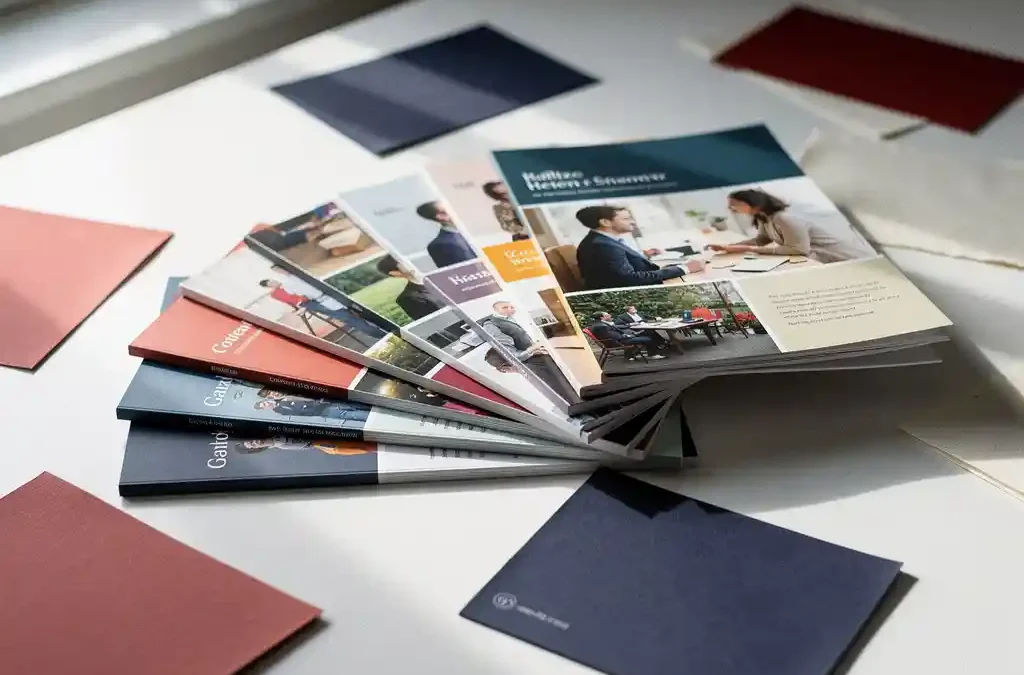
Printed materials meet the cultural expectations of a market when you go beyond translation alone and also adapt the layout, imagery, color use, and reading order to the local context. This applies to every type of printed material, from product manuals and packaging to marketing brochures and point-of-sale materials. In this article, we answer the most frequently asked questions about culturally aligned printing and localization. Do you have a specific question? Feel free to get in touch and we’ll be happy to help.
Which cultural elements influence the layout of printed materials?
The layout of printed materials is influenced by reading direction, color psychology, typographic conventions, imagery, and the cultural meaning of symbols. What looks professional and appealing in one market can come across as confusing or even offensive in another. Culture determines not only what is said, but also how it looks.
Color is one of the most underestimated factors. White represents purity in many Western cultures, but in parts of Asia it is associated with mourning. Red conveys luck and prosperity in China, while in other contexts it signals danger or prohibition. These associations have a direct impact on the choice of backgrounds, buttons, borders, and illustrations in printed materials.
Images of people also play a role. Hand gestures, facial expressions, and even clothing choices in photographs can be interpreted differently depending on the region. The same applies to the level of formality in text and visuals: Japanese and German audiences generally expect a different tone and visual style than a Brazilian or Australian audience.
How does DTP editing differ across language regions?
DTP editing differs across language regions because languages vary considerably in text length, reading direction, character sets, and typographic rules. A translation from English into German can produce up to thirty percent more text, while Arabic and Hebrew are read from right to left, which reverses the entire layout.
Asian languages such as Chinese, Japanese, and Korean follow different rules for hyphenation, line spacing, and character spacing. Some languages require specific fonts that are not available as standard in Western design software. A DTP editor with knowledge of the target language prevents errors that an automated layout adjustment would miss.
In practical terms, this means that a solid DTP process for international printing always includes language-specific checks: text overflow, hyphenation rules, number formatting, date formats, and punctuation placement. We work with an in-house DTP team that integrates these steps seamlessly with the translation process, so the final result is print-ready from the outset.
What is the difference between translation and full localization of printed materials?
Translation replaces words in the source language with equivalents in the target language. Localization goes further: it adapts the entire document to the cultural, visual, and functional expectations of the target market, including layout, images, measurements, currency, and color use. Localization transforms a translated document into one that feels as though it was originally created for that market.
For simple informational texts, a translation may be sufficient. But for printed marketing materials, packaging, instructions for use, or point-of-sale displays, full localization is almost always necessary. A brochure that is visually and substantively tailored to the local market converts better and strengthens trust in your brand.
A concrete example: a manual for a technical product may contain illustrations with measurements in inches that need to be converted to centimeters for European markets. Or an advertisement may feature an image that is appealing in one market but needs to be replaced with a culturally neutral image in another. That falls outside the scope of translation, but is fully within the scope of localization.
When does it make sense to have printed materials printed locally?
Local printing makes sense when lead times are short, volumes are large, or when local regulations require specific paper types, formats, or certifications. It reduces shipping costs and customs delays, and makes it easier to respond quickly to local market changes.
For global campaigns where brand consistency is critical, centralized production with local distribution may be a better choice. In this model, files are approved centrally and then printed by certified partners in the target market. This combines the benefits of quality control with the logistical efficiency of local printing.
Hybrid scenarios are also possible. High-volume print materials such as instruction booklets or technical manuals lend themselves well to centralized production, while seasonal promotional materials or retail displays often benefit from local printing due to shorter turnaround times. The right choice depends on volume, urgency, local requirements, and your distribution network.
Our printing services cover both offset and digital printing, with partners across Europe and beyond, so we can always offer the most efficient solution regardless of the target market.
How do you maintain brand consistency in printed materials across markets?
Brand consistency in printed materials across markets is maintained by working with a central brand guide, standardized templates, and a rigorous approval process. The brand guide defines which elements always remain the same — such as the logo, core colors, and typography — and which elements may be adapted per market.
What must always remain the same?
Logo usage, brand fonts, the core color palette, and the overall visual hierarchy form the fixed foundation of your brand identity. These elements must not be adapted per market, even if a local partner has a different preference. A clear brand guide in multiple languages helps communicate this to local teams and suppliers.
What may be adapted per market?
Imagery, tone of voice, layout proportions, and sometimes even color accents can be adapted to better align with local expectations, as long as this falls within the established brand guidelines. It is also advisable to involve local partners or native speakers in reviewing the final result before it goes to the printer.
A partner that combines translation, DTP, and printing under one roof significantly reduces the risk of inconsistencies. When every part of the production process is managed by the same party, there are fewer handover errors and quality control across all markets is easier to guarantee. Want to know how we approach this for your situation? Get in touch and we’ll discuss the options.
Frequently Asked Questions
How long does it typically take to localize printed materials for a new market?
The turnaround time depends on the type of document, the number of pages, and the target language, but for a complete localization including translation, DTP editing, and a print proof, you should typically allow two to four weeks. Complex languages such as Arabic or Japanese, where the entire layout is reversed or rebuilt from scratch, may require more time. By planning ahead and working with a dedicated partner that combines translation and DTP, you can significantly reduce the turnaround time.
What common mistakes should I avoid when localizing packaging?
One of the most frequent mistakes is using direct translations without cultural context, causing slogans or product descriptions to take on an unintended or even negative meaning. In addition, country-specific legal requirements — such as mandatory disclosures, pictograms, or minimum font sizes — are regularly overlooked. Involving a native speaker for a final review and a localization specialist who is familiar with local regulations will prevent costly reprints.
Can I reuse existing print files as the basis for localized versions?
Yes, existing print files can in many cases serve as a starting point, provided they were built in editable layout software such as Adobe InDesign and the text and image layers are kept separate. Files exported as flat PDFs without editable layers require additional editing time and increase costs. It is therefore advisable to account for future localization from the very first production run by saving files in a structured and well-documented format.
How do I handle text expansion in languages that take up significantly more space than the original?
Text expansion — such as in translations from English into German or French — requires a layout that is set up flexibly, with sufficient white space and adjustable text boxes. In practice, this may mean slightly reducing the font size, redistributing text blocks, or repositioning images to preserve readability. An experienced DTP editor resolves this without compromising the visual hierarchy or brand identity.
Is it necessary to produce a separate print proof for each target market?
For high-volume or brand-sensitive print materials — such as packaging, product catalogs, or retail displays — a market-specific print proof is strongly recommended. Color rendering can vary between printers and paper types, and a local proof provides the opportunity to make corrections in time. For standard informational documents with less visual complexity, a digital soft proof combined with a central color standard such as ISO 12647 will often suffice.
How do I involve local teams or distributors in the approval of localized printed materials?
Set up a structured review process in which local contacts receive a clear checklist covering key areas such as linguistic accuracy, cultural suitability of images, and compliance with local regulations. Use a digital proofing platform that allows multiple reviewers to add comments simultaneously, keeping feedback centralized and version control intact. Also establish clear deadlines and approval rounds to keep the process manageable and avoid delays.
What are the benefits of working with a single partner for translation, DTP, and printing?
Working with a single integrated partner eliminates the risks of handover errors between separate suppliers — such as text shifts, incorrect file versions, or color deviations that occur when DTP and printing are handled by different parties. Communication is also simpler, quality control is more centralized, and turnaround times are shorter because steps can be carried out in parallel. It also delivers cost savings, as there is no need for duplicate file conversions or additional coordination layers.
Related Articles
- What is the best printing solution for seasonal promotional materials?
- How do I prevent color variations between different print runs of my brand identity materials?
- Who can format and print my documentation?
- What are best practices for localisation project management?
- How do you plan software localisation project schedules?