
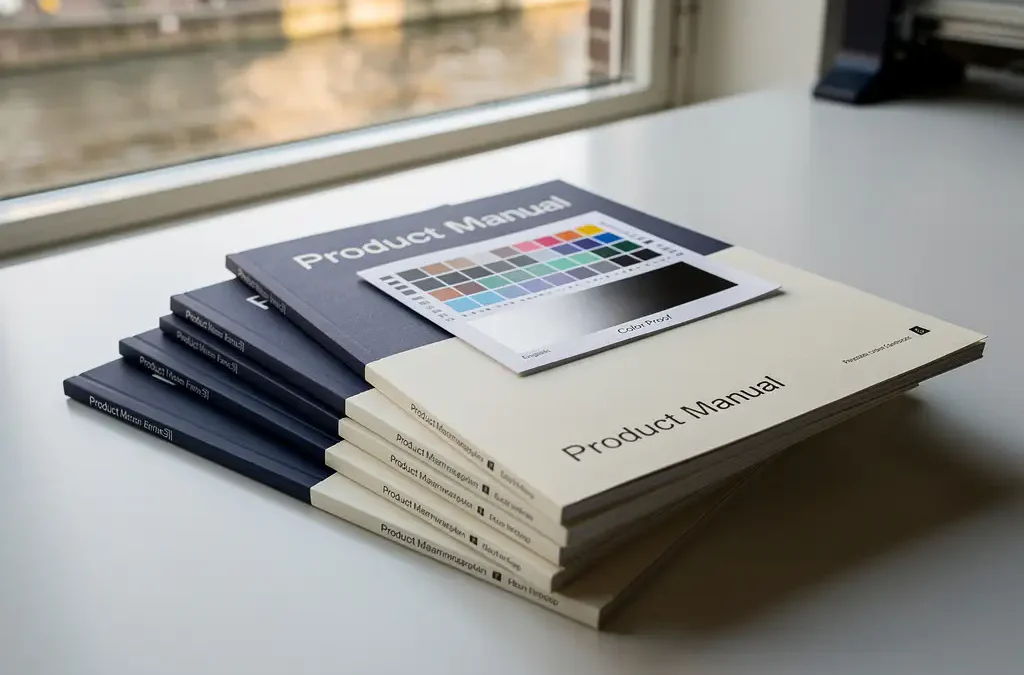
The turnaround time for printing product documentation in multiple languages typically ranges from two to six weeks, depending on the number of languages, the complexity of the content, and the chosen printing method. The more languages involved and the more technical the text, the more time each phase requires. Wondering what’s realistic for your project? Feel free to contact us for a no-obligation estimate. In this article, we answer the most frequently asked questions about planning and turnaround times for multilingual print projects.
What factors determine the turnaround time for multilingual print projects?
The turnaround time for multilingual print work is determined by the number of languages, the size and technical complexity of the documentation, the condition of the source files, and the chosen printing method. Each of these factors directly affects how much time translators, DTP specialists, and printers need to deliver the final product.
More languages means not only more translation work, but also more DTP rounds. Each language has its own text length, reading direction, and typographic conventions. For example, a technical manual that spans two pages in English can easily run ten to fifteen percent longer in German, which significantly affects the layout.
The quality of the source files also plays a major role. Well-prepared files with editable text and organized layers save considerable time in the DTP phase. However, if files are only available as scanned PDFs or outdated layout formats, additional preparation is required before translation can even begin.
Finally, the printing method influences how much time the production phase requires. Digital printing is suited to smaller print runs and can be started quickly, while offset printing for large runs requires more preparation time but is cheaper per unit.
How much time does translation take compared to the printing phase?
The translation phase takes an average of three to ten business days for a standard product document, depending on the word count and number of languages. The printing phase itself typically takes two to five business days, but the DTP work in between can take just as long as the translation itself.
Many clients underestimate the time between the completed translation and the moment the document is ready for the printer. After translation, the text must be re-fitted into the original layout. Fonts, white space, tables, and images all need to be realigned to match the translated text. This work — commonly known as DTP localization — is a specialized discipline that requires precision.
For a project in ten languages, the DTP phase can therefore involve ten separate editing rounds, each with its own revision cycle. When translation, DTP, and printing are handled under one roof — as we do at Crestec Europe — these phases are seamlessly coordinated, significantly reducing the overall turnaround time.
What is a realistic total turnaround time for a multilingual print project?
A realistic timeframe for a multilingual print project is between three and six weeks for documentation in five to ten languages. Straightforward projects in two or three languages can in some cases be completed within two weeks, provided the source files are well prepared.
A general indication by project type:
- Small documentation (up to 10 pages, 2–3 languages): approximately 8 to 12 business days
- Medium-sized manual (10–50 pages, 5–8 languages): approximately 15 to 20 business days
- Extensive technical documentation (50+ pages, 10+ languages): 4 to 8 weeks or more
These time estimates assume a smooth revision process. Each additional revision round after the translation or DTP phase adds time. It is therefore advisable to determine internally in advance who holds final responsibility for approval, so that feedback rounds run efficiently.
How can turnaround time be reduced without compromising quality?
The turnaround time for multilingual print work can be reduced by organizing parallel workflows, supplying well-prepared source files, and making use of translation memories and terminology databases. An integrated approach in which translation, DTP, and printing are handled by a single partner eliminates unnecessary handover moments.
In practical terms, there are several measures that save time directly:
- Supply editable source files in InDesign, Word, or a comparable format, including all fonts and images used.
- Use an approved terminology list so that translators don’t have to look up or align the same product-specific terms repeatedly.
- Schedule revision rounds in advance with fixed deadlines for internal approval, so the project doesn’t stall unnecessarily.
- Choose a one-stop supplier that combines translation, DTP, and print production in-house, eliminating handover time between parties.
Translation memories also play a significant role in speeding up repeated or updated documentation. When a product receives an update and only part of the text changes, only the modified portion needs to be retranslated. This saves not only time, but also costs.
When should you start planning a multilingual print project?
Start planning as soon as the product launch or publication date is known — ideally six to ten weeks in advance. For larger projects in more than ten languages, a lead time of three months is realistic. The earlier you start, the more room there is for revisions and unexpected delays.
In practice, we often see clients treat the localization of documentation as one of the last steps in the production process. This is understandable, since the content only becomes final once the product itself is ready. Nevertheless, it is wise to involve the localization partner early in the process, even if the content is not yet fully finalized.
Early consultation makes it possible to:
- Prepare the file structure for multilingual processing from the outset
- Develop terminology lists and style guides that streamline the translation process
- Determine print specifications per country or region in good time, avoiding surprises during production
- Build in buffer time for revisions and approvals
At Crestec Europe, we are happy to support clients from the preparation phase onward, ensuring that the final execution runs smoothly and within the desired timeframe. Want to know what a realistic schedule looks like for your specific project? Contact us and we’ll be glad to think it through with you.
Frequently Asked Questions
What happens if my source files are not editable — can the project still go ahead?
Yes, the project can still go ahead, but additional preparation will be needed to make the files suitable for translation and DTP. This may involve retyping text from scanned PDFs or reconstructing the layout. This typically adds two to four business days to the turnaround time and may also affect costs. It is therefore strongly recommended to always retain and supply the original editable source files.
How does a translation memory work, and what does it mean for me when a document is updated?
A translation memory is a database in which previously translated sentences and segments are stored, linked to the original source text. When a document is updated, the system automatically identifies which sections are unchanged and reuses the existing translations for those parts. Only the modified or new text needs to be retranslated, saving both time and costs. For regularly updated product documentation, this can result in significant savings over time.
Can I use different print specifications or paper sizes for different languages?
Yes, this is possible and occurs regularly in practice — for example, because certain markets use different standard formats or because local regulations impose specific layout requirements. It is important to communicate these differences early in the process so that the DTP specialist can adjust the layout correctly for each language version. Bear in mind that differing specifications per language may increase DTP time and printing costs.
What is the best way to organize internal approval rounds efficiently?
Designate one person with final responsibility per language or region in advance — someone with the authority to give definitive approval — so that feedback does not need to be gathered from multiple people. Set fixed deadlines for each revision round and communicate these clearly to everyone involved. Where possible, use a structured feedback format, such as annotated PDFs, to keep comments clear and traceable. This prevents the project from stalling unnecessarily due to slow or unclear responses.
Is it possible to place a rush order if a deadline has unexpectedly moved forward?
In many cases an expedited process is possible, but this depends on the size of the project, the number of languages, and the availability of translators and printers at that time. Rush orders typically carry a surcharge and require source files to be supplied immediately and in full. Contact your localization partner as soon as you know the deadline has changed, so that action can be taken right away and the impact on quality is kept to a minimum.
How do I ensure that technical terminology remains consistent across all language versions?
The most effective approach is to compile an approved terminology list or glossary before translation begins, covering product-specific terms and the preferred translations for each target language. This list is then used by all translators and stored in the translation tool, so that any deviations are flagged automatically. A style guide per language or region can be a valuable addition. Consistent terminology not only improves quality but also significantly reduces revision time.
What are the most common mistakes clients make when planning multilingual print projects?
The most common mistake is scheduling the localization phase too late, leaving insufficient time for DTP, revisions, and printing. Other frequent errors include supplying incomplete or non-editable source files, lacking a clear internal approval structure, and underestimating the DTP time required after translation. By involving a localization partner early in the process and establishing clear agreements on responsibilities and deadlines, most of these pitfalls are easy to avoid.
Related Articles
- How do I keep my technical documentation up to date when my product keeps changing?
- How do I make sure my packaging complies in every country I sell in?
- What's the difference between a user manual, service manual and installation guide?
- What has to be in a product manual to comply with EU law?
- How do you manage multilingual documentation?