
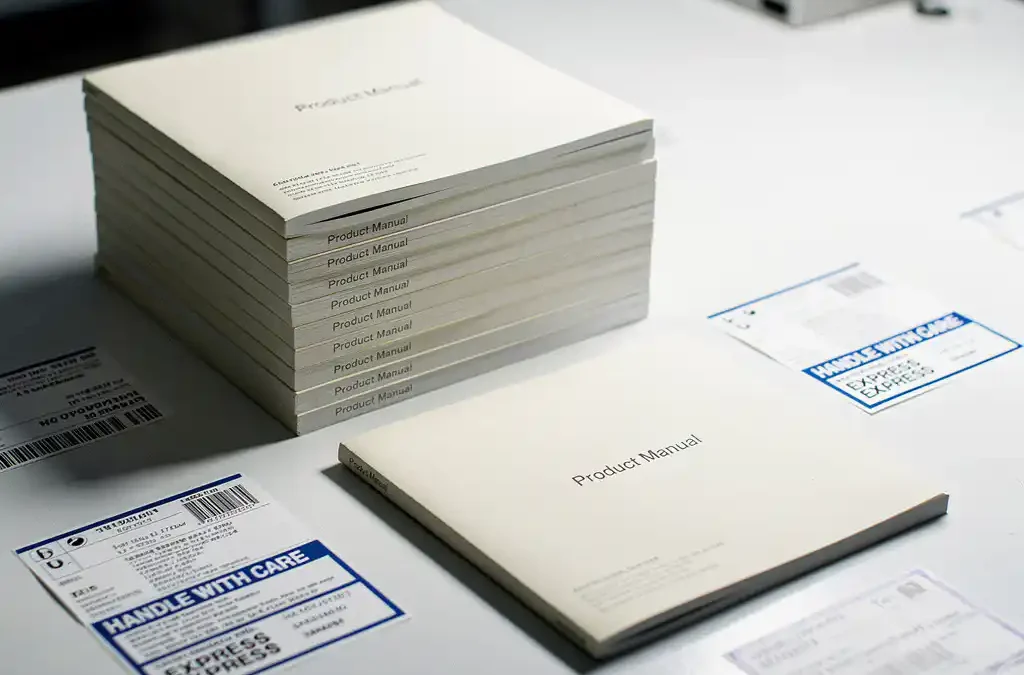
Print-on-demand is not always cheaper than bulk printing, but for international distribution it often delivers a lower total cost when you factor in storage, waste, and the complexity of multilingual documentation. Bulk printing wins on unit price, but that advantage erodes quickly once you account for shipping, warehousing, and the near-certainty of reprinting when content changes. The sections below break down exactly where each model costs more and which makes financial sense depending on your volume, languages, and distribution footprint. Our translation and localisation team works with clients across both models, so the guidance here reflects real-world documentation challenges rather than theory.
What hidden costs make bulk printing more expensive than it looks?
Bulk printing quotes show a low per-unit price, but the true cost of a bulk print run includes warehousing, obsolescence, and cross-border logistics that rarely appear on the original invoice. For international distribution specifically, these hidden costs can easily double or triple the apparent savings over print-on-demand.
The most common hidden costs in bulk printing for global markets include:
- Storage and warehousing fees across multiple countries or distribution hubs
- Inventory write-offs when content becomes outdated before stock is depleted
- Customs duties and import taxes on printed materials shipped across borders
- Returns and destruction costs for obsolete or incorrect language versions
- Reprinting costs triggered by regulatory changes, product updates, or translation corrections
- Currency and freight volatility that affects the cost of moving stock between regions
For companies managing documentation in multiple languages, the risk of obsolescence is particularly acute. A single regulatory update or product revision can render an entire warehouse of printed manuals unusable. When you multiply that risk across ten or twenty language versions, the financial exposure becomes significant.
How does print-on-demand pricing actually work for international orders?
Print-on-demand pricing for international orders is based on a per-unit cost that includes printing, finishing, and often local fulfilment, with no minimum order quantity. Because printing happens closer to the end user, international shipping costs are typically lower than bulk freight, though the per-unit print price is higher than bulk rates.
Most print-on-demand providers for international markets operate through a network of regional print facilities. When an order is placed, it is routed to the nearest facility, printed, and shipped locally. This model means:
- No upfront capital outlay for large print runs
- Per-unit costs that are fixed and predictable regardless of order size
- Local delivery that avoids customs complexity in many markets
- The ability to update digital files between orders at no additional setup cost
For multilingual documentation, print-on-demand also allows each language version to be ordered independently, so you are never forced to commit to equal quantities across all markets.
At what print volume does bulk printing become cheaper than print-on-demand?
Bulk printing typically becomes cheaper than print-on-demand on a pure unit-cost basis at volumes above roughly 500 to 1,000 copies per language version per print run, though this threshold varies by document complexity, paper specification, and finishing requirements. Below that volume, print-on-demand is almost always more cost-effective in total.
The crossover point is not a fixed number because it depends on several variables:
- Document length and complexity: Longer, more complex documents have higher setup costs, which bulk printing amortises more efficiently at scale
- Number of language versions: Each language version resets the volume calculation, so a run of 2,000 copies split across eight languages is effectively eight separate runs of 250
- Frequency of content updates: If documentation changes every six to twelve months, the effective shelf life of a bulk print run shrinks, reducing the real-world advantage
- Distribution geography: Wide geographic distribution adds freight and storage costs that erode bulk savings faster
A practical rule: if you can confidently distribute the entire print run within six months without content changes, bulk printing is worth evaluating at volumes above 1,000 units per version. If either condition is uncertain, print-on-demand reduces financial risk significantly.
What are the risks of bulk printing for multilingual documentation?
The primary risk of bulk printing for multilingual documentation is translation or content obsolescence before stock is fully distributed. When a single source document changes, every pre-printed language version becomes a liability. For companies operating across multiple markets, this risk compounds with each additional language.
Beyond obsolescence, bulk printing for multilingual content carries these specific risks:
- Translation errors discovered post-print: Correcting a bulk print run after a translation mistake has been identified means reprinting the entire affected language version
- Regulatory non-compliance: Different markets have different labelling and documentation requirements that can change, making pre-printed materials non-compliant
- Uneven demand across markets: Overestimating demand in one market leads to surplus stock, while underestimating in another requires an expensive short-run reprint
- Version control complexity: Managing multiple language versions across warehouses in different countries increases the risk of distributing the wrong version to the wrong market
These risks are not hypothetical. Companies that manage technical documentation across European, Middle Eastern, and Asian markets regularly encounter situations where a product update forces a reprint of documentation in a dozen or more languages simultaneously.
When does print-on-demand make more financial sense for global markets?
Print-on-demand makes more financial sense for global markets when distribution volumes per language are low, content changes frequently, or your market footprint is wide and geographically dispersed. In these scenarios, the higher per-unit print cost is offset by eliminating storage, reducing waste, and avoiding the cost of reprinting obsolete stock.
Specific situations where print-on-demand is the stronger financial choice include:
- Product launches into new markets where initial demand is uncertain
- Technical documentation that is updated with each product revision cycle
- Markets where customs duties on imported printed goods are high
- Situations where storage infrastructure in target markets is limited or expensive
- Documentation required in many languages at relatively low volumes per language
For companies entering new international markets in 2026, print-on-demand also reduces the financial risk of market entry. Rather than committing to a large print run before knowing actual demand, you can fulfil orders as they arise and scale print volume as the market develops.
How can localisation strategy affect your total printing costs?
A well-planned localisation strategy can significantly reduce total printing costs by minimising rework, streamlining file preparation, and ensuring that translated content is print-ready before any print decision is made. Poor localisation planning, on the other hand, introduces correction cycles that add cost to both bulk and print-on-demand models.
Translation quality and file readiness
Translation errors or DTP formatting issues discovered after a print run has been ordered are expensive to correct regardless of the printing model. Investing in thorough proofreading and desktop publishing review before files go to print eliminates the most common source of reprinting costs. Native translators who understand regional language conventions also reduce the risk of post-print corrections driven by localisation inaccuracies.
Content reuse and modular documentation
Structuring documentation for content reuse reduces the volume of text that needs translating when updates occur. If only a portion of a document changes, a modular approach means only that section needs to be retranslated and reprinted, rather than the entire document. This is particularly valuable for technical manuals, user guides, and compliance documentation that share large sections of common content across product lines.
At Crestec Europe, we work with clients to align their localisation and printing strategy from the outset, helping to avoid the costly mismatches that arise when translation and print planning happen in isolation. Whether you are evaluating bulk printing or print-on-demand for your next multilingual project, the right approach starts with a clear understanding of your volumes, update cycles, and distribution geography. Request a quote to discuss your specific situation, or contact us directly and we will help you find the most cost-effective path for your international documentation needs.
Frequently Asked Questions
Can I mix bulk printing and print-on-demand for the same documentation project?
Yes, a hybrid approach is often the most cost-effective strategy for international documentation. A common model is to bulk print for your highest-volume, most stable markets while using print-on-demand for smaller or newer markets where demand is uncertain or content changes more frequently. This lets you capture bulk savings where conditions genuinely support it without taking on unnecessary inventory risk across your entire language portfolio.
How do I calculate whether print-on-demand or bulk printing is cheaper for my specific project?
Start by building a total cost model rather than comparing unit prices alone. For bulk printing, add warehousing fees, estimated obsolescence write-offs, customs duties, and freight to the print quote. For print-on-demand, multiply the per-unit cost by your projected order volume over 12 months. The model that produces the lower 12-month total cost — accounting for your likely update frequency and distribution geography — is the stronger financial choice for your project.
What happens to my print-on-demand costs if I need to update a document mid-cycle?
One of the key advantages of print-on-demand is that updating a digital file between orders typically incurs no setup or plate change cost — you simply upload the revised file and future orders print from the updated version. This is a significant financial advantage over bulk printing, where a mid-cycle content update effectively means writing off remaining stock and funding a new print run. Just ensure your localisation and DTP files are properly version-controlled so the correct file is always the one going to print.
Are there specific industries or document types where print-on-demand is almost always the better choice?
Print-on-demand tends to be the default better choice for regulated industries where documentation requirements change frequently, such as medical devices, pharmaceuticals, and industrial machinery. Technical manuals, compliance guides, and safety documentation in these sectors are particularly vulnerable to obsolescence because a single regulatory update can invalidate an entire print run across multiple language versions. For these document types, the cost of holding bulk stock almost never justifies the per-unit saving.
How does the number of languages in a project affect which printing model I should choose?
Each additional language version effectively resets the volume threshold at which bulk printing becomes cost-competitive. If you are printing a document in 10 languages at 300 copies per language, you have 10 separate runs of 300 — well below the 500–1,000 unit crossover point where bulk printing starts to make financial sense. The more languages involved, the more strongly print-on-demand tends to win on total cost, particularly when you factor in the compounded obsolescence risk across all language versions.
What should I look for when choosing a print-on-demand provider for international markets?
Prioritise providers with a verified network of regional print facilities in your target markets, as local fulfilment is what makes international print-on-demand cost-competitive by reducing shipping distances and avoiding customs complexity. Also confirm that the provider supports the paper specifications, finishing options, and file formats your documentation requires, and that they have a clear process for file version management. Providers who can integrate with your localisation workflow — or partner with your translation supplier — will reduce handoff errors and turnaround time significantly.
How far in advance should localisation be completed before committing to a print run?
Localisation, including translation, desktop publishing, and native-language proofreading, should be fully signed off before any print commitment is made, whether bulk or print-on-demand. Rushing files to print before localisation is complete is one of the most common and costly mistakes in multilingual documentation projects, as even a minor translation correction discovered post-print can trigger a reprint of the entire affected language version. Building a localisation sign-off gate into your project workflow before the print order is placed eliminates this risk.