
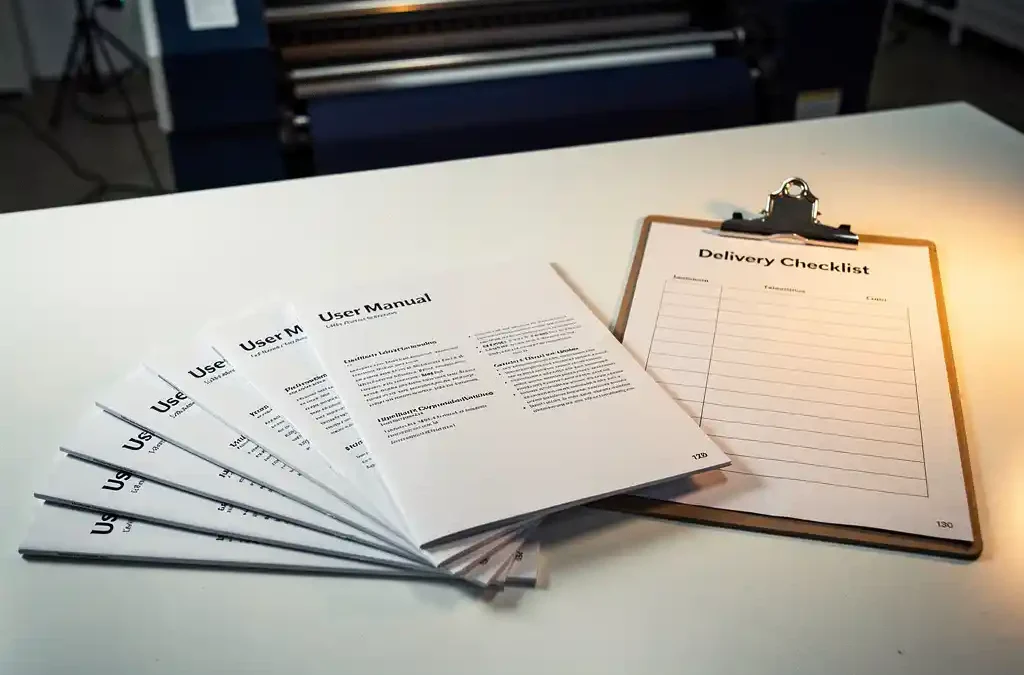
Delays in printing and distributing product documentation can largely be prevented by seamlessly aligning and integrating translation, DTP, and print production early in the process. Most delays do not stem from a single major mistake, but from small coordination errors between consecutive steps that accumulate over time. In this article, we answer the most frequently asked questions on this topic, so you can organize your documentation process more smoothly. Do you already have a specific question? Feel free to get in touch and we will be happy to help.
What are the most common causes of delays in product documentation?
The most common causes of delays in product documentation are late delivery of source materials, unclear approval processes, insufficient coordination between translation and layout, and a lack of alignment with the printer. Each of these bottlenecks can cause delays of several days on its own, but in combination they can completely derail the schedule.
In practice, we see that documentation projects most often get stuck at the point where texts have already been translated but the layout has not yet been prepared for the target language. Languages such as German or French are on average longer than English, which means that text fitting perfectly in the original layout may no longer fit the design after translation. If this only comes to light at the printer, fixing it costs valuable time.
Other common causes include:
- Incomplete or late delivery of source files
- Multiple rounds of revisions due to an unclear brief
- Failure to account for the lead times of external suppliers
- Poor communication between internal teams and external partners
- Missing or outdated reference materials for translators
How does the translation process affect the print production schedule?
The translation process directly affects the print production schedule, because translation must always be completed before final layout and print preparation can begin. Any delay in the translation phase automatically pushes back the DTP phase and the print schedule. The tighter the final deadline, the greater the impact of even a small delay early in the process.
Many organizations treat the translation process as a standalone step, when in reality it is inextricably linked to the rest of the documentation chain. When a translation is delivered later than planned, the DTP specialist has less time to adjust the layout. If that time is not available, mistakes are made that only surface during the print proof, leading to additional rounds of corrections.
A smart approach is to integrate the translation schedule into the overall project plan, including buffers for revision and approval. This prevents the printer from having to wait while the translation team is still working on the final pages.
What role does DTP play in preventing print errors and delays?
DTP (Desktop Publishing) plays a crucial role in preventing print errors and delays, as it forms the bridge between translated text and a print-ready file. A well-structured DTP process ensures that texts fit correctly within the design, that fonts and colors are accurate, and that files meet the printer’s technical specifications.
Without a strong DTP process, errors only surface at the end of the chain — at the point where they are most costly to fix. Think of text that falls outside the margins, images with insufficient resolution, or incorrect color profiles that only become visible on the print proof.
When DTP and translation work closely together, these kinds of issues are caught early. Translators can take space constraints into account from the outset, and DTP specialists can adjust the layout while the text is still in revision. This saves multiple rounds of corrections and keeps the schedule on track.
When does a one-stop solution for translation, DTP, and print production make sense?
A one-stop solution for translation, DTP, and print production makes sense as soon as you are dealing with multilingual documentation, tight deadlines, or multiple product launches per year. The more steps in the documentation chain that are handled by a single partner, the lower the coordination risk and the shorter the turnaround time.
When you use separate suppliers for translation, layout, and printing, you have to manage the coordination yourself. Every handover between parties is a potential point of delay. A translation error that is only discovered at the printer means the file has to go back to the translator, then to DTP, and then back to the printer again.
At Crestec Europe, we offer exactly this integrated approach: translation, DTP, and print production are coordinated internally, resulting in shorter turnaround times and a significantly lower risk of errors. Whether it involves thousands of copies in bulk or smaller print runs on demand, our approach is designed to keep quality and scheduling in balance.
How does effective inventory management and fulfillment ensure timely distribution?
Effective inventory management and fulfillment ensure timely distribution by making printed documentation available at the right time and in the right place, without you having to coordinate the logistics yourself. When inventory and distribution management are integrated into the documentation process, the delays that would otherwise arise between the moment of printing and the moment of delivery to dealers or end customers are eliminated.
Many organizations underestimate how complex the final link in the documentation chain can be. Even when printing goes perfectly and on time, poor coordination with the warehouse or shipping can still cause delays in the market. This is particularly risky for product launches where documentation and product must be available simultaneously.
By placing inventory management and fulfillment with the same partner that handles translation and printing, you remove the coordination link that is most prone to error. This ensures that updated documentation reaches the right recipients quickly and accurately — whether it is a product update or an entirely new product line.
Would you like to know how we can streamline your documentation process from translation to distribution? Get in touch and we will work together to find the best approach for your situation.
Frequently Asked Questions
How do I start streamlining my documentation process if I currently work with multiple separate suppliers?
The best first step is to map all the handover moments between your current suppliers: where is the most time being lost, and where do most errors occur? You can then assess which steps make the most logical sense to consolidate with a single partner. Even if you do not switch over completely right away, combining translation and DTP with the same party is a great starting point, as it eliminates the biggest source of coordination errors.
What is a realistic turnaround time for multilingual product documentation, from source file to printed end product?
Turnaround time depends heavily on the volume, the number of target languages, and the complexity of the layout, but for an average multilingual document you should allow a minimum of two to four weeks when translation, DTP, and print production are properly aligned. Without that alignment, the same job can easily take twice as long due to revision rounds and waiting times between suppliers. Building in a buffer of ten to fifteen percent is a sensible rule of thumb.
How do I prevent translated text from no longer fitting the original layout?
This problem can largely be prevented by accounting for text expansion during the design phase: use flexible text boxes and avoid rigid layouts where every line must be filled exactly. Another effective approach is to involve a DTP specialist with experience in multilingual documents early in the translation process. This way, space issues can be identified and resolved before they become a bottleneck.
What information should I provide to avoid delays at the start of a project?
At the start of a project, always provide the complete source files, including editable layout files, all fonts used, and images in high resolution, along with a clear brief specifying target languages, target audience, and any style guides or terminology lists. The more complete the starter package, the less chance of questions, misunderstandings, and unnecessary revision rounds. Missing reference materials are one of the most common causes of delays early in the process.
How do I manage approval rounds efficiently without delaying the schedule?
Set clear deadlines for each approval round in advance and communicate them explicitly to everyone involved, including internal stakeholders. Limit the number of reviewers to those who actually have decision-making authority, and use a structured feedback form so that comments are consolidated and submitted clearly. Also consider approving content by language or by section rather than all at once, so that DTP and print preparation can get started on the approved parts without waiting.
What are common mistakes when preparing files for the printer?
The most common mistakes are: images with insufficient resolution (less than 300 dpi), the use of RGB color profiles instead of CMYK, insufficient bleed around the page edges, and embedded fonts that were not included with the file. In a professional DTP process, these errors are caught early through a preflight check, so they never reach the printer. If you work with an integrated partner, this check is a standard part of the process.
Is it worthwhile to print product documentation in large quantities in advance, or is print-on-demand a better option?
This depends on how frequently your documentation is updated and how predictable your distribution needs are. Large print runs are more cost-efficient per unit, but carry the risk of being left with outdated materials after a product or regulatory change. Print-on-demand offers greater flexibility and is ideal for rapidly changing product lines or markets with specific local requirements. A good partner will help you find the right balance based on your product cycle and distribution volumes.
Related Articles
- Can I have my printed manuals distributed directly to my dealers in Europe?
- How do I choose the right finish for my printed marketing materials?
- My printed materials need to be FSC- and EUDR-compliant — who can handle that? The Netherlands? Germany? Europe?
- How do I reduce support tickets by improving my product documentation?
- How do you evaluate localisation company capabilities?