
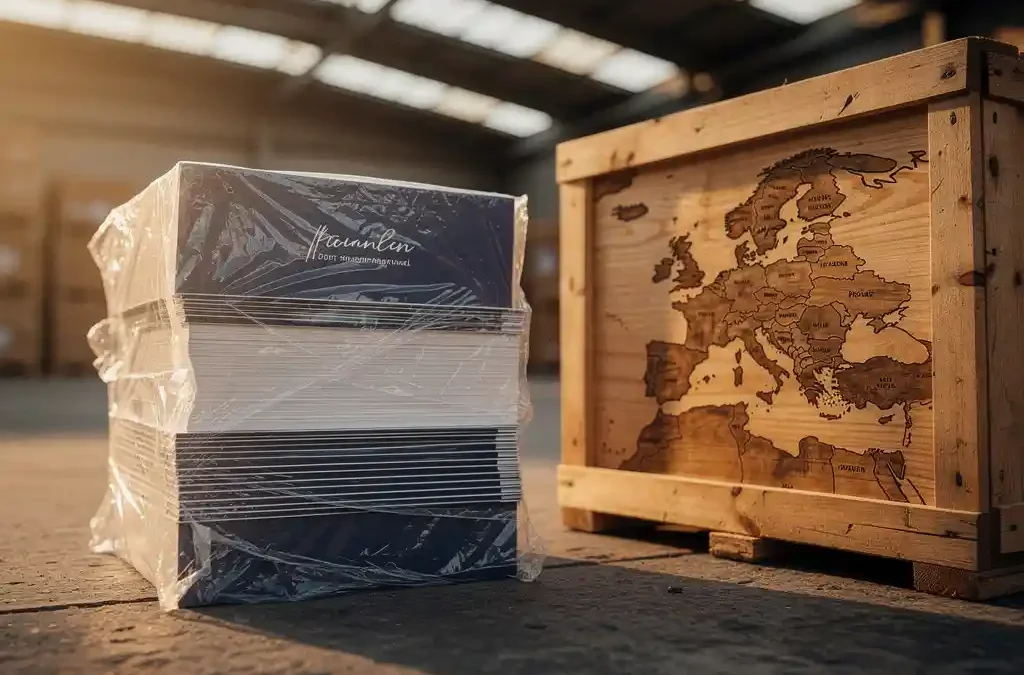
Yes, you can have your printed manuals distributed directly to your dealers across Europe. With the right logistics partner, your manuals are stored in a central warehouse after printing and shipped on demand to individual dealers in every European country. This saves you significantly on shipping costs and coordination time. In this article, we answer the most frequently asked questions about this process, from kitting to customs. Do you already have a specific question? Feel free to contact us and we’ll be happy to help.
What are the options for distributing printed manuals to European dealers?
There are three common options for distributing printed manuals to European dealers: direct shipping from the print facility to each dealer individually, centralized storage with on-demand fulfillment, or decentralized storage through regional distribution centers. For most companies serving multiple European markets, centralized storage combined with fulfillment offers the best balance of cost, speed, and control.
The right choice depends heavily on volume, the number of dealers, and how frequently your manuals are updated. If your product documentation changes regularly due to new software versions, regulations, or product launches, a centralized model is particularly efficient. You maintain a single inventory, update it when needed, and always ship the most current version to your dealers.
At Crestec Europe, we combine print, storage, and shipping into one integrated solution. That means you don’t have to worry about the logistics — we make sure the right manual reaches the right dealer at the right time.
What is kitting and how does it work for manuals?
Kitting is the process of assembling individual documents, manuals, and inserts into one complete set that is packaged and shipped as a whole. For manuals, this means combining the correct language versions, product-specific documents, and any additional inserts before the set is sent to a dealer or end customer.
In practice, kitting works as follows: after printing, the various components are sorted by destination or by dealer. A dealer in Germany receives a set containing a German-language manual, while a dealer in Spain receives the exact same product package — but with a Spanish-language version. All of this is configured in advance based on order information.
Kitting reduces errors at the dealer level and creates a professional, consistent unboxing experience for the end user. It is also a practical way to respond quickly to product changes: you update a single component in the kit without having to reassemble the entire set.
How are multilingual manuals prepared for different European markets?
Multilingual manuals are prepared by translating the source content into the required languages, then laying it out through DTP (desktop publishing) to ensure the design works correctly for each language, and finally printing by language version or as a combined multilingual edition. This process requires close collaboration between translators, DTP specialists, and the print facility.
European regulations require, in many product categories, that manuals be available in the official language of the country where the product is sold. This makes multilingual documentation not just a matter of customer convenience, but also of compliance.
With us, this process is fully integrated: translation, DTP, and printing are coordinated internally, which prevents delays and miscommunication. Changes to the source text are immediately applied across all language versions, ensuring you always have consistent documentation across all markets.
What are the benefits of centralized inventory management for manuals?
Centralized inventory management for manuals offers three concrete benefits: you always have visibility into your stock levels, you prevent outdated versions from remaining in circulation, and you reduce overall logistics costs by printing in larger runs and shipping from a single location.
When manuals are stored decentrally at dealers or regional offices, you quickly lose oversight. Dealers sometimes order too many, other times too few, and when a product is updated it becomes nearly impossible to retrieve all outdated copies. Centralized storage resolves this structurally.
In addition, centralized inventory management provides flexibility when products are updated. If a manual is revised, you only need to update the central stock. Dealers automatically receive the latest version with their next order, without you having to actively replace all printed copies held by them.
Who is responsible for customs and shipping within Europe?
Shipments within the European Union are not subject to customs formalities, as the EU is a single internal market with free movement of goods. Shipments to countries outside the EU — such as Norway, Switzerland, or the United Kingdom — are subject to customs requirements, and the sender must ensure the correct documentation and tariff classification are in place.
When you engage a logistics partner for fulfillment, that partner typically also takes responsibility for correct shipping documentation and handling the appropriate customs declarations for non-EU destinations. It is important to establish this clearly in your agreement from the outset.
For European dealers within the EU, shipping is generally straightforward and fast. Most shipments are delivered within two to five business days, depending on the destination and the carrier selected. A reliable fulfillment partner works with multiple carriers to guarantee the best value for money per destination.
When does it make sense to outsource manual distribution?
Outsourcing manual distribution makes sense once you are serving more than five European markets, regularly updating documentation, or when managing logistics in-house is consuming too much time and resources relative to the value it adds. The greater the geographic spread and the higher the update frequency, the stronger the business case for outsourcing.
Small companies that ship manuals occasionally can often handle this themselves. But once you are dealing with multiple language versions, different product lines, and dealers spread across Europe, complexity grows quickly. A logistics error — such as the wrong language version reaching a dealer — has a direct impact on the customer experience and potentially on compliance.
A partner that offers translation, printing, storage, and dealer shipping under one roof eliminates coordination risks and shortens the lead time between a product update and the moment dealers have the revised documentation in hand. Our ISO 9001 certification confirms that our working processes are structurally assured, while ISO 27001 guarantees that your documentation and business data are handled securely.
Want to find out what we can do for your printed manual distribution? Contact us and we’ll be glad to think through the most efficient approach for your situation.
Frequently Asked Questions
How long does it typically take for a dealer to receive their manuals after placing an order?
Delivery time depends on the destination and the carrier selected, but for most EU countries a delivery time of two to five business days after order processing applies. With a centralized fulfillment model, the manuals are already ready in the warehouse, so no additional production time is added. For time-critical situations, such as a product launch, express shipping can also be arranged.
What happens to the existing stock at a dealer when I need to update a manual?
With centralized storage, dealers automatically receive the updated version with their next order, but previously delivered copies at the dealer remain in circulation until they are used up or retrieved. It is therefore advisable, for significant changes such as safety instructions or legal amendments, to proactively contact dealers and ask them to return outdated copies. A good fulfillment partner can assist with this by tracking which version was shipped to which dealer and when.
Can I have small quantities of manuals shipped per dealer, or is there a minimum order?
This varies by fulfillment partner, but in principle it is possible to ship small quantities per dealer, even down to individual units. The cost per unit is higher for small quantities, as packaging and shipping weigh relatively more heavily. It is advisable to agree on a minimum order threshold per dealer with your partner that is both logistically and financially viable.
How do I ensure the correct language version always reaches the right dealer?
This is managed through a pre-configured dealer profile in your fulfillment partner’s order management system. Each dealer is linked to a specific language or market, so that with every order the correct version is automatically picked and shipped. It is important to keep this dealer profile up to date, especially if dealers operate in multiple countries or language regions.
What are the most common mistakes when setting up European manual distribution?
A common mistake is starting the translation and DTP workflow too late, resulting in the manual not being ready in time for a product launch. Companies also frequently underestimate the complexity of multilingual kitting, leading to incorrect language versions being included. Finally, organizations often forget to put agreements about customs documentation for non-EU countries in writing with their logistics partner, which leads to delays at the border.
Is it possible to distribute digital versions alongside printed manuals through the same process?
Yes, a growing number of fulfillment partners offer hybrid solutions in which printed and digital documentation are managed together. For example, a dealer can receive a QR code or download link alongside a physical manual, pointing to the most current digital version. This is particularly useful for product categories where regular updates are necessary, as the digital version can be updated immediately without the need for reprinting.
What information do I need to request a quote for manual distribution in Europe?
To prepare an accurate quote, the following details are at minimum helpful: the number of language versions and the expected print run per version, the number of dealers and their countries, the average order frequency per dealer, and whether kitting with multiple documents per set is involved. The more detail you can provide, the more accurate the quote and the better the logistics solution can be tailored to your specific situation.
Related Articles
- How do I manage the inventory of printed documentation for multiple countries?
- Who can format and print my documentation?
- How do I distribute printed product manuals to dealers across Europe?
- How do you evaluate localisation company capabilities?
- How do internationalisation and localisation work together?