
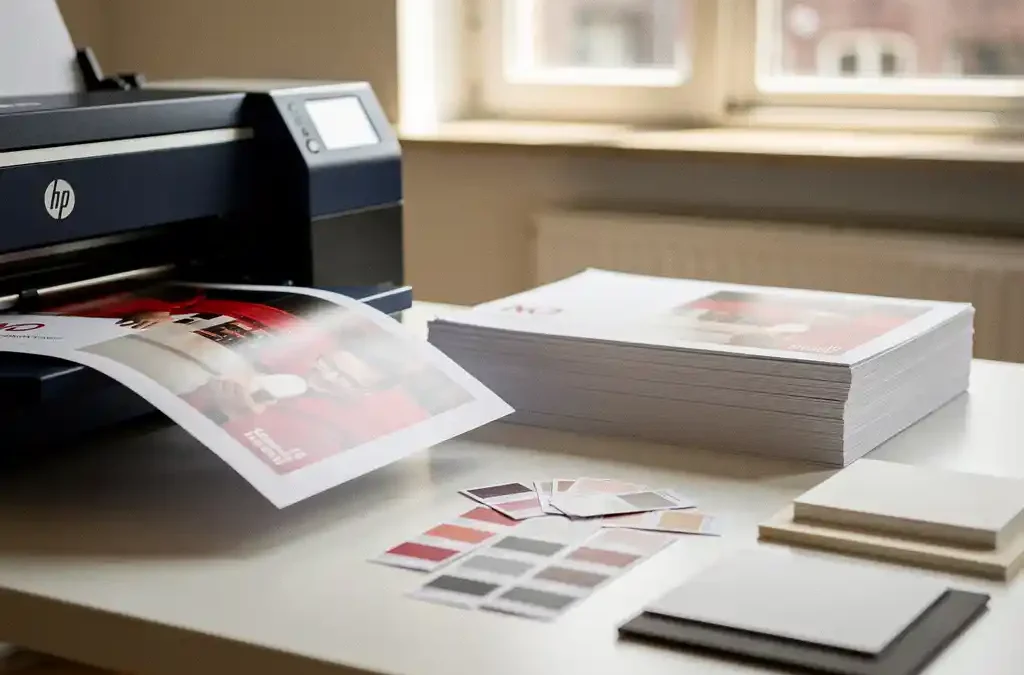
Offset printing uses plates to transfer ink onto paper through a multi-step mechanical process, making it ideal for large print runs where per-unit cost drops significantly. Digital printing skips the plates entirely, printing directly from a file, which makes it faster and more affordable for short runs. The right choice depends on your volume, timeline, and quality requirements — and this article walks through the key differences to help you decide.
How does offset printing actually work?
Offset printing works by transferring ink from a metal plate to a rubber blanket, which then presses the image onto paper. Each colour requires its own plate, and the setup process — known as makeready — takes time and materials before a single sheet is printed. Once running, the press produces consistent, high-quality output at speed.
The name “offset” refers to the fact that ink never touches the plate directly or the paper. Instead, it offsets via the rubber blanket, which gives the process its characteristic sharpness and ink density. This indirect transfer also protects the plate, allowing it to produce tens of thousands of impressions without degrading.
Because plates must be created for every job, offset printing carries a significant upfront cost. That investment only makes sense when spread across a large enough volume. For short runs, those setup costs make offset printing an expensive choice compared to alternatives.
How does digital printing differ from offset in the production process?
Digital printing transfers ink or toner directly from a digital file to the substrate, with no plates, no makeready, and no minimum run requirement. The press reads the file and prints immediately, which dramatically reduces setup time and allows each copy to be personalised or varied without additional cost.
Modern digital presses use either inkjet or laser-based (electrophotographic) technology. Inkjet systems spray microscopic droplets of ink, while laser systems use heat to fuse toner powder onto the page. Both approaches have improved enormously in recent years, narrowing the quality gap with offset for many standard print applications.
The key production difference is flexibility. Digital printing allows on-demand output, meaning you can print exactly the quantity you need, exactly when you need it. This makes it a natural fit for variable data printing, where names, addresses, or personalised content change from one copy to the next.
Which printing method produces better quality results?
For most commercial applications, offset printing still produces marginally superior quality, particularly in colour accuracy, ink density, and consistency across large runs. However, for standard documents, brochures, and everyday marketing materials, modern digital printing delivers results that are virtually indistinguishable to the naked eye.
Offset printing excels in specific areas where quality demands are highest. It supports a wider range of specialty inks, including Pantone spot colours, metallic inks, and varnishes that digital presses cannot always replicate. Colour consistency across thousands of sheets is also more reliable with offset, since the ink-to-paper relationship remains constant once the press is calibrated.
Digital printing has its own quality strengths. Because there is no plate wear and no makeready variation, the first and last sheet of a digital run look identical. For short runs, this consistency is actually an advantage over offset, where the first few hundred sheets may vary slightly while the press stabilises.
The honest answer is that for most projects in 2026, quality is rarely the deciding factor between the two methods. Volume, cost, and turnaround time are usually more relevant.
When does offset printing become more cost-effective than digital?
Offset printing becomes more cost-effective than digital when print volumes are high enough to absorb the upfront plate and setup costs. The crossover point varies by job, but as a general principle, offset typically becomes the better value somewhere between 500 and 2,000 copies, depending on format, paper, and complexity.
Below that threshold, the per-unit cost of digital printing is lower because there are no setup fees to recover. Above it, the economics reverse: offset setup costs become a smaller fraction of the total, and the press runs efficiently at a low cost per sheet.
Other cost factors also favour offset at scale. Specialty finishes, unusual paper stocks, and large-format jobs often suit offset better, and the cost difference widens further when those variables are introduced. For long-run catalogues, annual reports, or product manuals printed in high volumes, offset remains the commercially sensible choice.
What types of projects are best suited to each printing method?
Offset printing is best suited to high-volume, standardised projects where quality and consistency are paramount. Digital printing is best suited to short runs, personalised content, or jobs with fast turnaround requirements. Choosing the right method comes down to matching the print technology to the project’s specific demands.
Projects that suit offset printing
- Large-volume product catalogues and brochures
- Annual reports and corporate publications
- Packaging requiring Pantone or spot colour accuracy
- Printed manuals and technical documentation in high quantities
- Newspapers and magazines with fixed, recurring content
Projects that suit digital printing
- Short-run marketing collateral and event materials
- Personalised direct mail and variable data campaigns
- Prototypes and proofs before committing to a full offset run
- On-demand reprints of documentation or user guides
- Multilingual print jobs where each language version has a small print quantity
That last point is particularly relevant for companies managing multilingual content. When a document needs to be printed in ten languages with 200 copies per language, digital printing is almost always the practical and cost-effective solution.
Does the choice of printing method affect localisation and DTP workflows?
Yes, the printing method directly influences how localisation and desktop publishing (DTP) workflows are structured. Offset printing requires print-ready files with precise colour profiles, bleed settings, and plate-specific specifications, which adds complexity to the DTP stage. Digital printing is more forgiving in file preparation and better suited to the iterative nature of multilingual projects.
In a typical translation and localisation project, translated text often expands or contracts compared to the source language. German text, for example, can run 30% longer than English. This text expansion affects layout, and DTP work must be completed for every language version before files go to print. With digital printing, last-minute layout corrections can be incorporated quickly without the cost of remaking plates.
For offset jobs, the DTP and localisation workflow must be locked down before plates are produced. Any changes after that point are expensive. This means that offset printing demands a more thorough sign-off process and tighter coordination between the translation, DTP, and print teams.
When translation, DTP, and printing are managed under one roof, these workflow dependencies become much easier to handle. We integrate these steps seamlessly, ensuring that localised files move efficiently from translated text through DTP to print, regardless of which printing method is used. If you are planning a multilingual print project and want to discuss the best approach for your volume and timeline, we would be glad to help — request a quote or get in touch with us directly.
Frequently Asked Questions
How do I get a proof before committing to a large offset print run?
The most practical approach is to use digital printing to produce a short proof run before committing to offset plates. Because digital presses print directly from the same file you will submit for offset, a digital proof gives you a reliable representation of layout, colour, and content. Once you are satisfied with the proof, your DTP files can be finalised and sent for plate production with confidence.
Can I switch from digital to offset mid-project if my print volumes increase?
Yes, but the transition requires careful planning. If your volumes grow beyond the digital-to-offset crossover point, you will need to ensure your files meet offset specifications — including correct colour profiles, bleed settings, and ink density requirements — which may mean additional DTP work. It is worth discussing potential volume growth with your print supplier at the outset so your files are prepared to the highest standard from the start, making any switch straightforward.
What file formats and colour profiles should I supply for each printing method?
For offset printing, files should typically be supplied as press-ready PDFs using CMYK colour mode (or with specified Pantone spot colours where applicable), with 3–5mm bleed and all fonts embedded. Digital printing is more flexible and can often accept RGB files, though supplying CMYK PDFs is still best practice for predictable colour output. Always confirm the exact specifications with your print supplier before finalising files, as requirements vary between presses and facilities.
How does paper stock choice differ between offset and digital printing?
Offset printing supports a significantly wider range of paper stocks, including uncoated, textured, and heavyweight substrates that digital presses may struggle to handle reliably. Digital presses, particularly laser-based systems, can have limitations with very thick stocks or highly textured surfaces because of how toner adheres under heat. If your project calls for a specialist paper, confirm substrate compatibility with your supplier early — the paper choice can sometimes influence which printing method is the more viable option.
What are the most common mistakes to avoid when briefing a print job?
The most frequent mistakes are underestimating final print quantities, supplying files in the wrong colour mode, and failing to account for text expansion in multilingual projects before DTP is completed. Underestimating quantity is particularly costly with offset printing, since reprinting a short top-up run digitally later will carry a higher per-unit cost than printing the correct quantity upfront. Providing a thorough brief — including confirmed quantities, language versions, paper preferences, and intended use — gives your supplier the information needed to recommend the right method and avoid costly revisions.
Is digital printing a viable long-term solution for recurring print needs, or should I plan to move to offset eventually?
Digital printing is a perfectly viable long-term solution for many organisations, particularly those with diverse, short-run, or frequently updated materials. However, if a specific print item is produced in consistently high volumes on a recurring basis — such as an annual catalogue or a product manual printed in thousands of copies — offset will almost always deliver a lower cost per unit over time. A practical approach is to start with digital, track your actual consumption, and reassess the economics once you have reliable volume data.
How does variable data printing work in practice, and what are its limitations?
Variable data printing (VDP) uses a digital press to merge a fixed design template with a database of personalised content — such as names, addresses, personalised offers, or QR codes — so that each printed copy is unique. The main practical limitation is data quality: if your database contains errors or inconsistencies, those errors will appear in print, so thorough data validation before the job runs is essential. Very complex variable layouts with large image swaps can also slow press output speeds, so it is worth discussing the scope of personalisation with your supplier when planning turnaround times.
Related Articles
- Who can handle my promotional print materials for European retail?
- How can I use my printed documentation to improve the customer experience?
- What are the advantages of local printing versus central printing and distribution?
- Do I need to have translated PDF manuals available for the countries I export to?
- I need a print-on-demand partner for all my European markets