
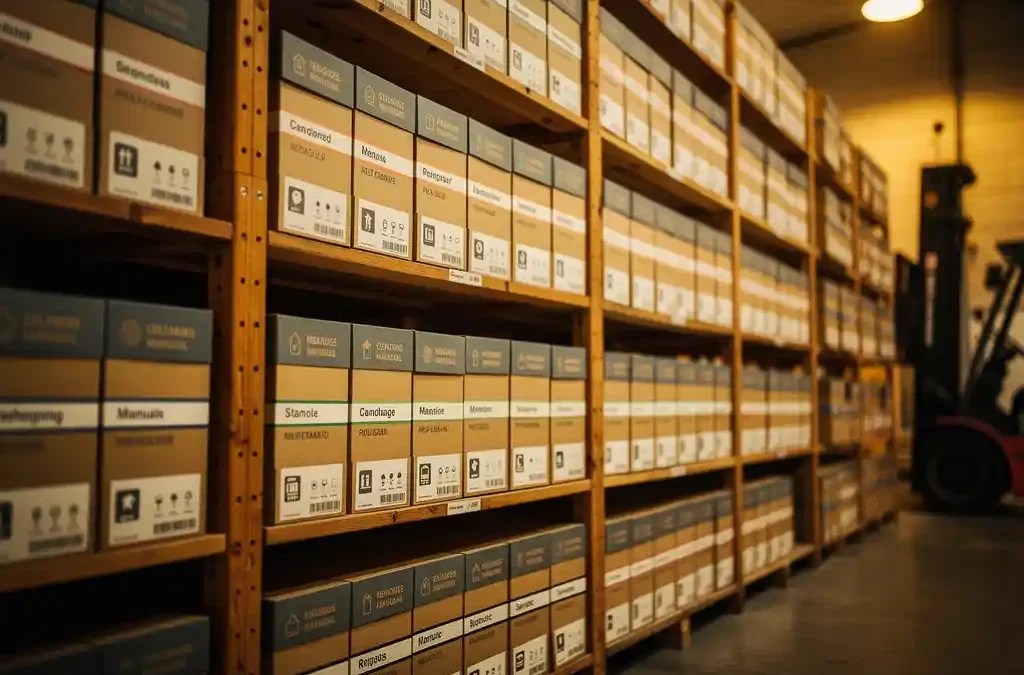
Managing printed documentation inventories across multiple countries requires a combination of central oversight, smart storage decisions, and clear agreements with suppliers. By determining stock levels per country based on consumption data, maintaining tight version control, and working with a fulfillment partner, you can avoid both shortages and waste. Curious about how this works in practice? We’re happy to help, so feel free to get in touch. In this article, we answer the most frequently asked questions on this topic.
What challenges does printed documentation for multiple countries involve?
Printed documentation for multiple countries presents challenges in the areas of language versions, local regulations, shipping logistics, and version control. Each country requires specific content — sometimes a different layout or paper size as well — while stock must be available in the right place at the right time. This makes coordination between teams, suppliers, and storage locations complex.
When a company operates in ten or more countries, the number of unique document variants quickly adds up. Think of user manuals in different languages, country- or market-specific safety warnings, and documents that must comply with local legal requirements. Every change to the source product means multiple versions need to be updated and reprinted simultaneously.
On top of that comes the logistical complexity: how do you ensure stock is replenished on time without holding large quantities for longer than necessary? Delays in print production or shipping can lead to empty shelves at dealers or distributors, while overproduction results in waste when a new product version renders the old documentation obsolete.
How do you determine the right stock levels per country?
You determine the right stock levels per country by combining historical consumption, projected demand, reprint lead times, and local seasonal patterns. Use consumption data from at least the past twelve months as a baseline, and adjust for planned product launches or marketing campaigns that will temporarily increase demand.
A practical starting point is to work with a minimum stock level — also known as safety stock — large enough to bridge the lead time for a new print order. Set that lead time realistically: including translation, layout, printing, and shipping, it can easily be three to six weeks for complex documents.
In addition to safety stock, it is worth examining the distribution method for each country. Countries with a large dealer network or many points of sale require larger buffers than countries where documentation is only shipped through a central webshop. By analyzing these factors separately for each country, you can avoid both shortages and unnecessary overproduction.
What is the difference between centralized and decentralized storage?
With centralized storage, all printed documentation is managed and shipped from a single location to all destination countries. With decentralized storage, stock is distributed across multiple regional depots, closer to the final destination. The key difference lies in the trade-off between control and speed.
Advantages of centralized storage
Centralized storage gives you complete visibility over all stock from a single point. It is easier to make adjustments, version control is simpler to maintain, and you need to hold less safety stock because your inventory can be deployed flexibly across multiple countries. This model works well when delivery times to all countries are acceptable and demand is reasonably predictable.
Advantages of decentralized storage
Decentralized storage significantly reduces delivery times to the end customer or dealer. For markets with high and irregular consumption, a regional depot can make the difference between timely delivery and a shortage. The downside is that you need a higher total stock level and version control becomes more difficult: when a document is updated, all depots must be updated and outdated copies must be removed.
In practice, many organizations opt for a hybrid model: a central main depot with limited regional buffers for the most active markets.
How do you prevent waste from outdated document versions?
You prevent waste from outdated document versions by combining print-on-demand with strict version control and short print runs. Do not print more than you need in the short term, maintain a central version register, and establish a clear policy for retiring old copies as soon as a new version becomes available.
A common mistake is printing large runs to reduce the unit cost, without accounting for the likelihood of product changes. The savings on print costs rarely outweigh the expense of destroying and reprinting thousands of copies. Shorter, more frequent print runs are in many cases more cost-effective on an annual basis.
Digital print solutions also make it possible to produce documents on demand, so you always deliver the most up-to-date version without holding large stocks. Combine this with clear document version numbering and a procedure for recalling and destroying outdated copies at all storage locations.
What role does a fulfillment partner play in documentation management?
A fulfillment partner takes care of storage, order picking, and shipping of printed documentation, freeing your organization to focus on document content and management. A good partner offers real-time stock visibility, handles distribution to dealers or end customers in multiple countries, and proactively flags when stock needs to be replenished.
The added value lies primarily in process integration. When translation, printing, and fulfillment are handled by the same partner, the coordination burden across multiple suppliers disappears. A product update then directly triggers a coordinated process: the new text is translated, laid out, printed, and automatically processed in the inventory management system.
At Crestec Europe, we offer exactly this integrated approach: from translation and DTP to printing, storage, and shipping — all under one roof. Our ISO 9001 certification ensures that every part of that process meets defined quality standards, while ISO 27001 ensures that your documentation data is handled securely.
How do you maintain oversight of documentation inventories across multiple countries?
You maintain oversight of documentation inventories across multiple countries by working with a central inventory management system that provides real-time visibility into all storage locations, combined with fixed reporting intervals and clear reorder points per document type and per country. Without central registration, it is impossible to make timely adjustments.
In practical terms, this means that every country or storage location uses the same system for recording incoming and outgoing stock. Choose a system that can be integrated with your order management system or ERP, so that orders from dealers or points of sale are automatically processed in the inventory administration.
Also set fixed reorder points for each document variant. As soon as the stock of a specific language version falls below that level, a signal is automatically generated to initiate a new print order. This prevents both last-minute rush orders and the accumulation of unnecessary buffers. Regular physical stock audits — at least once per quarter — help identify and correct discrepancies between the system and reality in a timely manner.
Effective inventory management of printed documentation across multiple countries requires structure, the right systems, and a reliable partner who connects multiple links in the process. Want to find out how we can simplify your documentation management? Get in touch and we’ll work together to find the best approach for your situation.
Frequently Asked Questions
How do I get started setting up structured inventory management for printed documentation across multiple countries?
Start by taking stock of all existing document variants per country, including language versions, version numbers, and current storage locations. Then map out historical consumption per variant and use this data to establish safety stock levels and reorder points. Next, work with a fulfillment partner who can connect a central inventory management system to your internal order processes, giving you immediate real-time visibility.
What are the most common mistakes in managing multilingual documentation inventories?
The most common mistake is printing large runs to reduce the unit cost, without accounting for upcoming product changes or version updates. Other frequent errors include the absence of a central version register — which allows outdated copies to remain in circulation — and failing to set up automatic reorder points, leading to last-minute rush orders with higher costs. A clear version control policy and shorter print runs prevent most of these problems.
Is print-on-demand suitable for all types of printed documentation, or are there exceptions?
Print-on-demand is ideal for documents that are updated regularly, such as user manuals, safety instructions, and product data sheets. For documentation with very high and stable consumption, such as standard packaging inserts, a larger print run may still be more cost-effective. The key is to evaluate each document type individually, weighing update frequency, consumption volume, and the risks of obsolescence.
How do I handle urgent documentation requests for a specific country?
Make sure your fulfillment partner has a clear rush procedure with agreed lead times for urgent print orders and express shipping to specific countries. By maintaining adequate safety stock and setting reorder points in a timely manner, you significantly reduce the likelihood of rush requests. Should a rush order still be necessary, an integrated partner who handles translation, printing, and shipping under one roof is a major advantage, as no time is lost coordinating between multiple suppliers.
How do I ensure that outdated document versions are actually removed from all storage locations?
Establish a formal recall policy that is automatically triggered as soon as a new document version becomes available: all storage locations receive an instruction to block, return, or destroy old copies before the new version is distributed. Combine this with clear physical labeling on boxes or pallets — such as a version number or color coding — so warehouse staff can immediately identify outdated stock. Quarterly audits help verify that the policy is being followed in practice.
What requirements should a good inventory management system for printed documentation support?
A suitable system provides real-time visibility into stock at all locations, supports automatic reorder notifications per document variant, and can be integrated with your ERP or order management system. It is also important that the system supports version control, so you can see which version of each document type is held at which location and when it was last updated. Ask your fulfillment partner whether they offer their own portal or system integration, so you are not reliant on manual reports.
How do I keep the costs of international documentation management under control without compromising on quality or delivery time?
The greatest cost savings come from avoiding overproduction, reducing rush orders, and consolidating suppliers. By working with a single integrated partner for translation, printing, storage, and shipping, you eliminate coordination costs and reduce the risk of errors between links in the chain. Review stock levels per country annually based on current consumption data, so buffers do not grow unnecessarily and you only print what you actually need.