
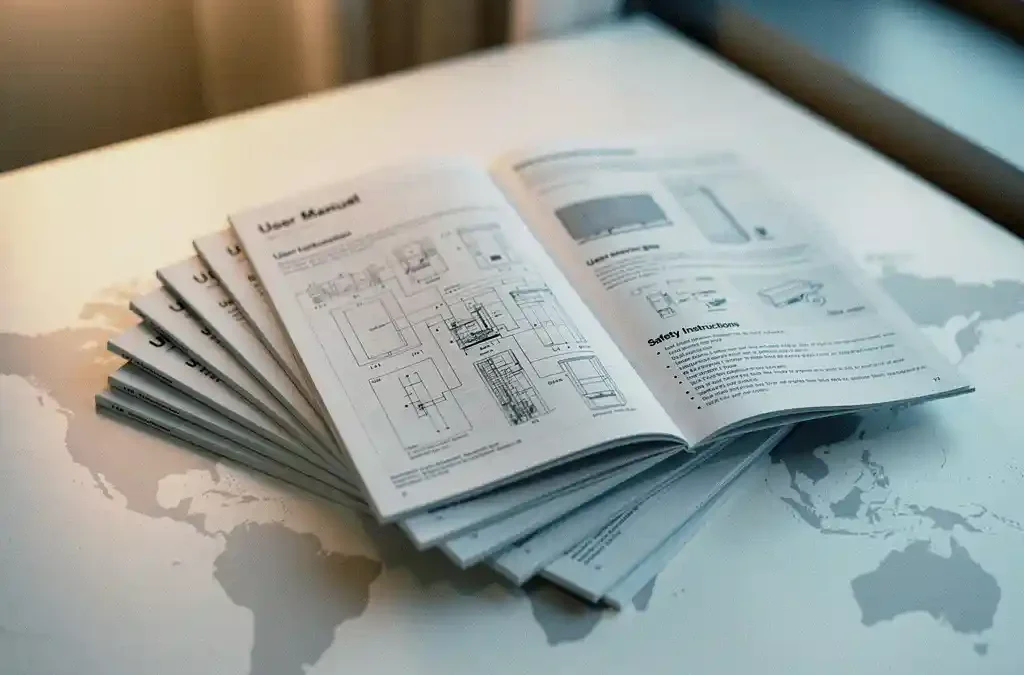
Yes, in most countries you export to, you are required to include a manual in the local language with your product. This is especially true within the European Union, where CE marking requires that user instructions be available in the official language or languages of the country of sale. In this article, we answer the most frequently asked questions about translated manuals, export requirements, and choosing the right translation partner. Have a question right away? Feel free to contact us and we’ll be happy to help.
Which countries require a translated manual for import?
Within the European Union, manufacturers and importers are legally required to provide manuals in the official language or languages of the country where the product is placed on the market. This is established in various EU directives, including the Machinery Directive, the Low Voltage Directive, and the General Product Safety Regulation. Outside the EU, similar requirements apply in countries such as the United Kingdom, Canada, Australia, and Japan.
For products subject to CE marking, a translated manual is not optional — it is mandatory. If it is missing, the product may not legally be sold in that country. The specific language requirements vary by country:
- EU member states: manual required in the official language of the country of sale, sometimes in multiple languages simultaneously
- Switzerland: German, French, and Italian are required for most product categories
- Canada: both English and French are mandatory for consumer products
- Japan: Japanese manual required for the import of electrical appliances and medical devices
- Brazil: Portuguese translation mandatory for certified products
It is advisable to check the applicable regulations for each export market, as requirements can vary significantly by product category.
Is a manual legally required to be provided as a PDF?
No, in most cases there is no legal obligation to provide a manual specifically as a PDF. The law generally stipulates that the information must be available and accessible to the end user, but does not prescribe a specific format. Printed manuals, digital files, and online documentation can all meet the requirements, provided the user can access them easily.
There are exceptions, however. For certain product categories, such as medical devices or industrial machinery, legislation may specify that documentation must be available in a durable and legible form. In practice, many companies opt for a combination of printed material and a digital version, precisely to meet a range of different requirements.
From a usability and cost-efficiency perspective, a digital manual offers clear advantages: easy to update, inexpensive to distribute, and always accessible. That said, a printed manual remains the standard in many sectors, particularly for complex machinery, consumer electronics, and medical equipment. A well-organized print process ensures that printed manuals align seamlessly with the translated and typeset content.
What are the consequences of a missing or incorrect translation?
A missing or incorrect manual translation can result in serious legal, financial, and reputational damage. In the worst case, your product may be denied customs clearance or prohibited from sale in the destination country. Customs authorities and market surveillance bodies have the power to block, return, or even destroy products if the documentation does not meet local requirements.
The potential consequences include:
- Market access blocked: products without a compliant manual may not be sold
- Fines and penalties: regulatory authorities can impose fines on importers or distributors
- Product liability: if an accident occurs due to incorrect instructions, the manufacturer may be held liable
- Reputational damage: complaints about unclear or inaccurate manuals harm brand image
- Costly recalls: if an error in the manual creates a safety risk, a product recall may become necessary
An error in a technical manual is therefore never just a linguistic problem. It is a risk to the safety of the end user and to the legal standing of your business.
How do I know which languages my manual needs to be in?
The languages required for your manual are determined by the countries and regions where you sell or distribute your product. The first step is to map out your export markets and then check the applicable language requirements for each market based on the product category and relevant regulations.
A practical approach looks like this:
- Compile a list of all countries where your product is actively sold or exported to
- Check which directives or standards apply to your product category in each country
- Identify the mandatory languages based on the official national languages and any regional requirements
- Account for future export markets so that your documentation is scalable
- Consult a specialized translation partner for advice on market-specific requirements
Within the EU, this often means a manual must be available in ten or more languages if you are active in multiple member states. Some companies opt for a combined multilingual manual, while others prefer separate documents per language. Both approaches are viable, as long as the content is complete and accurate.
What is the difference between translation and localization of a manual?
Translation is the process of converting text from one language to another, while localization goes further by adapting the content to the cultural, technical, and legal context of the target market. For manuals, localization means that not only the words are translated, but also units of measurement, symbols, safety warnings, and even the layout are adapted to local standards and expectations.
Concrete examples of localization in manuals:
- Conversion of imperial measurements to metric units (or vice versa)
- Adaptation of safety symbols to local standards (such as ANSI in the US versus ISO in Europe)
- Adaptation of legal disclaimers to local regulations
- Reformatting the layout for languages read from right to left
- Adaptation of color usage or images that may be culturally sensitive
For technical manuals, localization is in many cases a necessity, not merely a preference. A literal translation may be technically accurate yet still cause confusion or even danger if the context is not right. Anyone who takes their documentation seriously will choose an approach that goes beyond simple word-for-word translation.
How do I choose the right partner for translating technical manuals?
The right partner for translating technical manuals combines subject-matter expertise, proven quality processes, and the capacity to produce multilingual documentation efficiently. When making your choice, look for demonstrable experience in your industry, certified quality management systems such as ISO 9001, and the ability to handle translation, typesetting, and printing under one roof.
Key criteria when selecting a translation partner:
- Industry experience: a partner with knowledge of technical terminology in your field makes fewer errors and works more efficiently
- Quality certification: ISO 9001 certification confirms structured quality management throughout the production process
- Information security: ISO 27001 certification guarantees that your documentation and business data are handled securely
- Language coverage: a partner offering more than 90 languages gives you the flexibility to expand into new markets
- Integrated services: a provider that combines translation, DTP, and printing saves time and reduces coordination risk
At Crestec Europe, we offer exactly this integrated approach: from translation and typesetting to printing and fulfillment, all under one roof. This means you don’t need to coordinate multiple suppliers, and the entire journey from product update to delivered print runs as smoothly as possible. Ready to take the next step? Get in touch and we’ll be glad to discuss what we can do for your documentation project.
Frequently Asked Questions
How long does it typically take to have a technical manual translated?
The turnaround time depends on the length of the manual, the number of target languages, and the complexity of the content. An average manual of 50 pages in one language is typically ready within five to ten business days, while multilingual projects involving ten or more languages take longer. By working with a partner who combines translation, typesetting, and printing, you avoid unnecessary waiting times between the various stages of the process.
Can I reuse an existing translation when my product is updated?
Yes, in many cases this is possible and even advisable from a cost perspective. Professional translation agencies work with Translation Memory, which automatically reuses previously translated sentences and segments when an update is made. This not only saves time and money, but also ensures consistency in terminology and tone across different versions of your documentation. Just make sure your partner accurately identifies the updated sections, so that only the changed parts are retranslated.
What are the most common mistakes when having technical manuals translated?
A common mistake is engaging a general translation agency without specific technical or industry knowledge, which leads to incorrect terminology and potentially dangerous instructions. Other frequent errors include skipping the typesetting stage after translation — causing text to overflow text boxes or images to no longer align — and ignoring localization requirements such as adapted safety symbols or units of measurement. Finally, many companies underestimate the importance of a final review by a native speaker with subject-matter expertise.
Is a machine-translated manual (such as via AI or DeepL) legally valid?
Machine translation alone is in most cases legally insufficient for technical manuals that fall under CE marking or other product regulations. Legislation generally requires that documentation be accurate, comprehensible, and complete, and machine translations regularly contain errors in technical terminology, safety phrasing, and contextual nuance. Machine translation can serve as a starting point, provided the output is always post-edited and validated by a qualified human translator with subject-matter expertise.
Do I need to print a separate manual for each country, or can I use a combined multilingual version?
Both options are legally permitted, as long as the manual contains all required languages for the country of sale and the information is complete and accurate. A combined multilingual manual is more cost-efficient for large print runs and reduces the risk of including the wrong version with a product. The downside is that the document can become thicker and less user-friendly; some sectors, such as medical devices, impose additional requirements in this regard. Discuss with your translation and print partner which approach best suits your product category, distribution strategy, and budget requirements.
How do I ensure my manual remains consistent across multiple languages and versions?
Consistency starts with a well-managed source document: make sure your source manual — whether in Dutch or English — is always the current version and that changes are tracked centrally. Use a translation partner that works with Translation Memory and termbase management, so that technical terms and standard phrases are applied uniformly across all languages. In addition, establish a clear version control process whereby every update to the manual automatically triggers a revision of the translated versions, ensuring all language versions remain in sync at all times.
What does it typically cost to have a technical manual translated?
The cost of translating a technical manual is determined by factors such as word count, language pairs, content complexity, and the desired turnaround time. On average, professional translation agencies charge between €0.12 and €0.25 per word per language for technical texts, excluding typesetting and printing. For multilingual projects, volume discounts and reuse through Translation Memory can significantly reduce the total cost. Always request a detailed quote based on your specific project, so you can make a fair comparison between providers.
Related Articles
- What are the risks of working with multiple print partners in different countries?
- What are the options for custom print materials for my B2B communications?
- Who can format and print my documentation?
- How do you adapt UI design for different cultures?
- What are the biggest software localisation challenges?