
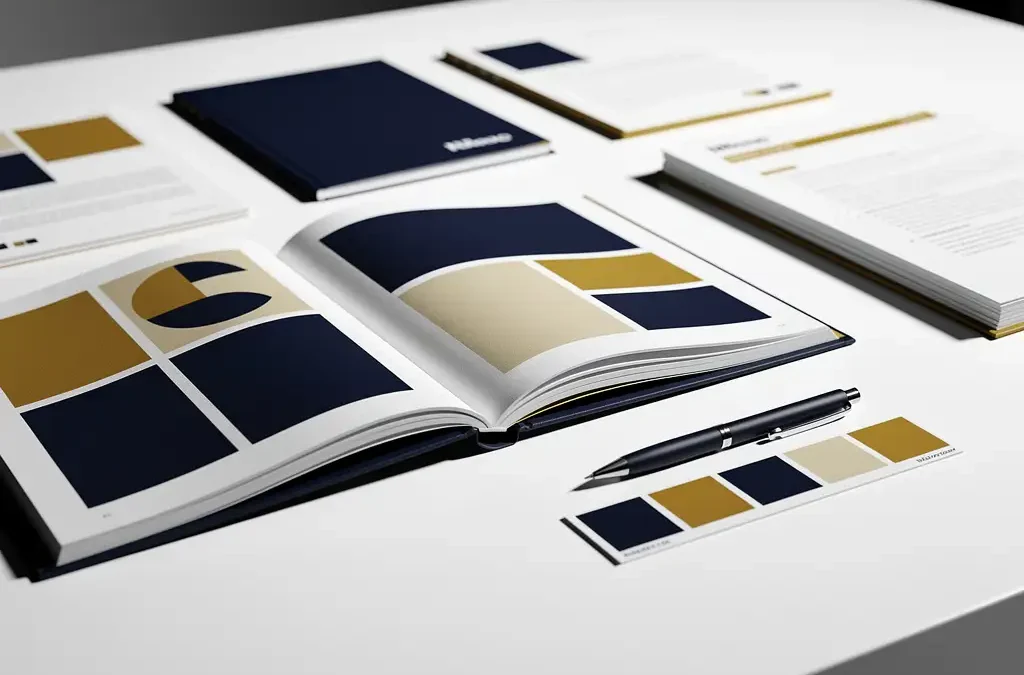
Maintaining brand identity in documentation means applying a consistent house style, using fixed terminology, and consistently incorporating visual elements such as logos, colors, and typography in every document your organization produces. This applies to technical manuals, marketing materials, and printed documents alike. The questions below guide you step by step through embedding brand identity across all your documentation, including during translation and localization. Have questions about how we can help? Feel free to contact us.
Which elements define brand identity in documentation?
Brand identity in documentation is shaped by a combination of visual and textual elements that together create a recognizable whole. Think of the logo, color palette, typography, tone of voice, and document structure. Together, these elements give readers an immediate sense that they are engaging with your brand, even before they read the content.
Visual elements are often the first thing people notice. Consistent use of brand colors and fonts ensures that a technical manual, a product brochure, and a software interface all unmistakably belong to the same brand. But writing style also plays a major role. Do you address customers formally or informally? Do you use professional or conversational language? These choices are just as defining as the color of your logo.
Structure and layout matter as well. Documents with a consistent format, recognizable headings, and a logical flow convey professionalism and strengthen trust in your brand. Brand identity, then, is not simply a matter of placing a logo on a document — it is a carefully considered system that runs through every element of your documentation.
How do you ensure a consistent house style across all documents?
Achieving a consistent house style across all documents starts with creating a clear style guide and applying it consistently to every document your organization publishes. A style guide defines which colors, fonts, logo variants, and writing conventions apply, so that everyone who creates or edits documents is working from the same foundation.
A solid style guide should include at least the following elements:
- Logo usage and exclusion zones
- Primary and secondary colors with exact color codes
- Typography guidelines, including font sizes and line spacing
- Tone and writing style, including example sentences
- Document templates for commonly used formats
Alongside a style guide, it is important to use document templates. Templates prevent team members from having to make formatting decisions from scratch each time, which reduces the risk of inconsistencies. In larger organizations, a central library of approved templates and assets helps keep everyone aligned.
DTP — desktop publishing — plays a crucial role here. A professional DTP team ensures that documents are not only accurate in content, but also visually aligned with the house style, even when text is updated or documents are reformatted.
What happens to brand identity during translation and localization?
During translation and localization, brand identity risks becoming diluted if clear guidelines are not in place. Translators work with text, but the visual layout, terminology, and tone must also hold up in the target language. A translation that is technically correct but does not align with the brand’s style can undermine your organization’s image in another market.
Localization goes beyond translation. The goal is for a document in another language and culture to convey the same brand experience as the original. This means that color choices may sometimes need to be reconsidered due to cultural associations, that tone is adjusted to local communication norms, and that terminology remains consistent through an approved termbase or glossary.
Printed documentation adds an extra dimension. When printing localized documents, layout and house style must be reviewed again, because text in other languages may be longer or shorter than the original. Seamless collaboration between translation, DTP, and print production is essential to maintaining brand identity across all language versions.
Which tools help maintain brand identity in documentation?
Tools that help maintain brand identity in documentation include translation memories, termbases, digital style guides, and DTP software. Together, these tools ensure that documents remain consistent, regardless of who creates them or in which language they appear.
The most commonly used tools are:
- Translation memory: stores previously translated sentences so that the same phrasing is consistently reused in new documents.
- Termbase or glossary: an approved word list of brand-specific terms in multiple languages, ensuring that product names and technical terms are always rendered the same way.
- Digital style guide: a centrally accessible document containing all house style guidelines, preferably online so that updates are immediately available to everyone.
- DTP software: programs such as Adobe InDesign ensure that documents are formatted correctly after translation.
- Quality assurance tools: software that automatically checks whether translations are consistent with the termbase and translation memory.
The combination of these tools is more powerful than any single instrument on its own. A translation memory without an approved termbase will still produce inconsistent terminology. And DTP software without a clear style guide will deliver documents that deviate visually from the brand. Investing in a well-structured set of tools pays off in the long run.
When should you bring in a professional documentation partner?
You should bring in a professional documentation partner when the complexity, volume, or linguistic diversity of your documentation exceeds what can be managed internally. This is especially true when documents need to be published in multiple languages, when printed materials must maintain a consistent house style across different markets, or when both speed and quality are critical.
Practical signs that it is time to work with a partner include:
- Documents in more than two languages need to be managed
- Internal staff are spending too much time on formatting and translations
- There are complaints about inconsistent terminology or visual discrepancies
- Localized documents also need to be printed and distributed
- No internal DTP team is available to check formatting after translation
At Crestec Europe, we combine translation, DTP, and print production under one roof, eliminating coordination risks and reducing turnaround times. Our ISO 9001 certification guarantees structured quality management throughout the entire production process, while ISO 27001 ensures that your documentation and business data are handled securely. Whether it involves bulk printing, point-of-sale materials, or localized technical documentation, we make sure your brand identity remains recognizable in every document. Get in touch and find out what we can do for your documentation process.
Frequently Asked Questions
How do I start creating a style guide if my organization doesn't have one yet?
Start with an audit of existing documents to identify which visual and textual elements are already being used consistently. Document these elements in a simple file covering logo guidelines, color codes, fonts, and writing conventions. Start small and expand the style guide gradually as you add more documents and formats. A professional documentation partner can help you build this foundation quickly and in a structured way.
What are the most common mistakes when maintaining brand identity in documentation?
The most common mistakes include the absence of a central style guide, inconsistent use of logo variants and colors, and failure to maintain an approved termbase. Layout checks after translation are also frequently skipped, causing localized documents to deviate visually from the original. Another pitfall is that templates are created but not updated when the house style evolves, leaving outdated versions in circulation.
How do I ensure that external suppliers and freelancers also follow the brand guidelines?
Always actively share your style guide, approved templates, and termbase with external parties at the start of a collaboration, and include brand guidelines in your briefing or contractual agreements. A digital, centrally accessible style guide has a clear advantage here: updates are immediately visible to everyone. Also schedule a review moment for every document delivered by an external party, so that deviations are identified and corrected early in the process.
How do I handle text expansion when translating printed documents?
Text expansion is a common challenge in translation: a text in German or French can be up to 30% longer than the Dutch or English source text. Account for this during the design phase by using flexible layouts with adjustable text frames. An experienced DTP team will adjust the layout after translation without compromising the house style. This is one of the reasons why translation and DTP are best handled as an integrated process.
How often should I review my style guide and document templates?
Review your style guide at least once a year, or immediately after a rebranding, a merger, or a significant expansion of your product portfolio. Process small updates — such as new product names or adjustments to the color palette — as quickly as possible to prevent outdated guidelines from remaining in circulation. Pair every update with a communication moment to all staff and external partners who work with the documentation, so that everyone is always working with the most current version.
Is brand identity in documentation relevant for purely digital documents such as PDFs and emails?
Absolutely. Digital documents such as PDFs, presentations, email templates, and online manuals are often the first point of contact with customers or partners, making them an important part of the brand experience. The same guidelines for typography, color, tone, and structure apply here just as much as for printed materials. Make sure your style guide explicitly addresses digital formats, including guidelines for screen resolution, interactive elements, and accessibility.
What is the difference between a termbase and a translation memory, and do I need both?
A termbase is an approved word list of brand-specific terms, product names, and technical concepts in multiple languages, ensuring consistent terminology. A translation memory stores complete translated sentences and paragraphs, so that previously approved translations are automatically reused in new documents. Both tools complement each other: the termbase manages word choice at the term level, while the translation memory ensures consistency at the sentence level. Together, they form the backbone of an efficient and brand-compliant translation process.