
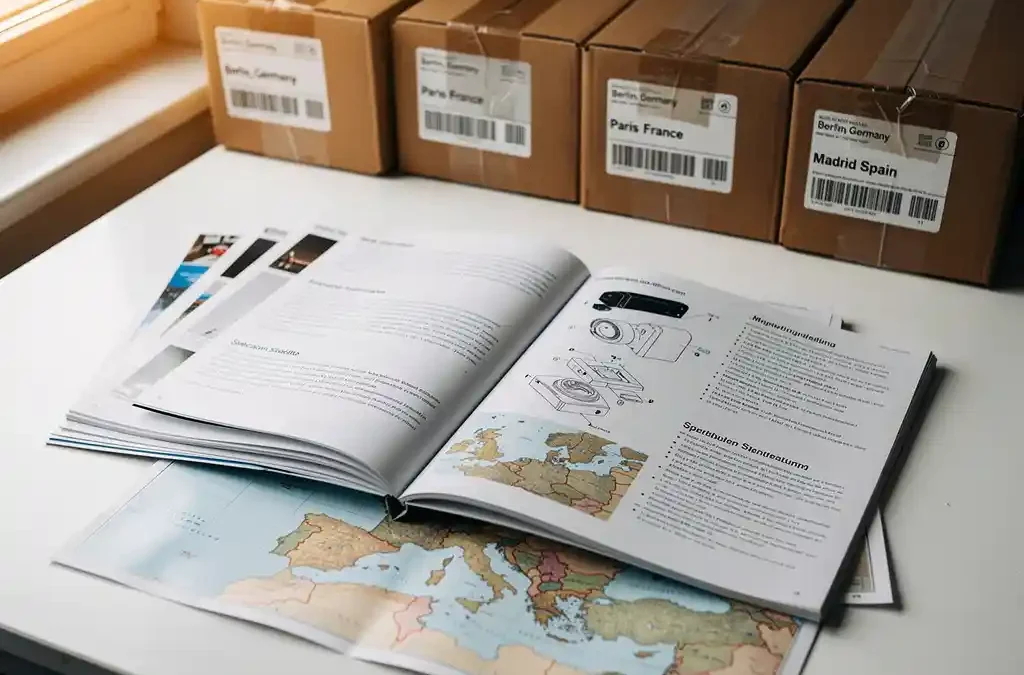
The most effective way to distribute printed product manuals to dealers across Europe is to work with a fulfillment partner who combines translation and localisation with print management, warehousing, and dealer-level shipping under one roof. This approach removes the complexity of coordinating separate vendors for each country while ensuring every dealer receives the correct language version at the right time. The sections below address the practical questions that come up when building a reliable European manual distribution system.
What are the most common challenges of distributing manuals across multiple countries?
The biggest challenges are language version management, customs and logistics coordination, and keeping dealer stock current when products are updated. Distributing manuals across Europe means dealing with dozens of languages, varying regulatory labeling requirements, inconsistent dealer ordering habits, and the constant risk of outdated versions reaching end customers.
Language complexity alone can be significant. A product sold in 15 European countries may require 12 or more distinct manual versions, each with its own print run and inventory. Add to that the differences in paper size conventions, safety symbol regulations, and import documentation requirements between markets, and the operational load becomes considerable. Without a centralized system, companies often end up with overstock in some countries and shortages in others, while dealers in smaller markets wait weeks for resupply.
What does a fulfillment service for printed manuals actually include?
A manual fulfillment service typically includes warehousing of printed stock, order processing, pick-and-pack operations, and direct shipment to individual dealer locations. More comprehensive services also cover inventory tracking, low-stock alerts, kitting of multiple documents into a single package, and returns handling.
The practical value of a full-service fulfillment operation is that dealers can place orders through a simple portal or request system, and the right manual version ships directly to them without requiring your internal team to manage each transaction. Inventory levels are monitored continuously, so you receive advance notice before stock runs out rather than discovering a shortage when a dealer complains. For companies distributing manuals in multiple formats, kitting services can bundle printed manuals, quick-start guides, warranty cards, and other inserts into a single dealer pack before shipment.
How do you manage different language versions for different European markets?
Managing language versions effectively requires a clear version control system, a reliable localisation workflow, and a fulfillment setup that stores and tracks each language variant separately. Each manual version should carry a unique identifier tied to the language, product version, and print date so that the correct document always reaches the correct market.
The localisation process itself is where quality is either built in or lost. Using native translators who understand both the technical subject matter and the cultural conventions of each target market reduces errors and the costly reprints that follow them. For European distribution specifically, this means covering not only Western European languages but also Eastern European, Scandinavian, and, where relevant, Russian and Middle Eastern variants. A well-structured localisation workflow integrates translation, DTP formatting, and print-ready file preparation as sequential steps rather than separate projects, which shortens lead times and reduces version mismatch errors.
Should you print manuals centrally or locally in each market?
Central printing with regional distribution is generally more cost-effective and quality-consistent than printing locally in each market. Printing in one location gives you full control over paper quality, color accuracy, and binding standards, while a fulfillment network handles onward distribution to dealers across the continent.
Local printing can make sense in specific situations, such as when a market requires very large volumes that make cross-border shipping expensive, or when local regulatory requirements demand materials that differ significantly from the standard version. In most cases, however, the savings from print volume consolidation and the quality consistency of a single print production process outweigh the logistical convenience of printing close to the end destination. The key is pairing central print production with a fulfillment partner who has the warehouse capacity and carrier relationships to reach dealers across Europe reliably and quickly.
How do dealers request and receive updated manual versions?
Dealers typically request manuals through an online ordering portal, an email-based request system, or a direct account manager contact, depending on the fulfillment setup you have in place. When a product update triggers a new manual version, the fulfillment partner replaces old stock with the updated print run and ensures new orders draw from the current version only.
A well-managed system also handles the transition between versions proactively. Rather than waiting for dealers to notice they have outdated materials, a good fulfillment partner can flag existing dealer stock for recall or replacement and coordinate the outbound shipment of updated versions to all affected locations. For high-priority updates, such as safety-related changes, this proactive distribution capability is not just convenient but essential. Clear version labeling on every manual makes it straightforward for dealers to identify whether they hold current stock.
What should you look for in a European manual fulfillment partner?
The most important qualities in a European manual fulfillment partner are multilingual capability, integrated print and logistics services, proven quality management processes, and the ability to scale with your distribution needs. A partner who handles translation, print production, warehousing, and dealer shipping under one roof removes coordination risk and shortens the time between a product update and updated manuals reaching the field.
ISO certification is a meaningful indicator of process reliability. ISO 9001 confirms structured quality management across the production and fulfillment workflow, while ISO 27001 confirms that your product documentation and business data are handled securely. Both matter when you are sharing pre-release product information or proprietary technical content with a service provider.
Experience across European markets, including smaller and less commonly served ones, is equally important. A partner with genuine coverage of Eastern European, Scandinavian, and Southern European markets will handle your full dealer network rather than leaving gaps in less prominent territories.
If you are ready to simplify your European manual distribution and ensure every dealer receives the right language version on time, we are here to help. Request a quote to discuss your specific requirements, or get in touch with us directly to talk through how we can support your print fulfillment and localisation needs across Europe.
Frequently Asked Questions
How long does it typically take to set up a European manual fulfillment system from scratch?
Setting up a full European manual fulfillment system generally takes between four and eight weeks, depending on the number of language versions required, the complexity of your dealer network, and how much existing print-ready content you can supply. The main setup tasks include onboarding your dealer list, configuring the ordering portal, completing any outstanding translations, and completing an initial print run for each language variant. Working with a partner who handles translation, print, and logistics under one roof significantly compresses this timeline by eliminating handoffs between separate vendors.
What happens to existing manual stock when a product update requires a new version?
When a product update triggers a new manual version, your fulfillment partner should quarantine or withdraw the outdated stock immediately and replace it with the updated print run before any new dealer orders are fulfilled. A proactive partner will also identify dealers who already hold old stock and coordinate replacement shipments, rather than waiting for dealers to request them. For safety-critical updates, it is worth discussing a mandatory recall and replacement process with your fulfillment partner before you need it, so the workflow is already in place when urgency matters most.
How do you prevent dealers from accidentally ordering the wrong language version for their market?
The most reliable safeguard is a dealer ordering portal configured to present only the language versions relevant to each dealer’s assigned market, removing the possibility of selecting an incorrect variant entirely. Each manual SKU should also carry clear language and version labeling on the physical packaging, so any mismatch is immediately visible on receipt. On the fulfillment side, warehouse pick logic tied to dealer location adds a further verification layer, ensuring the correct version is selected even when orders are processed manually.
Is it cost-effective to use a fulfillment partner for smaller dealer networks, or only for large-scale distribution?
Fulfillment partnerships are cost-effective at a wider range of scales than most companies assume, because the savings come not only from print volume but also from eliminating internal staff time spent coordinating orders, managing inventory, and chasing carriers across multiple countries. Even a network of 30 to 50 dealers spread across several European markets can generate enough administrative overhead to justify outsourcing. The clearest way to assess this is to request a quote that includes your current internal coordination costs alongside the fulfillment service fee, rather than comparing the fulfillment fee to print costs alone.
What file formats and technical specifications should you prepare before approaching a print fulfillment partner?
Most print fulfillment partners work with print-ready PDF files built to their specified bleed, color profile, and resolution standards, so confirming these requirements early avoids costly file rework later. You should also supply editable source files, such as InDesign or Illustrator packages, if the partner will be handling DTP formatting as part of the localisation workflow, since translators and DTP operators need access to the original layout rather than a flattened PDF. Providing a clear document specification sheet that covers page count, paper weight, binding type, and finish for each manual variant will allow the partner to produce accurate pricing and production timelines from the outset.
How do you handle manual distribution for markets with very low order volumes, such as smaller Eastern European countries?
Low-volume markets are best served through a fulfillment model that uses consolidated warehousing rather than holding separate local stock in each country, which avoids the risk of tying up inventory in markets where demand is unpredictable. A fulfillment partner with established carrier relationships across Eastern Europe can ship small quantities directly to individual dealers within a few days from a central warehouse, making local stockholding unnecessary. Setting minimum order quantities and agreed replenishment lead times for these markets in advance helps dealers plan their stock needs without creating pressure for your fulfillment partner to maintain uneconomical local buffers.
What are the most common mistakes companies make when first setting up European manual distribution?
The most frequent mistakes are underestimating the number of distinct language and regulatory variants required, failing to build a version control system before distribution begins, and treating manual distribution as a one-time logistics task rather than an ongoing managed process. Companies also commonly overlook the importance of proactive stock monitoring, discovering shortages only when a dealer complains rather than receiving advance low-stock alerts. Starting with a clear document taxonomy, unique version identifiers for every manual variant, and a fulfillment partner who provides real-time inventory visibility will prevent the majority of these issues before they affect your dealer network.
Related Articles
- What are the options for large-format printing for trade shows?
- How do I ensure consistent quality in print materials across multiple printing partners?
- Can I print small runs of my product manuals per target market?
- How do you protect sensitive data during localisation?
- How do you ensure software localisation quality?