
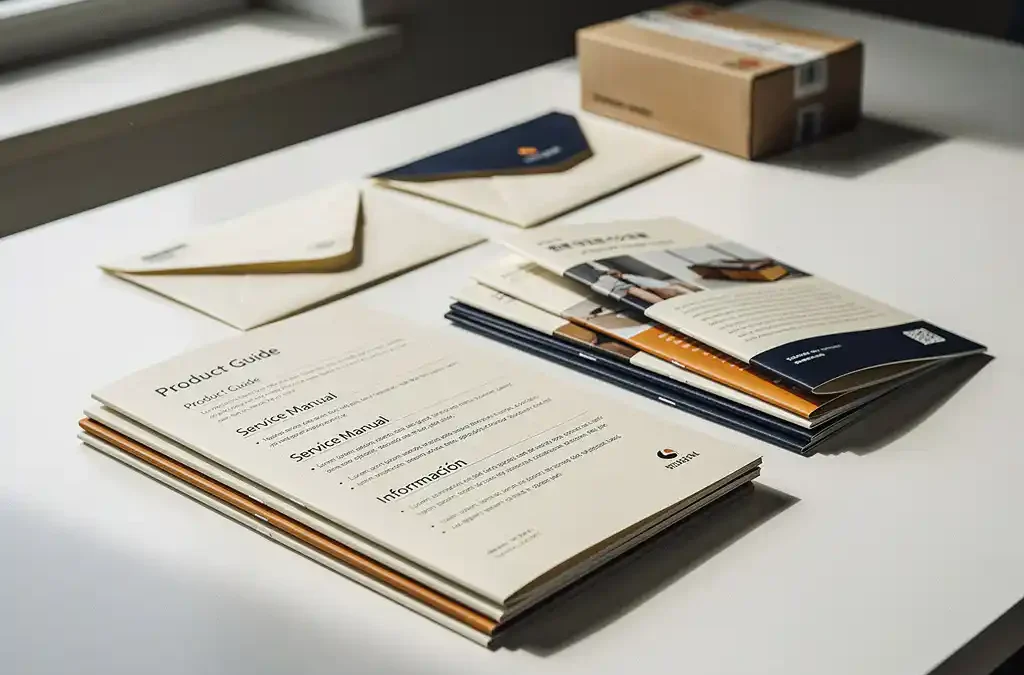
To make printed materials suitable for different distribution channels, you need to account for technical specifications such as size, paper weight, and finishing options on a per-channel basis, as well as the logistical requirements around storage and shipping. A smart base design that can be flexibly adapted saves both time and money. If you have any questions about this, you are always welcome to contact us for tailored advice. In this article, we answer the most frequently asked questions about print materials for multiple channels.
What technical specifications determine the suitability of print materials per channel?
The technical specifications that determine whether print materials are suitable for a given distribution channel are: size, paper weight, finishing, color profile, and file resolution. Each channel places different demands on these parameters. Print materials intended for direct mail delivery, for example, must meet the weight standards set by postal carriers, while materials for trade shows or retail stand out through size and finishing.
In concrete terms, here is what each specification means:
- Size: Retail displays often require non-standard sizes; direct mail is bound by postal format requirements.
- Paper weight: Heavier paper enhances perceived quality but also increases shipping costs. A lower paper weight is often the smarter choice for direct mail.
- Finishing: Laminate or UV coating increases durability but can limit recyclability. Relevant for retail, less so for disposable materials.
- Color profile: Print uses CMYK; digital channels work with RGB. Make sure your files are correctly converted before sending them to the printer.
- File resolution: A minimum of 300 dpi is required for quality print output. Lower resolutions result in grainy results, regardless of the channel.
By incorporating these specifications during the design phase, you avoid costly adjustments after the fact and ensure that the same design can be smoothly scaled across multiple channels.
What is the difference between print materials for retail and direct mail?
The most important difference between print materials for retail and direct mail lies in the purpose and context of use. Retail materials are designed to attract attention at the point of sale, while direct mail targets individual recipients at home or in the office. This difference drives decisions around size, paper type, personalization, and mailing requirements.
Print materials for retail
Retail materials such as displays, brochures, and point-of-sale items need to stand out in a busy environment. Here, it is all about visual impact: bold colors, sturdy materials, and eye-catching sizes. Think of freestanding displays, product cards, or promotional posters that speak directly to the customer. The focus is on brand experience and encouraging impulse purchases.
Print materials for direct mail
In direct mail, personal relevance takes center stage. The material must appeal to the recipient while also meeting postal carrier requirements: weight limits, envelope sizes, and addressability. Paper weight is a cost factor here. Personalization, such as a name or location-specific offer, significantly increases response rates. The lifespan of the material is shorter, meaning lighter finishing options are sufficient.
How do you adapt multilingual print materials for international distribution channels?
Adapting multilingual print materials for international distribution channels requires an integrated approach in which translation, layout, and print preparation are closely aligned. Text in other languages changes in length and reading direction, which has a direct impact on the layout. Starting the localization strategy early in the process prevents the need for major redesigns later on.
Practical considerations for multilingual print materials:
- Text expansion: Translations are on average 20 to 30 percent longer than the English source text. Design with sufficient white space to accommodate this.
- Right-to-left languages: Arabic and Hebrew require a mirrored layout. This affects the entire page structure.
- Local regulations: Some markets have legal requirements regarding the language of product labels or instructions for use. Check this on a country-by-country basis.
- DTP integration: Ensure that translators and DTP specialists work together. A translation that is technically correct but does not fit the design will still cause problems at the printer.
At Crestec Europe, we combine translation, DTP, and print production in a single integrated process, making multilingual print materials for international channels more efficient and error-free.
When does it make sense to use a single base design for multiple channels?
Using a base design across multiple distribution channels makes sense when the core message and brand identity need to remain consistent, and when the economies of scale outweigh the cost of per-channel adaptations. This works best when your design is built modularly, so that elements can be easily adjusted without having to redesign everything from scratch.
A modular approach means working with fixed elements such as the logo, color palette, and typography, combined with variable blocks for text, size, or channel-specific information. This allows you to use the same base material for a retail brochure, a direct mail card, and a trade show display, with minimal adjustments per application.
When a base design is less suitable:
- When target audiences differ significantly across channels in terms of language, culture, or expectations.
- When legal requirements in different markets demand substantial content changes.
- When the technical specifications vary so widely across channels that the design needs to be completely reworked regardless.
In those cases, it is more efficient to develop a dedicated variant for each channel, while still using brand guidelines as a shared foundation.
What role do fulfillment and inventory management play in printed materials?
Fulfillment and inventory management largely determine how quickly and reliably printed materials reach their intended destination. Without proper inventory management, you risk materials becoming outdated by the time they are deployed, or shortages arising at critical moments such as product launches or seasonal campaigns.
A structured fulfillment process includes storing printed materials, managing inventory levels, packing and shipping to dealers, stores, or end users, and identifying reorder needs in a timely manner. When product updates occur, it is crucial that outdated print materials are quickly replaced with current versions.
A partner that offers translation, print production, storage, and shipping under one roof significantly reduces coordination risks and shortens the lead time between a product change and the moment updated materials are in the field. At Crestec Europe, we offer exactly that integrated approach, including inventory management and fulfillment as part of our comprehensive documentation service.
Want to know how we can prepare your printed materials for multiple distribution channels? Get in touch and we will be happy to think along with you.
Frequently Asked Questions
How do I get started setting up a print strategy for multiple channels?
Start with a channel analysis: map out which distribution channels you use and what the technical requirements are per channel in terms of size, paper weight, and finishing. Then create a modular base design to serve as the starting point for all channel variants. By doing this preparation early in the process, you avoid costly revisions later and maintain consistency in your brand presentation.
What are the most common mistakes when adapting print materials for multiple channels?
A common mistake is failing to adjust the color profile per application: designers sometimes work in RGB while the printer requires CMYK, leading to unexpected color deviations in the final result. Another frequent error is not leaving enough space for text expansion in multilingual versions, causing the layout to become completely unbalanced during translation. Finally, many companies underestimate the impact of paper weight on shipping costs, particularly in large-scale direct mail campaigns.
How do I ensure my brand identity remains consistent across all printed channels?
Create a detailed brand style guide with fixed guidelines for logo usage, color palette (including CMYK values), typography, and visual language. Use this document as a mandatory reference point for everyone involved in creating or adapting print materials, including external suppliers. A modular design structure also helps apply brand elements consistently, even when formats or content vary per channel.
When is print-on-demand a better choice than large-scale pre-printing?
Print-on-demand is advantageous when your materials are updated frequently, when you need small print runs for multiple niche markets, or when you want to minimize the risk of outdated inventory. Large-scale pre-printing is more cost-efficient for stable content and high volumes, but requires a solid inventory management process to prevent waste. The choice depends heavily on your update frequency, print run size, and storage capacity.
How do I keep print materials scalable as my product line or market expands?
Design print materials with scalability in mind from the outset: use templates with variable blocks for product information, languages, or region-specific details, so that new variants can be created quickly without revising the base design. Connect your print process to a central content or asset management environment, so that updates can be applied easily and consistently across all variants. An integrated partner for translation, DTP, and print production significantly accelerates this process during international expansion.
What do I need to know about sustainability and recyclability of print materials when choosing finishing options?
Finishing options such as plastic laminate or UV coating increase the durability and visual quality of print materials, but make recycling more difficult because paper and plastic cannot be easily separated. For materials with a short lifespan, such as promotional brochures or direct mail cards, matte or aqueous coating finishes are a more environmentally friendly alternative that still delivers a professional appearance. Also check whether your printer uses FSC-certified paper and eco-friendly inks, which is increasingly a requirement in European tenders and among retail partners.
How do I calculate the total cost of print materials for multiple distribution channels?
When calculating costs, account for four components: production costs (print run, paper, finishing), per-channel adaptation costs (DTP hours, translations), logistics costs (storage, packaging, shipping), and indirect costs such as coordination time and reprints due to errors. An integrated provider that handles multiple steps under one roof can reduce total costs through fewer handoff moments and more efficient workflows. Always request an itemized quote so you can make a realistic cost comparison per channel.
Related Articles
- What are the options for large-format printing for trade shows?
- How do I prevent color variations between different print runs of my brand identity materials?
- My printed materials need to be FSC- and EUDR-compliant — who can handle that? The Netherlands? Germany? Europe?
- How do I lower the cost of printing catalogues in 10 languages?
- How do you adapt UI design for different cultures?