
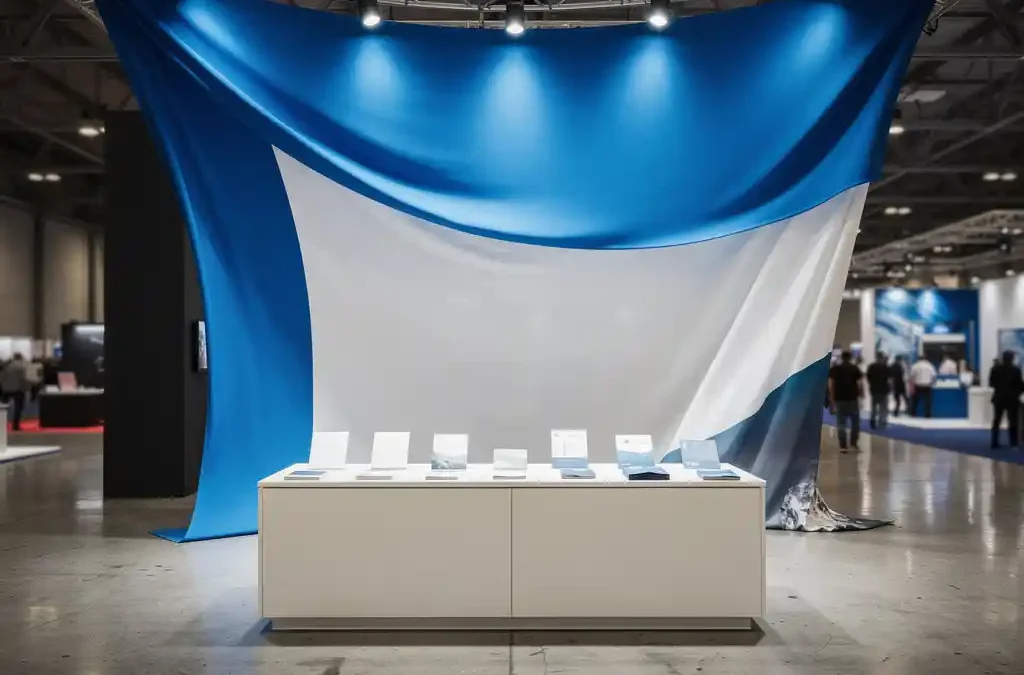
For trade shows, there are numerous large-format print options available: from roll-up banners and exhibition backdrops to floor stickers, banners, displays, and wall panels. The right choice depends on the venue, your available budget, and the look you want to achieve. Have questions about what works best for your situation? Feel free to contact us and we’ll be happy to help. In this article, we answer the most frequently asked questions about large-format trade show printing, from material selection to file submission.
What types of large-format print are suitable for trade shows?
The most commonly used types of large-format print for trade shows are roll-up banners, exhibition backdrops, banners, floor stickers, X-banners, pop-up displays, and wall panels. Each format serves a specific purpose: some are designed to attract visitors from a distance, while others create atmosphere and brand recognition right at the booth.
Roll-up banners are compact and easy to transport, making them ideal for companies that exhibit at trade shows on a regular basis. Exhibition backdrops offer a larger surface area and serve as the visual background for the entire stand. Pop-up displays are more elaborate and create a three-dimensional effect that draws attention. Floor stickers are increasingly used for wayfinding or brand reinforcement on the show floor itself.
The choice of a specific type also depends on the available booth space. A small 3×3 meter stand calls for different solutions than a large island stand. It’s also worth considering a combination of materials: a backdrop as the central focal point, complemented by one or two roll-up banners on the sides, creates a professional and consistent look.
What is the difference between a roll-up banner and an exhibition backdrop?
The key difference between a roll-up banner and an exhibition backdrop is size and function. A roll-up banner is a freestanding, portable display — typically 85 by 200 centimeters — that can be set up in seconds. An exhibition backdrop is a large background wall that spans the full width of a booth space and delivers a striking brand presentation.
A roll-up banner is lightweight and fits in a carrying bag, making it particularly well suited for companies that attend multiple trade shows per year. The print is single-sided, and the system uses a spring mechanism that allows the graphic to be rolled up and down in seconds.
An exhibition backdrop, on the other hand, requires more space and setup time, but also delivers far greater visual impact. Backdrops come in various formats: sleek fabric panels on an aluminum frame, modular systems that can be combined in multiple widths, or tensioned graphics with a lightbox for added attention. For companies with a permanent or recurring trade show presence, a backdrop is a worthwhile investment.
What materials are used for large-format trade show printing?
Large-format trade show printing primarily uses PVC film, fabric, polystyrene, and coated paper. The choice of material determines image quality, weight, durability, and the potential for reuse. For trade show materials, lightweight construction and robustness are typically the most important criteria.
PVC film is the most common material for banners and backdrops due to its low cost and weather resistance. However, fabric — such as polyester with dye-sublimation printing — is rapidly gaining ground because it folds without creasing, delivers high image quality, and has a premium look and feel. Fabric is also more durable and more easily reused than PVC.
For rigid displays and wall panels, materials such as Dibond (aluminum composite), Forex (PVC foam board), and polystyrene are used. These materials are sturdy enough to stand freely or be mounted to a structure without warping. For floor stickers, special anti-slip films are used that meet the safety requirements of exhibition halls.
How do you maintain consistent branding across multilingual trade show materials?
Consistent branding across multilingual trade show materials is achieved by working from a centrally designed template that locks in the visual elements — such as the logo, colors, and typography. Translated texts are incorporated into that template without altering the layout, ensuring a uniform appearance across all language versions.
This is precisely where an integrated approach proves its value. When translation, DTP, and print are coordinated under one roof, the risk of brand inconsistencies is minimal. Text expansion or contraction in another language — a common occurrence in translation — is handled directly within the layout, without the client having to communicate back and forth between multiple suppliers.
At Crestec Europe, we combine translation, DTP, and print production in a single continuous process. This means that a trade show stand with materials in five languages maintains the same visual quality and brand experience in every version. Consider a European trade show campaign where the same backdrop is produced in English, German, French, Spanish, and Italian: the layout remains intact and the branding is consistent throughout.
When should you choose reprinting versus reusable trade show materials?
Reprinting is the right choice when the content of your trade show materials changes frequently — such as with new products, updated pricing, or campaigns with a limited run. Reusable trade show materials are the better option when your core message remains stable and you set up the same stand multiple times a year.
Reprinting is relatively inexpensive per run, but costs add up quickly if you attend multiple trade shows per year. It also generates waste when materials are discarded after a single use. Reusable systems, such as fabric panels on an aluminum frame, require a higher initial investment but are more cost-effective and more sustainable in the long run.
A smart middle ground is the use of modular systems where the structure is reusable and only the printed graphic is replaced. This allows you to update an exhibition backdrop for a new campaign without purchasing an entirely new stand. This is particularly attractive for companies active at international trade shows with varying themes or language versions.
What should you look out for when submitting files for large-format printing?
When submitting files for large-format printing, the most important considerations are resolution, color profile, and bleed. Files must be submitted in CMYK color mode, with a resolution of at least 100 dpi at the final output size, and with a bleed of at least 5 millimeters on all sides.
A common mistake is submitting files at actual size with too low a resolution, or submitting RGB files intended for screen display. In large-format printing, colors are reproduced differently than on a monitor, which makes proper color conversion essential for a predictable end result.
It is also important to embed fonts or convert them to outlines, to avoid issues with missing fonts at the printer. Artboards in Adobe Illustrator or InDesign must match the intended final dimensions exactly. Discuss the specific submission requirements with your print partner in advance, as these can vary depending on the material and printing process.
Need help preparing your trade show materials, or want to find out what we can do for you? Get in touch and we’ll discuss the best approach for your trade show participation in 2026.
Frequently Asked Questions
How far in advance should I order my trade show materials?
Ideally, place your order at least two to three weeks before the show date to allow sufficient time for design, print production, and delivery. For multilingual materials or complex projects involving DTP adjustments, four to six weeks is recommended. Also factor in any rounds of corrections after receiving a print proof, as these can add a few extra working days.
What are the most common mistakes when designing trade show materials?
The most common mistakes are putting too much text on a single piece, using a font size that is too small to read from a distance, and using too many different colors or typefaces that undermine brand consistency. Trade show materials are often viewed from several meters away, so keep the message short and impactful: one central message per piece works best. Also make sure your logo and contact details are always clearly visible.
Can I have existing trade show materials updated for a new campaign or language version?
Yes, this is certainly possible and is often the most cost-effective approach. If the structure or frame is reusable, only the printed graphic needs to be replaced. With an integrated approach where DTP and printing are handled under one roof, updates such as a new language version or a revised campaign message can be implemented quickly and consistently without losing the layout or brand identity.
Which type of trade show material is best suited for outdoor shows or open-air events?
For outdoor use, weather-resistant materials such as PVC banners, outdoor banners made from coated polyester, and UV-resistant films are the best choice. Make sure the structure is wind-resistant — for example, by using weighted bases or anchor points. Ask your print partner specifically about materials with a UV coating to prevent colors from fading quickly in sunlight.
How do I ensure the colors on my trade show materials match my brand colors?
Always provide the exact Pantone or CMYK values of your brand colors when placing your order, and request a calibrated print proof before the full run is printed. Keep in mind that colors on a monitor (RGB) will always differ from printed colors (CMYK), and that different materials such as fabric and PVC may render the same color slightly differently. A good print partner offers color management as part of the production process.
Is large-format trade show printing available in sustainable or eco-friendly options?
Yes, the industry is offering an increasing number of sustainable alternatives, such as fabric panels made from recycled polyester, solvent-free inks, and FSC-certified paper for temporary displays. Reusable systems on an aluminum frame are also significantly more environmentally friendly in the long run than single-use PVC materials. Ask your print partner about the available sustainable options that fit your budget and needs.
What should I bring to the trade show besides the printed materials themselves?
In addition to the printed materials, it’s wise to bring tools for assembly — such as a hammer, tape, and cable ties — as well as spare parts like extra feet or locking pins for your display structure. Also prepare a checklist of all materials so nothing gets left behind during transport, and keep the original print files saved digitally so you can quickly arrange a reprint in case of loss or damage. For multilingual materials, bring an overview indicating which material is intended for which language version or location.
Related Articles
- What is the difference between transcreation and translation when adapting marketing materials?
- How can I use my printed documentation to improve the customer experience?
- How do I choose the right print partner for my European expansion?
- How do I make sure my product message isn't misunderstood abroad?
- How do you sync updates across multiple localised versions?