
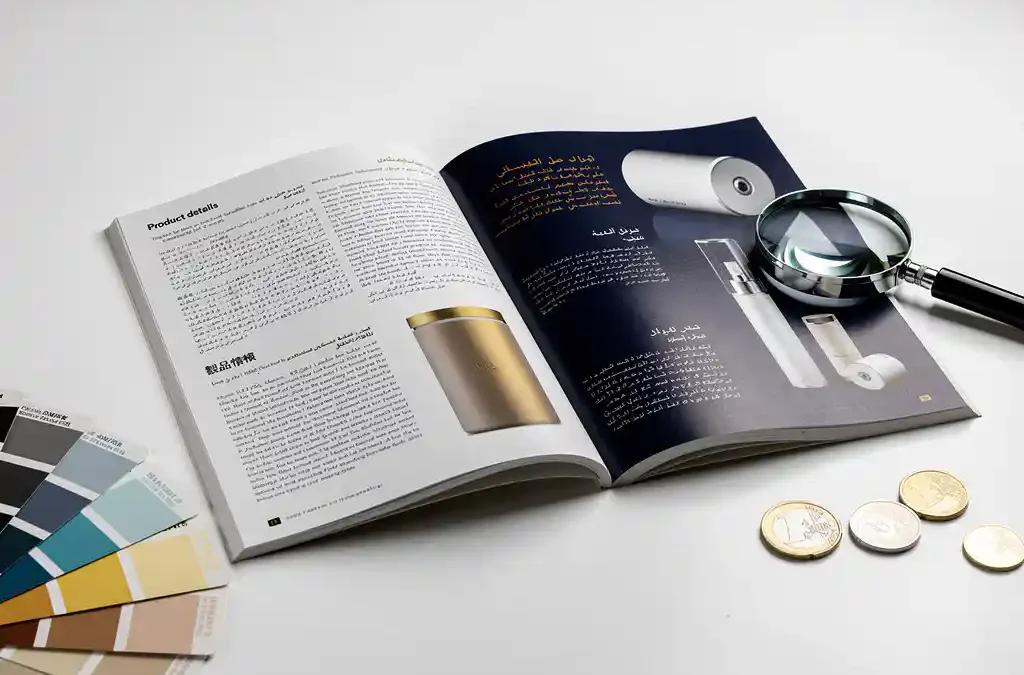
Having a multilingual catalogue professionally laid out typically costs between €0.25 and €1.50 per word for translation, plus €30 to €120 per page for DTP work, depending on language combinations, design complexity, and the number of languages involved. The total investment for a mid-sized catalogue in three to five languages commonly falls in the range of several thousand euros, though highly complex projects with many languages can go significantly higher. The sections below break down exactly what drives those numbers and how to keep costs under control.
What factors affect the price of multilingual catalogue layout?
The price of multilingual catalogue layout depends on four core variables: the number of target languages, the complexity of the original design, the volume of text, and whether the source files are supplied in an editable format. Projects involving right-to-left languages such as Arabic or Hebrew, or character-based languages such as Chinese and Japanese, typically carry a higher DTP rate because the layout requires more hands-on adjustment.
Other factors that influence cost include:
- Number of pages and images: More pages mean more layout time, and catalogues with dense image grids require careful repositioning whenever text lengths change.
- File format: Native InDesign or Illustrator files are far easier and cheaper to work with than PDFs or locked formats that require rebuilding.
- Brand guidelines: Strict typography rules, custom fonts, and precise spacing requirements add time to every language version.
- Turnaround time: Rush projects almost always carry a premium.
The more languages you add, the more economies of scale come into play, since the setup work for the layout process is largely a one-time cost that gets spread across each additional language version.
How much does professional multilingual DTP typically cost?
Professional multilingual DTP is generally priced per page, per hour, or as part of a combined translation-and-layout package. Per-page rates for standard European languages typically range from €30 to €70 per page, while complex layouts or non-Latin scripts can push that figure to €80 to €120 per page or more. Hourly DTP rates at professional agencies generally fall between €50 and €90.
These figures cover the work of reflowing translated text into the existing design, adjusting line breaks, resizing text frames, repositioning captions, and checking that the final output matches the original visual quality. They do not include translation itself, which is priced separately based on word count and language pair.
For a 40-page product catalogue translated into four languages, a realistic combined budget including both translation and DTP might range from €5,000 to €15,000 depending on complexity. Requesting a detailed quote that separates translation costs from DTP costs helps you understand where the budget is going and where savings might be found.
What’s the difference between translation and DTP in a catalogue project?
Translation and DTP are two distinct services that work in sequence. Translation is the process of converting the source text into the target language, handled by qualified linguists. DTP (Desktop Publishing) is the process of placing that translated text back into the original design so that the layout looks as polished and intentional as the source version. One without the other produces an incomplete result.
In practice, translation produces a text file or a tagged document that a DTP specialist then imports into the design software. The DTP specialist handles all visual adjustments: correcting text overflow, adapting line breaks, resizing call-out boxes, and ensuring that fonts support the target language’s character set. For catalogues, where visual presentation is central to the product’s appeal, the DTP stage is just as important as the translation itself.
Confusing the two services is a common source of budget surprises. Clients sometimes receive a translation quote and assume it covers the full finished document, only to discover that the layout work is a separate line item. Always confirm upfront which services are included in any quote you receive.
Why does text expansion cause extra layout costs in some languages?
Text expansion occurs when translated text is longer than the original source text, which forces the DTP specialist to refit content that no longer matches the original layout. German, for example, regularly runs 20 to 35 percent longer than English. Finnish and Dutch can also expand significantly. When text expands, text frames overflow, headlines wrap onto extra lines, and carefully designed spreads no longer hold together visually.
Each overflow instance requires manual intervention: the designer must either reduce font size, tighten tracking, rewrite or shorten text in collaboration with the translator, or restructure the layout. In a dense product catalogue with many small text frames, this work adds up quickly and can substantially increase the DTP hours required.
Languages that contract relative to English, such as Chinese or Japanese, present the opposite challenge: text frames become too large, leaving awkward white space that looks unintentional. Both expansion and contraction require skilled layout adjustment, which is why agencies price these language pairs differently from straightforward European combinations.
Should you use a translation agency or a separate DTP studio?
Using a single translation agency that handles both translation and DTP in-house is almost always more efficient and cost-effective than coordinating two separate suppliers. When translation and layout are managed under one roof, handoff errors are reduced, revision cycles are shorter, and the project manager has full visibility over both workstreams simultaneously.
Separate suppliers introduce coordination overhead: the client becomes responsible for transferring files between parties, managing version control, and resolving any conflicts between what the translator produced and what the layout specialist needs. This friction adds time and often cost to every revision round.
That said, a combined supplier is only advantageous if their DTP capability is genuinely strong. It is worth asking to see samples of finished multilingual layouts before committing, and confirming that the agency works in your source design software rather than recreating layouts from scratch. Our translation and localisation service integrates DTP directly into the workflow, which means translation, layout, and quality checks happen in a single coordinated process rather than across disconnected teams.
How can you reduce the cost of future multilingual catalogue updates?
The most effective way to reduce the cost of future updates is to invest in clean, well-structured source files from the start and to use translation memory (TM) tools throughout the project. Translation memory stores every approved translated segment so that when you update the catalogue next year, any unchanged sentences are reused automatically at a reduced or zero cost per word.
Additional strategies that lower long-term costs include:
- Maintain editable source files: Always keep the original InDesign or equivalent files organised and version-controlled. Rebuilding from a PDF every update cycle wastes budget.
- Write for translation: Short, clear sentences with consistent terminology expand less and translate faster than complex, idiomatic copy.
- Use a style guide and glossary: Agreed terminology reduces translator queries and revision rounds across every update.
- Plan updates in batches: Combining multiple small changes into one update round is significantly more economical than requesting individual changes one at a time.
- Keep your supplier consistent: Switching agencies between updates means losing accumulated translation memory leverage, which resets a significant portion of your cost savings.
Over time, a well-managed translation memory for a regularly updated catalogue can reduce per-update translation costs by 30 to 50 percent, making the initial investment in a structured workflow well worth it. If you are ready to plan your next multilingual catalogue project, request a quote to get a clear picture of what your specific project involves, or get in touch and we will be happy to walk you through the options.
Frequently Asked Questions
How long does a typical multilingual catalogue project take from start to finish?
A mid-sized catalogue of 40 pages translated into three to five languages typically takes between two and six weeks, depending on complexity, the number of revision rounds, and supplier availability. Translation and DTP are usually sequential rather than parallel processes, so the timeline compounds across both stages. Providing editable source files, a glossary, and clear brand guidelines at the outset is the single most effective way to shorten the overall turnaround.
What file formats should I supply to keep DTP costs as low as possible?
Native editable files — such as Adobe InDesign (.indd) with all linked assets and fonts — are the gold standard for DTP efficiency. Supplying a well-organised InDesign package (using the ‘Package’ function to collect fonts and images) means the DTP specialist can begin work immediately without any rebuilding. Avoid supplying locked PDFs or flattened files as the sole source, as reconstructing a layout from scratch can double or even triple the DTP cost compared to working from native files.
Can I translate a catalogue myself and just hire someone for the DTP work?
Technically yes, but it carries real risks for a product catalogue where accuracy and brand tone are critical. Machine translation or non-specialist translation can introduce terminology errors, awkward phrasing, and inconsistent register that are difficult for a DTP specialist to catch or correct. If budget is a concern, a better middle ground is to use a professional translator for high-visibility sections — covers, headlines, product descriptions — and explore machine translation with human post-editing (MTPE) for more repetitive or specification-heavy content.
What happens if my translated catalogue needs revisions after the layout is finalised?
Late-stage revisions — especially changes to text length or design elements — can trigger a cascade of layout adjustments, which is why they are typically billed as additional work rather than included in the original quote. To minimise revision costs, invest time in thorough proofreading of the translated text before it enters the DTP stage, and consolidate all feedback into a single clearly marked round rather than sending changes incrementally. Most agencies will define the number of included revision rounds in their quote, so clarify this upfront.
Is machine translation a viable option for reducing catalogue translation costs?
Machine translation with professional post-editing (MTPE) can meaningfully reduce translation costs for catalogues with a high volume of repetitive or technical content, such as specification tables, dimensions, or material lists. However, for marketing-led copy — brand messaging, product narratives, or promotional headlines — full human translation is strongly recommended, as machine output often lacks the persuasive tone and cultural nuance that catalogue copy requires. A hybrid approach, applying MTPE selectively to lower-stakes content, is often the most cost-effective strategy.
How do I evaluate whether a multilingual DTP supplier is genuinely capable?
Ask to see finished samples of multilingual layouts in the languages you need, particularly for any non-Latin scripts or right-to-left languages in your project. Confirm that the supplier works in your original design software rather than recreating layouts in a different application, and ask whether their DTP team is in-house or outsourced. It is also worth checking that they have a formal quality assurance step — such as a bilingual proofreader reviewing the laid-out document — rather than treating the DTP output as the final deliverable without linguistic review.
At what point in a catalogue redesign should I involve a multilingual DTP specialist?
Ideally, before the design is finalised. Involving a multilingual DTP specialist — or at least consulting with your translation agency — during the design phase allows you to build in text expansion allowances, choose fonts that support all required character sets, and structure layouts with flexibility in mind. Retrofitting a rigid, heavily typeset design for multiple languages is significantly more expensive than designing with localisation in mind from the start. Even a brief consultation at the design stage can prevent costly structural rework later.
Related Articles
- How do I print promotional materials for an international trade show?
- How do I measure the effectiveness of my printed marketing materials?
- How do I quickly process product changes across all my printed documentation?
- How do I ensure my printed materials comply with local regulations in each country?
- How do I keep my technical documentation up to date when my product keeps changing?